Translate

Monday, January 15, 2024

Inspiration: Original action and Divine quality

Jon Gleason makes an important and helpful distinction regarding inspiration, one that he believes is “sorely neglected” (and I agree):

“This is, in my opinion, a hugely important topic that is sorely neglected in churches today. We’ve let [the teaching of B. B.] Warfield shift the focus on inspiration from the divine quality to the original action. But in doing so, and by neglecting Biblical teaching on preservation, we’ve undermined confidence in that Book in our hands! We’re so busy trying to be technically right that we’re being technical where God was practical, and missing the power of what God said, did, and has given us.”

Sunday, January 14, 2024

We sing how great thou art

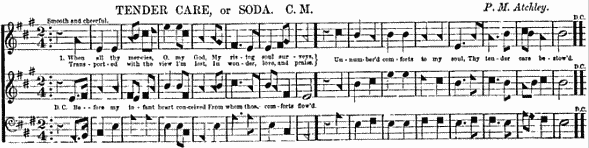
Lutishia Bass Watson wrote “O Lord We Sing,” and it was matched with the tune Tender Care/Soda (by P. M. Atchley) in the 1973 Harp of Ages (Song No. 202). 

Della Lutishia Bass was born April 22, 1911 in Brown County, Texas, the daughter of Henry Isom Bass (1873–1968) and Mary Evaline Jones (1877–1961). In 1933 she married Charlie Agbert Watson in Portales, New Mexico. They had six children. Son Don Russell Watson is a Primitive Baptist preacher.

Lubbock Avalanche-Journal, Sunday, October 1, 1933

Lutishia and Charlie were charter members of the Muleshoe Primitive Baptist Church at Muleshoe in Bailey County, Texas. Their story in Tales & Trails of Bailey County, the First 70 Years (Dallas, TX: Taylor Publishing Company, 1988) indicates Lutishia wrote other poetry in addition to this hymn. She was an older sister of Harvey Lee Bass (1918–2007), who for several years was president of Harp of Ages, Inc. – the company formed to keep A. N. Whitten’s Harp of Ages songbook in print. The vice-president, Afton Elwyn Richards, was her brother-in-law. The second and third stanzas of the hymn suggest it could have been written around a time of war, with the subject being on her mind. God is glorified for his greatness, presence, and goodness in all times, even though we “see only in part.” The hymn meter is common meter, doubled, and the hymn has four stanzas.

Lutishia Bass Watson died September 13, 1996 in Lubbock, Texas at age 85, and is buried beside her husband in Muleshoe Memorial Park Cemetery at Muleshoe, Bailey County.

The tune used with Watson’s hymn is called Tender Care when used with Song No. 17 in the Harp of Ages, and Tender Care, or Soda in The Southern Harmony by William Walker. It was written by P. M. Atchley, who apparently is Pleasant M. Atchley, the son of Noah Atchley and Elizabeth Pharis. He was born in Tennessee in 1827 and died in 1910 in Sevier County, Tennessee. He was a Baptist preacher, ordained by Alder Branch Baptist Church.

1. O Lord we sing, how great thou art,
With all thy riches known;
We get a glimpse of Holy bliss
Around thy great white throne.
O glorious light, O what a view
Of all the beauties there,
And yet we see only in part,
The city called Four Square.

2. Often our path on earth is dark
And weary seems the way
The dawn will come, the sun will shine
To drive the clouds away;
Often we see our loved ones leave
To cross the stormy sea,
Our hearts are torn; they are at war,
That we may worship free.

3. Still we can sing, How great thou art,
With all thy tender care;
In life, in death, in peace and war,
We know that thou art there.
In twinkling stars, the turtle dove,
The hills, the flowing spring
Are here to tell us thou art there
To tune our hearts to sing.

4. Our span of life, is oh so short
Compared to that great time
When all God’s children are called home
For eternal life sublime.
We sing, O Lord, how great thou art,
And cast our eyes afar,
Unto the place called ecstasy—
I think I’m almost there.

Daily Journal and Tribune, Saturday, June 18, 1910, p. 5

Saturday, January 13, 2024

AV 1611: Examining the Marginal Notes, and other links

The posting of links does not constitute an endorsement of the sites linked, and not necessarily even agreement with the specific posts linked.

Friday, January 12, 2024

Spirit or Light? Ephesians 5:9

It is to be expected that when we write polemically, we try to put our own position in the best light. Some Bible translations write their text-critical notes to put their position in the best light. While I expect them to believe what they produce, nevertheless it seems that text-critical notes should be aimed more at education than disputation. What am I talking about?

This is often seen in comments on Mark 16:9-20, where it is pointed out that this text is “not in the oldest and best manuscripts.” They most often do not clarify they are only talking about two manuscripts, both of which have quirks at the end of Mark. See, for example, Odd Features at the Ending of Mark in Codex Sinaiticus.

This type of diversion can be seen in the text-critical note on Ephesians 5:9 in the New English Translation (NET) by Biblical Studies Press, L.L.C. The traditional reading is “Spirit,” while most modern translations have “light” instead

  • NET: for the fruit of the light consists in all goodness, righteousness, and truth—
  • KJV: for the fruit of the Spirit is in all goodness and righteousness and truth;

The Textus Receptus and Critical Texts differ in one word.

  • CT: ὁ γὰρ καρπὸς τοῦ φωτὸς ἐν πάσῃ ἀγαθωσύνῃ καὶ δικαιοσύνῃ καὶ ἀληθείᾳ
  • TR: ὁ γὰρ καρπὸς τοῦ πνεύματος ἐν πάσῃ ἀγαθωσύνῃ καὶ δικαιοσύνῃ καὶ ἀληθείᾳ

Excerpted from the NET Bible®:

Ephesians 5:9 tc Several mss (P46 D2 Ψ 1175* 1505 M) have πνεύματος (pneumatos, “Spirit”) instead of φωτός (phōtos, “light”) ... Further, the external evidence for φωτός is quite compelling (P49 א A B D* F G P 33 81 1175c 1739 1881 2464 latt co).

Notice how that, according to the NET, “Several mss” have “Spirit” (6 are listed), but the “external evidence for φωτός is quite compelling” – and over twice as many MSS are listed in support of that reading. This could impress the uninitiated that the majority of manuscripts support the reading φωτός/light. Nevertheless, the majority of extant manuscripts actually support the traditional reading – πνεύματος/Spirit. See, for example, the Majority Text of Robinson-Pierpont, which agrees with the Textus Receptus:

ὁ γὰρ καρπὸς τοῦ πνεύματος ἐν πάσῃ ἀγαθωσύνῃ καὶ δικαιοσύνῃ καὶ ἀληθείᾳ —

In my opinion, Critical Text advocates often find their tales in cracks and try to skew the evidence polemically toward their viewpoint rather than educationally pointing out the facts for readers to consider and make a choice. Again, I am not opposed to disputation in polemical fields of discussion. Nevertheless, text-critical notes in Bibles are not the place for such sleight-of-hand magic tricks!

Thursday, January 11, 2024

Roaming the Damascus Road

Roaming the Damascus Road (Acts Chapters 9, 22, 26)

The book of Acts provides three accounts of Saul’s Damascus road experience – the narrative of Luke (Acts 9:1-19), and two testimonies of Paul, before the multitude in Jerusalem (Acts 22:4-16) and before Agrippa (Acts 26:12-18). The narrative harmonizes and summarizes thusly:

  • Purpose
    • Saul traveled to find, arrest, and punish the disciples of Jesus. 9:1-2; 22:4-5; 26:11-12
  • People
    • Saul traveled with an unknown number of companions. 9:7; 22:9; 26:13
  • Place
    • The incident occurred on the road to Damascus, near the town. 9:3; 22:6; 26:12
  • Time
    • The incident occurred at noon, midday. 22:6; 26:13
  • Sequence
    • Sudden bright light, brighter than the sun. 9:3; 22:6; 26:13
    • Saul and companions fall to the ground. 9:4; 22:7; 26:14
    • A voice (in the Hebrew tongue). 9:4; 22:7; 26:14
    • Dialogue of the Lord and Saul. 9:4-6; 22:7-8; 26:14-18
    • Reaction of the companions. 9:7; 22:9
  • Resolution
    • Saul is blinded, led into Damascus by his companions. 9:8; 22:11

Naysayers looking for contradictions have tried to find fault with two points: (1) “the men which journeyed with him stood speechless” (9:7) vs.we were all fallen to the earth” (26:14); and (2)hearing a voice, but seeing no man” (9:7) vs. “they that were with me saw indeed the light, and were afraid; but they heard not the voice of him that spake to me” (22:9).

Those men on this journey of persecution with Saul were confused and frightened (Acts 22:9). They were dumbfounded – “stood speechless” – they could hear the sound of a voice (while not understanding it, Acts 22:9; cf. John 12:29).[1] They saw the light (Acts 22:9), but saw not the one from whom the voice emanated.


[1] “Stood” here may refer to their condition, stopped in their tracks so to speak, rather than that they were in an upright position on their feet. In addressing Agrippa, Paul indicates that those journeying with him also fell to the earth (Acts 26:13-14). On the other hand, they simply may have fallen, and then stood to their feet, speechless.

Summary suggested by Danny Dwyer, The Book of ActsNashville, TN: Randall House, 2018, pp. 142-43.

Wednesday, January 10, 2024

King James Whole Marginal Notes

In An Exhaustive Listing of the Marginal Notes of the 1611 edition of the King James Bible Calvin George wrote, “At least 9 entire verses were rewritten in marginal notes.” In his Lesson 212 The AV 1611: Examining The Marginal Notes, Bryan Ross mentioned this comment by George. Alex Hanna compiled a list of all such verses at the Literatura Bautista web site. (He found twelve.)

Twelve Whole Verse Alternative Renderings
  1. 1 Samuel 3:7 Now Samuel did not yet know the LORD, neither was the word of the LORD yet revealed unto him: Or, thus did Samuel, before he knew the LORD; and before the word of the LORD was revealed unto him
  2. 2 Kings 19:25 Hast thou not heard long ago how I have done it, and of ancient times that I have formed it? now have I brought it to pass, that thou shouldest be to lay waste fenced cities into ruinous heaps: Or, Hast thou not heard how I have made it long ago, and formed it of ancient times? Should I now bring it to be laid waist, and fenced cities to be ruinous heaps?
  3. Job 19:26 And though after my skin worms destroy this body, yet in my flesh shall I see God: Or, After I shall awake though this body be destroyed, yet out of my flesh shall I see God
  4. Job 40:24 He taketh it with his eyes: his nose pierceth through snares: Or, will any take him in his sight? or bore his nose with a ginn?
  5. Psalm 120:3 What shall be given unto thee?: Or, what shall the deceitful tongue give unto thee? or what shall it profit thee?
  6. Psalm 120:4 Sharp arrows of the mighty, with coals of juniper: Or, It is as the sharp arrows of the mighty man with coals of juniper
  7. Psalm 121:1 I will lift up mine eyes unto the hills, from whence cometh my help: Or, shall I lift up mine eyes to the hills? whence should my help come?
  8. Proverbs 17:10 A reproof entereth more into a wise man, than an hundred stripes into a fool: Or, a reproof aweth more a wise man, then to strike a fool an hundred times
  9. Proverbs 25:23 The North wind driveth away rain, so doeth an angry countenance a backbiting tongue: Or, The North wind bringeth forth rain, so doeth a backbiting tongue, an angry countenance
  10. Proverbs 26:10 The great God that formed all things both rewardeth the fool, and rewardeth transgressors: Or, a great man grieveth all, and he hireth the fool, he hireth also transgressors
  11. Isaiah 37:26 Hast thou not heard long ago, how I have done it; and of ancient times, that I have formed it? now have I brought it to pass, that thou shouldest be to lay waste defenced cities into ruinous heaps: Or, Hast thou not heard how I have made it long ago, and formed it of ancient times? Should I now bring it to be laid waste, and defenced cities to be ruinous heaps?
  12. 2 Timothy 2:6 The husbandman that laboureth, must be first partaker of the fruits: Or, the husbandman laboring first must be partaker of the fruits
Ten *Honorable Mentions* (either most of the verse, “Or” or “More Literal”)
  • Exodus 32:29 For Moses had said, Consecrate yourselves today to the LORD, even every man upon his son, and upon his brother: Or, And Moses said, Consecrate yourselves today to the LORD, because every man hath been against his son, and against his brother, etc
  • 2 Samuel 20:18 They were wont to speak in old time, saying, They shall surely ask counsel at Abel: and so they ended the matter: Or, they plainly spake in the beginning, saying, surely they will ask of Abel; and so make an end
  • 1 Chronicles 21:20 And Ornane turned back and saw the Angel, and his four sons with him hid themselves: Or, When Ornan turned back, and saw the Angel, then he and his four sons with him, hid themselves
  • Jeremiah 25:35 And the shepherds shall have no way to flee, nor the principal of the flock to escape: Heb. flight shall perish from the shepherds, and escaping from, etc.
  • Amos 2:13 I am pressed under you, as a cart is pressed that is full of sheaves: Or, I will press your place as a cart full of sheaves presseth
  • Psalm 89:18 the LORD is our defense, and the holy One of Israel is our king: Or, our shield is of the LORD, and our king is of the holy One of Israel
  • Psalm 140:11 evil speaker be established in the earth, evil shall hunt the violent man to overthrow him: Heb. a man of tongue, or, an evil speaker, a wicked man of violence be established in the earth, let him be hunted to his overthrow
  • Psalm 141:5 Let the righteous smite me, it shall be a kindness, and let him reprove me, it shall be an excellent oil, which shall not break my head: Or, let the righteous smite me kindly, and reprove me, let not their precious oil break my head, etc.
  • Jeremiah 18:14 the snow of Lebanon which cometh from the rock of the field? or shall the cold flowing waters that come from another place be forsaken?: Or, my fields for a rock, or for the snow of Lebanon? shall the running waters be forsaken for the strange cold waters?
  • Hebrews 2:16 took not on him the nature of Angels, but he took on him the seed of Abraham: Gr. he taketh not hold of Angels, but of the seed of Abraham he taketh hold

On October 29, 2023, Brian Ross updated this with the lesson The AV 1611: Examining The Marginal Notes (Complete & Partial Verse Rewrites) with associated PDF notes.

Tuesday, January 09, 2024

King James Bible Marginal Notes

In the May 17, 2022 essay “Reading the 1611 Bible,” I included a brief paragraph on the marginal notes in this 1611 translation. On September 24, 2023, Bryan Ross published a good video lesson called “The AV 1611: Examining The Marginal Notes.” This encouraged me to expand and enlarge my comments on the marginal notes into something more comprehensive.

Early historical references to the marginal notes.

1603. King James on marginal notes, at the Hampton Court Conference

[Doctor Reinolds] moved his Majesty, that there might be a new Translation of the Bible…Whereupon his Highnesse wished, that some special paines should be taken in that behalf for one uniform ..And so this whole Church to be bound unto it, and none other…withall, he gave this caveat (upon a word cast out by my Lord of London) that no Marginal Notes should be added, having found in them which are annexed to the Geneva translation…some Notes very partial, untrue, seditious, and favouring too much of dangerous, and traitorous conceits.

The Summe and Substance of the Conference…at Hampton Court, Jan. 14. 1603 (William Barlow, Clerkenwell, UK: Bye and Law, Printers, 1804, pp. 34-35).

1604. Two of the King James’s Translation Rules that relate to marginal notes.

  • 6. No Marginal Notes at all to be affixed, but only for the explanation of the Hebrew or Greek Words, which cannot without some circumlocution, so briefly and fitly be expressed in the Text.
  • 7. Such Quotations of Places to be marginally set down as shall serve for the fit Reference of one Scripture to another.

The transcription of these rules is as they appear in In The Beginning: The Story of the King James Bible and How It Changed a Nation, a Language, and a Culture, (Alister Edgar McGrath, New York, NY: Random House, Inc., 2001, pp. 173-175). Three manuscript copies of the translators’ rules are extant.  According to David Norton in his A Textual History of the King James Bible, these are in the British Library: BL Add. 28721, fol. 24r; BL Harley 750; and BL Egerton 2884 fol. 6r. The first two contain 14 rules, and “BL Egerton” includes rule 15. This at least suggests that the first 14 were drawn up originally, and then rule 15 was added later.

1611. Miles Smith in “The Translators to the Reader

Reasons Moving Us To Set Diversity of Senses in the Margin, where there is Great Probability for Each

Some peradventure would have no variety of senses to be set in the margin, lest the authority of the Scriptures for deciding of controversies by that show of uncertainty, should somewhat be shaken. But we hold their judgment not to be so sound in this point. For though, whatsoever things are necessary are manifest, as S. Chrysostom saith, and as S. Augustine, In those things that are plainly set down in the Scriptures, all such matters are found that concern Faith, Hope, and Charity. Yet for all that it cannot be dissembled, that partly to exercise and whet our wits, partly to wean the curious from loathing of them for their every-where plainness, partly also to stir up our devotion to crave the assistance of God’s spirit by prayer, and lastly, that we might be forward to seek aid of our brethren by conference, and never scorn those that be not in all respects so complete as they should be, being to seek in many things ourselves, it hath pleased God in his divine providence, here and there to scatter words and sentences of that difficulty and doubtfulness, not in doctrinal points that concern salvation, (for in such it hath been vouched that the Scriptures are plain) but in matters of less moment, that fearfulness would better beseem us than confidence, and if we will resolve, to resolve upon modesty with S. Augustine, (though not in this same case altogether, yet upon the same ground) Melius est dubitare de occultis, quam litigare de incertis, it is better to make doubt of those things which are secret, than to strive about those things that are uncertain. There be many words in the Scriptures, which be never found there but once, (having neither brother nor neighbor, as the Hebrews speak) so that we cannot be holpen by conference of places. Again, there be many rare names of certain birds, beasts and precious stones, etc. concerning which the Hebrews themselves are so divided among themselves for judgment, that they may seem to have defined this or that, rather because they would say something, than because they were sure of that which they said, as S. Jerome somewhere saith of the Septuagint. Now in such a case, doth not a margin do well to admonish the Reader to seek further, and not to conclude or dogmatize upon this or that peremptorily? For as it is a fault of incredulity, to doubt of those things that are evident: so to determine of such things as the Spirit of God hath left (even in the judgment of the judicious) questionable, can be no less than presumption. Therefore as S. Augustine saith, that variety of Translations is profitable for the finding out of the sense of the Scriptures: so diversity of signification and sense in the margin, where the text is no so clear, must needs do good, yea, is necessary, as we are persuaded. We know that Sixtus Quintus expressly forbiddeth, that any variety of readings of their vulgar edition, should be put in the margin, (which though it be not altogether the same thing to that we have in hand, yet it looketh that way) but we think he hath not all of his own side his favorers, for this conceit. They that are wise, had rather have their judgments at liberty in differences of readings, than to be captivated to one, when it may be the other. If they were sure that their high Priest had all laws shut up in his breast, as Paul the Second bragged, and that he were as free from error by special privilege, as the Dictators of Rome were made by law inviolable, it were another matter; then his word were an Oracle, his opinion a decision. But the eyes of the world are now open, God be thanked, and have been a great while, they find that he is subject to the same affections and infirmities that others be, that his skin is penetrable, and therefore so much as he proveth, not as much as he claimeth, they grant and embrace.

1618. Three comments on marginal notes from the “Report on the Making of the Version of 1611 Presented to the Synod of Dort.”

  • …no notes were to be placed in the margin, but only parallel passages to be noted.
  • …where a Hebrew or Greek word admits two meanings of a suitable kind, the one was to be expressed in the text, the other in the margin. The same to be done where a different reading was found in good copies.
  • …the more difficult Hebraisms and Graecisms were consigned to the margin.

How many marginal notes, and other comments.

F. H. A. Scrivener supplies the following count of marginal notes in the original 1611 Bible newly translated by the order of King James.

  • Old Testament 6,637 (“4111 express a more literal meaning…2156 give alternative readings…in 63 the meaning of Proper names is stated…in 240 necessary information is given by way of harmonizing the text with other passages of Scripture…the remaining 67 refer to various readings of the original text”)
  • Apocrypha 1,018
  • New Testament 765 (“35 relate to various readings…112 present us with a more literal rendering…582 are alternative translations, 35 are explanatory notes
  • Total 8,418

“On the marginal notes and the original texts of the Authorized Version of the English Bible,” The Cambridge Paragraph Bible of the Authorized English Version (Frederick Henry Ambrose, Scrivener, Cambridge: University Press, 1873, pp. xxiv-xxxii)

Scrivener says that 494 marginal notes were added by editors of later editions (in 1629, 1638, 1762, and 1769). Timothy Berg points to a slightly different modern computer total: 6,565 marginal notes in the OT, and 777 in the NT, for a total of 7,342 marginal notes, not counting the Apocrypha. This seems to be taken from the count that Calvin George gives: “There are 6,565 marginal notes in the OT, and 777 in the NT, for a total of 7,342 marginal notes.” Berg also suggests dividing the marginal notes into five types rather than three.

The types of marginal notes or references.

King James wanted “no Marginal Notes…added.” Considering the outcome, this restriction was not absolute, but referred to the types of marginal notes that filled the Geneva Bible – religious and theological commentary, similar to what we moderns might think of as a “Study Bible.” Though not often mentioned, the Bishop’s Bible also had study notes that included theological commentary.[i] By restricting these notes, the genius of the new translation avoided outwardly supporting the views of either the Puritans or the established Episcopacy.[ii] The rules set before the translators confirm this desire of the King – “No Marginal Notes at all to be affixed, but only…” Rule 6 allows for necessary explanation of original language words that would not fit succinctly within the text itself. Rule 7 suggests cross references “of one Scripture to another.”

In “Translators to the Reader,” Miles Smith does not detail the extent of the use of marginal notes, but rather is defending their use with “Reasons Moving Us To Set Diversity of Senses in the Margin.” In doing so, he gives examples of some types of notes used.  Notes are found in places of difficulty – such as words used only once, rare names, etc. – and notes of these kinds will “admonish the Reader to seek further.”

Samuel Ward’s explanation before the Synod of Dort corresponds with the three symbols used in marking marginal notes. He indicates they were used for cross references, alternate readings, and difficult readings.

Illustration. Isaiah 53:5-6

This picture with information to the left of the two verses from Isaiah 53:5-6 illustrates the three different symbols used to lead to marginal notes: asterisk, dagger (or cross), and double bar (*, †, ||). The asterisk (*) denotes a cross reference to a related scripture or scriptures. The dagger, (†) indicates a more literal translation (prefaced by Heb., Chal., or Gr., followed by a word or words in italics). The double bar (||) points to an alternate reading (|| Or, followed by a word or words in italics).

Based on the three symbols used, as well as the period references to or explanations of the marginal notes, we can conclude there are three types of marginal references in the 1611 King James Bible. At least one type admits of sub-categories. These may possibly be confused at times by the printer using the wrong symbol.
  • Cross reference
  • More literal translation
  • Alternate reading
The third category might be subdivided to explain what kinds of alternate readings are noticed, such as a simple alternate reading (e.g., Job 30:29 ), definitions or explanations of names (e.g., Genesis 22:14), and reference to a reading in another TR (e.g., 2 Peter 2:2).
  • Job 30:29  owles || Or, ostriches.
  • Genesis 22:14 Jehovah-jireh || That is, The LORD will see, or, provide.
  • 2 Peter 2:2 || Or, lascivious wayes, as some copies reade.
Within the Apocrypha another type of system is also used, a small roman letter (a, b, c, d, etc.) in the text corresponding to a small roman letter in the margin. See example below from I Esdras 5:22-26.

Concluding thoughts.

Inspecting the marginal readings in the 1611 translation made by the order of King James provides evidence that the translators carefully followed rules 6 and 7. They provided notes of the kinds approved, and avoided partisan theological commentary. They were scrupulous or meticulous in ways that give insight into their thinking and choices (e.g., sometimes showing what they left out). It appears the printers made a few errors in their use of the symbols, For example, to me Genesis 22:14 and Genesis 28:19 seem to be the same type of note, yet one is marked with the double bar (||) and the other with the dagger (†). On the other hand, some argument could be made for why certain notes could be marked either way.

Over the years the original marginal notes have dropped out. The primary reason is that it saves the publishers time, space, and money. One can read the King James translation, learn from and be blessed by it, and live a Christian life according to it – without ever knowing the original contained these marginal notes. However, the notes can be instructive to all.  Especially one who intends to engage in King James Bible and modern version debates should become familiar with them.

[i] For example, this page shows commentary on Acts 13:34, 50-51; 14:4, 7, 19, 23. 
[ii] Paul V. M. Flesher, professor in University of Wyoming’s Department of Religious Studies, explains: “Archbishop Bancroft pioneered a new approach to Bible translation, one which helped the translation overcome the political and religious conflict in which the project was conceived...Archbishop Bancroft...was a partisan bulldog for the Church of England establishment. Yet, he guided the creation of a new Bible translation that lasted for more than four centuries and was accepted by most branches of Protestant Christianity.”

Monday, January 08, 2024

Jesus and the Scriptures

 The Relation of Jesus Christ to the words of Scripture.

  1. Christ Himself was inspired as to His words - Deuteronomy 18:18; John 6:63; 8:26, 28, 40; 12:49-50; Luke 4:18; Acts 1:2; Revelation 1:1; 2:1, 11.
  2. Christ used the Scriptures as though they were inspired to their words - Matthew 22:31-32, 42-45; John 10:34-36; Matthew 4:4, 6-7.
  3. Christ teaches that the Scriptures are inspired as to their words - Matthew 5:17-18.

[Based on the writings of James Martin Gray, as quoted in Fundamentalism Versus Modernism, by Eldred C. Vanderlaan. Gray notes the several texts of Scripture above with his points, pages 173-175]

The compass that always points North

“If my compass always points to the North, I know how to use it; but if it veers to other points of the compass, and I am to judge out of my own mind whether it is right or not, I am as well without the thing as with it. If my Bible is right always, it will lead me right; and as I believe it is so, I shall follow it.”

Barbed Arrows from the Quiver of Charles H. Spurgeon

Sunday, January 07, 2024

Ever faithful, ever sure

“Let us with a gladsome mind” is a paraphrase of Psalm 136, (according to John Julian) made by John Milton when he was 15 years old. The original paraphrase has 24 stanzas, though most of them are not printed in hymnals. “Let us with a gladsome mind” was printed in 1645 in Poems of Mr. John Milton, Both English and Latin, Compos’d at Several Times. The meter is 7s., the psalm often paired with Monkland (a tune with which I am not particularly familiar).

Milton was born in London on December 9, 1608. Perhaps best known for “Paradise Lost,” he became quite important in English literature and poetry, and his 19 psalms are a minor contribution in comparison. Brittanica calls him the most significant English author after William Shakespeare. John Milton died in London November 8, 1674. He is buried at St. Giles Cripplegate Churchyard, and also has a cenotaph at Westminster Abbey.

Like the Psalm, the paraphrase has a repeating refrain extolling the forever faithful and certain mercies of God.

Psalm 136

1. Let us with a gladsom mind,
Praise the Lord, for he is kind,
For his mercies ay endure,
Ever faithfull, ever sure.

2. Let us blaze his Name abroad,
For of gods he is the God;
For, &c.

3. O let us his praises tell,
That doth the wrathfull tyrants quell.
⁠For, &c.

4. That with his miracles doth make
Amazed Heav’n and Earth to shake.
⁠For, &c.

5. That by his wisdom did create
The painted Heav’ns so full of state.
⁠For, &c.

6. That did the solid Earth ordain
To rise above the watry plain.
⁠For his, &c.

7. That by his all-commanding might,
Did fill the new-made world with light.
⁠For his, &c.

8. And caus’d the Golden-tressed Sun,
All the day long his cours to run.
⁠For his, &c.

9. The horned Moon to shine by night,
Amongst her spangled sisters bright.
⁠For his, &c.

10. He with his thunder-clasping hand,
mote the first-born of Egypt Land.
⁠For his, &c.

11. And in despight of Pharao fell,
He brought from thence his Israel.
⁠For, &c.

12. The ruddy waves he cleft in twain,
Of the Erythræan main.
⁠For, &c.

13. The floods stood still like Walls of Glass,
While the Hebrew Bands did pass.
⁠For, &c.

14. But full soon they did devour
The Tawny King with all his power.
⁠For, &c.

15. His chosen people he did bless
In the wastfull Wildernes.
⁠For, &c.

16. In bloody battail he brought down
Kings of prowess and renown.
⁠For, &c.

17. He foild bold Sihon and his host,
That rul’d the Amorrean coast.
⁠For, &c.

18. And large-lim’d Og he did subdue,
With all his over hardy crew.
⁠For, &c.

19. And to his Servant Israel,
He gave their Land therin to dwell.
⁠For, &c.

20. He hath with a piteous eye
Beheld us in our misery.
⁠For, &c.

21. And freed us from the slavery
Of the invading enimy.
⁠For, &c.

22. All living creatures he doth feed,
And with full hand supplies their need.
⁠For, &c.

23. Let us therfore warble forth
His mighty Majesty and worth.
⁠For, &c.

24. That his mansion hath on high
Above the reach of mortall ey.
⁠For his mercies ay endure,
⁠Ever faithfull, ever sure.

Saturday, January 06, 2024

The prisoner was you, and other quotes

The posting of quotes by human authors does not constitute agreement with either the quotes or their sources. (I try to confirm the sources that I give, but may miss on occasion; please verify when possible.)

“To forgive is to set a prisoner free and discover that the prisoner was you.” -- Lewis B. Smedes (sometimes changed to this rhyme: “To forgive is to set a captive free, only to discover the captive is me!”)

“To avoid sin’s tragedy, learn Satan’s strategy.” -- Unknown

“The greatest kindness one can render to any man consists in leading him from error to truth.” -- Thomas Aquinas

“If my Bible is right always, it will lead me right; and as I believe it is so, I shall follow it.” -- Charles H. Spurgeon

“…the KJV prevailed not by demolishing its predecessors, but by learning from them and ‘inhaling’ all the best that could be detectable in older translations.” -- Seda Gasparyan

“Truth does not mind being questioned. A lie does not like to be challenged.” -- Unknown

“If a church is built on pragmatic methodologies, not on Word and Spirit, then it won’t stand when the winds and waves pound away.” -- Phil A. Newton

“The hinge of history is on the door of a Bethlehem stable.” -- Ralph Washington Sockman

“That which is deformed by sin must be reformed by God.” -- Unknown

“…worship must be governed by Sola Scriptura functioning as the Regulative Principle.” -- Sam Waldron

“Only fools and dead men don’t change their minds.” -- John Henry Patterson

“A wise man changes his mind sometimes, but a fool never. To change your mind is the best evidence you have one.” -- Desmond Ford

Friday, January 05, 2024

King James Bible for Catholics?

I mention this only as an intriguing curiosity, and not as something I see as a good thing. In September 2020, an outfit called Walsingham Publishing in Acton, Massachusetts produced The King James Bible for Catholics in two volumes. The more complete titles are:

  • The King James Bible for Catholics with the Deuterocanonical Books and The Prayer of Manasses, I Esdras and II Esdras: Volume I - Genesis to Ecclesiasticus
  • The King James Bible for Catholics with the Deuterocanonical Books and The Prayer of Manasses, I Esdras and II Esdras: Volume II - Isaiah to Revelation

This Roman Catholic edition is based on the 1611 KJV text with spelling and orthographic changes from the 1769 Oxford edition, edited by Benjamin Blayney. There are a few textual modifications that bring it in line with Catholic strictures. One thorough change is replacing “Jehovah” (and JAH) with “The Lord” in the eight places where these words appear in the KJV. This subjects the KJV text to the instruction from the Roman Catholic Congregation for Divine Worship Statement on the Name of God.[i] The deuterocanonical books (called the Apocrypha and diminished in authority in the KJV) are spread out into the Old Testament canon in the way they appear in fully Catholic Bibles. This Bible has some footnotes, which probably correspond somewhat with the notes HERE.

The motivation for creating this Bible rests not in the Roman Catholic Church beginning to lean to some kind of preference toward the KJV. Instead it is related to the Ordinariate, a Roman Catholic structure for Anglicans, Episcopalians, and Methodists to reunite with the Catholic Church while preserving some elements of their liturgy.[ii] Additionally, it is a recognition that “The King James Bible has had more influence on English language and culture than any other book ever published.”


[i] Statement on the Name of God: “The Congregation for Divine Worship and the Discipline of the Sacrament has issued guidance to Bishops’ Conferences on the translation of the ‘Name of God’ in texts for use in the liturgy. The directives expand on the instruction Liturgiam Authenticam and note that the Hebrew Tetragrammaton YHWH, Yahweh or Jehovah, has in the tradition of the Church always been translated as ‘Lord’.” It is further indicated that this instruction is at least partially based not only on church tradition, but also because Jews find the pronunciation of Jehovah or Yahweh offensive.
[ii] Some Catholics have pushed back at this edition being a violation of their Canon Law 825 §1. “Books of the sacred scriptures cannot be published unless the Apostolic See or the conference of bishops has approved them. For the publication of their translations into the vernacular, it is also required that they be approved by the same authority and provided with necessary and sufficient annotations.”

Thursday, January 04, 2024

Worship

Worship defined: (verb) to render religious reverence and homage to God; to adore, pay honor and reverence to; to attend services of divine worship; (noun) the act of paying reverent honor, adoration, and homage to God; formal or ceremonious rendering of such honor and homage.

In some languages the equivalent word for “worship” literally means “bend over,” “fall down (before),” or “bow down (before).”

Our English word “worship” comes from the Old English worthscipe, “worth” + suffix “–ship” – acknowledging one in the condition worthy of reverence and honor. 

  • Worth: deserving honor, worthy, valued.
  • -Ship: quality, condition, state, or relation.
  • Worthship: condition of being worthy.
  • Over time this becomes “reverence paid to Deity.”

The Bible does not give an explicit or formal definition of worship. The biblical view of worship must be discerned from the teachings on the subject throughout the Bible.

Preparing to worship

The principle of worship proceeds from the concept that there is someone worthy to be worshipped (and then that there is someone in a position to worship, render honor).

Worship is regulated by the one worshipped; in truth, John 4:24. Deut. 12:32

The Regulative Principle of Worship – Whatever is commanded in the Scriptures for the public worship of God is required, and whatever is not commanded is prohibited. This principle accepts that only God and not man ordains how he will be worshipped. Exodus 20:3-6.

Worship is responding from an inner heart movement; in spirit, John 4:24

  • Fear before him
  • Humble yourselves

We see that God is worthy of our submission and homage, (then) we give him our reverence and respect (then) we are ready to do service and offer sacrifice. Romans 12:1

The London Baptist and Philadelphia Baptist Confessions describe acceptable worship: “…the acceptable way of worshipping the true God, is instituted by himself, and so limited by his own revealed will, that he may not be worshipped according to the imagination and devices of men, nor the suggestions of Satan, under any visible representations, or any other way not prescribed in the Holy Scriptures.”

In our doctrinal and position statements, our church declares “The sufficiency of Scripture for all matters of faith and practice,” which declarations insist that our worship is dictated by God to us through his Scripture.

  • Psalm 29:2 Give unto the Lord the glory due unto his name; worship the Lord in the beauty of holiness.
  • Psalm 95:6 O come, let us worship and bow down: let us kneel before the Lord our maker.
  • Psalm 96:9 O worship the Lord in the beauty of holiness: fear before him, all the earth.
  • Psalm 99:5 Exalt ye the Lord our God, and worship at his footstool; for he is holy.
  • Revelation 4:10 the four and twenty elders fall down before him that sat on the throne, and worship him that liveth for ever and ever, and cast their crowns before the throne, saying,
  • Revelation 5:14 And the four beasts said, Amen. And the four and twenty elders fell down and worshipped him that liveth for ever and ever.
  • Revelation 7:11 And all the angels stood round about the throne, and about the elders and the four beasts, and fell before the throne on their faces, and worshipped God,

Reverential Anthem

Wednesday, January 03, 2024

My View of King James Only: Reprise

I am here revising and tweaking the past writing “My View of King James Only.” This is primarily because I believe it too readily acknowledged the bogus categories created by James R. Whiteout White – which I now reject as polemic, confusing, and doing more harm than good to fruitful discussion.

I consider myself “King James Only.” Unlike some, I am not bothered by association with the terminology. However, I find myself at odds with different ideas proclaimed in my own “camp,” in addition to not fitting how others perceive of or categorize us. I think it will be good (for me, and perhaps my readers) to again clarify by own thoughts and ideas.

I believe the Scriptures are inspired, infallible, inerrant, trustworthy, and our only rule of faith and practice. The autographs are inspired and inerrant in the most direct and immediate fashion.[i] The Holy Spirit moved on men (2 Peter 1:19-21), the result being that all Scripture is given by inspiration of God (cf. 2 Timothy 3:16-17). In that sense, neither copy nor translation is on par with the original, that is, in the sense of the “autograph” being the time and place where the divine transaction between God and his penman occurred. This does not mean we should doubt having the word of God in the present tense. All scripture is given by inspiration.

I accept phrasing used by Francis Turretin – authentic formally & authentic materially. Doubtless I have a slightly nuanced meaning. The scriptures in their present condition may not be “authentic formally” because they are not the original form or writing on the original media. They are “authentic materially” because the same truth is expressed in words that are providentially preserved. The word of the Lord is forever settled in heaven (Cf. Psalm 119:89). The original documents were written on perishable media (think “paper”[ii]). The original text, the words of God, survive and exist without the original media. The original message is not a physical object that has perished. It is a living word that is preserved. God’s message is not lost, when copied or translated accurately.

I accept the traditional Hebrew and Greek texts as equivalent to the autographs, and the King James Bible as the trustworthy available English translation of those words (texts). Or, as Edward Hills and others might put it, the King James Bible is a representative TR text (“the King James Version ought to be regarded … as an independent variety of the Textus Receptus,” Hills, King James Version Defended). King James advocates receive the traditional texts of the Old and New Testaments, rather than try to reconstruct them. Why? Either the text we have received is preserved by God, or we don’t have an accurate or preserved text. If we don’t have a received/preserved text, we neither can have an authentic text nor even know whether we have a true representation of the autographs. The advocates of the critical text must admit that we are all in the same leaky boat if they are correct.

I believe that the Scriptures are inspired by God; that the original words (but not the original media) are preserved by God; and that the preserved words have been accurately translated into languages other than the original languages.[iii] In the English language, I believe the King James Bible represents this work of God, is an accurate translation of the originally inspired words, and can therefore confidently be considered the inspired words of God, preserved and translated. (Some people express it this way: Copies and translations have derivative inspiration. Derivative means not original, i.e., secondary. That seems okay to me. I’m not sure, however, that everybody means the same thing when they use the terminology.) I do not believe the King James translators were inspired. I believe King James Bible can be referred to as inspired and inerrant because it accurately reflects the original documents, the preserved original language manuscripts, and the copies derived from them – all of which are both inspired and inerrant. I do not believe that God’s words are only preserved in English.[iv]

Unlike some in the “King James Only” camp, I do not spend much of my time on tirades against other printed translations of the Bible.[v] I am loathe to say that the words “Jesus wept” (John 11:35) or “Eber, Peleg, Reu” (1 Chronicles 1:25) somehow are no longer God’s words when printed within the lids of the American Standard Version, Christian Standard Bible, New International Version, or the Revised Standard Version. When the Douay-Rheims Version (DRA, 1899 American Edition) says in John 14:6 “Jesus saith to him: I am the way, and the truth, and the life. No man cometh to the Father, but by me” it is a clear testimony that Jesus is the only way, even though contained in a Catholic translation. This is not an endorsement of these Bible translations, but a simple acknowledgement that God’s word cannot be bound or broken! (Compare 2 Timothy 2:9, John 10:35, & Isaiah 55:11, for examples). Wherever it is accurately translated – even in translations with which I otherwise disagree – God’s word is God’s word! (To be clear, I do disagree with specific ways words and verses are translated in other Bibles and discuss such things. For example, read my essays on John 7:8 or Luke 3:36.)

The King James Bible translators, in The Translators to the Reader, put it this way:

“Now to the latter we answer; that we do not deny, nay we affirm and avow, that the very meanest translation of the Bible in English, set forth by men of our profession, (for we have seen none of theirs of the whole Bible as yet) containeth the word of God, nay, is the word of God. As the King’s speech, which he uttereth in Parliament, being translated into French, Dutch, Italian, and Latin, is still the King’s speech, though it be not interpreted by every Translator with the like grace, nor peradventure so fitly for phrase, nor so expressly for sense, everywhere.”

God’s word is resilient; it is powerful and persistent; it cannot be bound or broken. Bury it and it will rise again! John 6:63 “…the words that I speak unto you, they are spirit, and they are life.” (Jeremiah 23:29, Ephesians 6:17)


[i] In theological terms, the autographs (or autographa) refer to the first or original writing (or manuscript) of the documents of the Bible. Therefore, for example, the first document created when Matthew penned his gospel is the “autograph.” When the original document is copied, it is still the Gospel of Matthew but the copy is not considered the autograph.
[ii] Much of the scripture, so it is believed, was originally written on papyrus, a writing material made from a papyrus or reed plant. We get our English word paper from the word papyrus. It may not seem troublesome to scholars to discuss our “not having” the inspired writings, but it is troublesome to destroy the people’s confidence in the Bible.
[iii] “Another rendering of the authentic version is itself also Sacred Scripture, so long as it has been translated into other languages as devoutly as possible, and corresponds to it precisely and completely—as much, at least, as this can be done. Such translation is not only permitted and useful (contrary to what certain papal teachers have determined), but also entirely necessary (Acts 2:4, 6, 11; Nehemiah 8:8, 9, 14, 18), so that it may be of use to all people (Deuteronomy 31:11; Colossians 3:16), and so that it may be understood, read, and heard by all people and those of any kind—also lay-people.” – Synopsis Purioris Theologiae, or Synopsis of a Purer Theology
[iv] Some people think – some even insist – that “King James Only” implies or means this.
[v] Nevertheless, the multiplying of translations, in and of itself, causes a great deal of confusion with bad consequences. By “tirades” I have in mind rants that call modern translations things like the “Energized Satanic Version,” as well as the condemning of all translators or users of modern texts to eternity in hell. There is plenty of room for and need of pushback against bad translations of bad texts, bad translations of good texts, and good translations of bad texts. If a translation includes some of God’s truth, we should acknowledge that while pointing out the errors.

Tuesday, January 02, 2024

The Acts 21:37 Test: ἑλληνιστὶ γινώσκεις

“And as Paul was to be led into the castle, he said unto the chief captain, May I speak unto thee? Who said, Canst thou speak Greek?”

The Acts 21:37 Test. Do you know Greek?

We often, in Christian circles, banter around the words “know Greek” or “read Greek.” Most often that only means we have had some Greek courses and can “read” Greek in a minor sense – that we know the letters (alphabet), how they make words, know some of the words (vocabulary), some things about mood, tense, voice (conjugation), and so on. With the help of good tools, we can figure out what sentences in the Greek New Testament say. This is not really reading Greek. It is a good skill and a good tool, but honesty calls us to admit that we are doing a lot of studying with helps (in itself, not a bad thing) and not much reading. I have had a little study in five different languages, and I can only read and speak one – English (and not always well, at that).

Without looking at or using any helps, write the Greek words or phrases that correspond with the following common English words or phrases:

  1. Maybe                  ______________
  2. Table                     ______________
  3. Wolf                       ______________
  4. Eight                      ______________
  5. Chicken                ______________
  6. Yellow                   ______________
  7. Hot                         ______________
  8. Elbow                    ______________
  9. To shout               ______________
  10. To swim                ______________
  11. Bonus: “Goodbye, God bless you.” _______________________________

(With acknowledgement to Daniel Streett for the idea)

Without looking at or using any helps, read, understand, and translate the following sentence:

Πᾶς δὲ ὁ ἐρχόμενος ἐν ὀνόματι κυρίου δεχθήτω· ἔπειτα δὲ δοκιμάσαντες αὐτὸν γνώσεσθε, σύνεσιν γὰρ ἕξετε δεξιὰν καὶ ἀριστεράν.

Don’t post your results. There is no way we can know whether you worked from what was in your head, or used tools to cheat (from lexicons to online translators), or some combination of both. Just be honest with yourself and maybe benefit from the exercise. This is for personal growth; only in a live setting would we know for sure of the results.

The results for most of us should make us aware of at least two things.

  • We should not represent ourselves as seeming to know more than we really know.
  • If we have a limited knowledge of a language we cannot read or speak, we may lead ourselves or others astray with what we think we know.

Monday, January 01, 2024

Teach us to number our days

...we spend our years as a tale that is told...teach us to number our days, that we may apply our hearts unto wisdom. Psalm 90.

So teach us to number our days ... Not merely to count them, how many they are, in an arithmetical way; there is no need of divine teachings for that; some few instructions from an arithmetician, and a moderate skill in arithmetic, will enable persons not only to count the years of their lives, but even how many days they have lived: nor is this to be understood of calculating or reckoning of time to come; no man can count the number of days he has to live; the number of his days, months, and years, is with the Lord; but is hid from him: the living know they shall die; but know not how long they shall live, and when they shall die: this the Lord teaches not, nor should we be solicitous to know: but rather the meaning of the petition is, that God would teach us to number our days, as if the present one was the last; for we cannot boast of tomorrow; we know not but this day, or night, our souls may be required of us: but the sense is, that God would teach us seriously to meditate on, and consider of, the shortness of our days; that they are but as a shadow, and there is no abiding; and the vanity and sinfulness of them, that so we may not desire to live here always; and the troubles and sorrows of them, which may serve to wean us from the world, and to observe how unprofitably we have spent them; which may put us upon redeeming time, and also to take notice of the goodness of God, that has followed us all our days, which may lead us to repentance, and engage us in the fear of God.

John Gill, from his exposition on the whole Bible

Sunday, December 31, 2023

To us salvation now is come

Paulus Speratus (circa 1484-1554) wrote “To us salvation now is come” (Es ist das Heil uns kommen her) from a prison cell, imprisoned for his beliefs. His theology of faith shines through in his phrasing in stanzas such as:

  • “Faith looks to God’s beloved Son”
  • “A faith whose light will shine abroad”
  • “A holy faith that works by love”
  • “By faith in him...Yes, I receive...”
  • “Faith is wrought with power”
  • “False is the faith that shuns the light”

This hymn is founded on Romans 3:28 (Therefore we conclude that a man is justified by faith without the deeds of the law.). Historians believe the hymn was probably written in the autumn of 1523, during his imprisonment at Olmütz. It was printed in the Etlich Cristlich Lider in 1524. It included this statement: “A hymn of Law and Faith, powerfully furnished with God’s Word. Doctor Paul Speratus.”

Speratus began religious ministry as a Catholic priest in Swabia, but by 1521 he was following Luther in the Protestant Reformation. The Roman Catholic Church excommunicated him in 1522, and in 1523 he was imprisoned and condemned to death by burning. Friends were able to secure his release on condition he leave the country. He joined Luther in Wittenberg and soon contributed three hymns to the 8-hymn hymn book Achtliederbuch (Etlich Cristlich Lider).

1. To us salvation now is come,
God’s wondrous grace revealing;
Works never can avert our doom,
They have no power of healing.
Faith looks to God’s beloved Son,
Who has for us deliv’rance won—
He is our great Redeemer!

2. What God’s most holy precept claims
No child of Adam renders;
But from the throne dread vengeance flames,
And speaks the curse in thunders.
The flesh ne’er prompts those pure desires
That ’bove all else the Law requires—
Relief by Law is hopeless!

3. ’Tis then a vain delusive dream
That God the law has given,
That we thereby reward might claim,
And earn our way to heaven:
But ’tis a glass, where we descry
How many sins in ambush lie,
And in our flesh are hiding.

4. By our own strength to put aside
God’s wrath, and win his blessing,
The task, though many oft have tried,
Is but our guilt increasing:
For God hypocrisy abhors,
And flesh with goodness ever wars,—
’Tis, in its nature, evil.

5. But all the Law must be fulfilled,
Or we must sink despairing;—
Then came the Son—so God had willed,—
The human nature sharing,
For us the Law’s demands obeyed,
And thus his Father’s vengeance stayed,
Which over us impended.

6. With all the Law ’tis now complied
By one could well obey it:
Each humble soul, now justified
By faith in him, may say it—
“Yes, I receive thee, gracious Lord,
“Thy death to me shall life afford,
“For me is paid the ransom!”

7. “Here all excuse for doubt were vain,
“Thy truth cannot deceive me,
“And thou hast said,—in words so plain,
“No room for doubt they leave me,—
“‘Whoso shall humbly trust my name
“‘To save his soul from guilt and shame,
“‘Is heir to my salvation.’”

8. This faith—whose heart is right with God,
And he alone can know it;
A faith whose light will shine abroad,
While holy works shall show it:
’Tis one God will himself approve,
A holy faith that works by love,
Art thou of God ;begotten?—

9. Then by the Law will sin be shown,
Thy soul its guilt deploring,—
Till grace too make her message known,
To hope thy soul restoring;—
She says—“In Christ are sinners blest,
“In him, not in the Law,—is rest;”—
Thus faith is wrought with power.

10. From faith in Jesus that is right,
Good works are always flowing;
False is the faith that shuns the light,
On works no care bestowing:
E’en if true faith alone could live,
It needs good works the proof to give
That it is true and saving.

11. Hope, though deferred, let none destroy,—
God’s ;promise is abiding:
What day our hope shall end in joy—
Most wisely he is hiding.
He knows the fittest time to give,
His promise never can deceive—
With him we will may leave it.

12. Nor, when thy wishes may be crossed,
Thy confidence give over;
E’en when thy good he’s seeking most,
His purpose he may cover:
Though flesh and sense may oft reprine,
His word of grace is ever thine,—
On this repose securely.

13. Now to the God of matchless grace,
To Father, Son, and Spirit,
We lift our highest songs of praise,
All praise his favors merit.
His promised grace he will perform,
And save us by his mighty arm,—
His worthy name be hallowed!

14. Thy kingdom come! thy will be done
On earth as done in heaven:
Give us our bread, each day its own!
And be our debts forgiven;
As we our debtors shall forgive!
Far from temptation may we live!
From evil save—So be it!

The English translation was made by Henry Mills, and published in his Horae Germanicae; A Version of German Hymns (Auburn, NY: H. & J. C. Ivison, 1845), hymn 22 on pages 44-48 – titled “Salvation by Faith.” In his “Advertisement,” Mills wrote that the book of translations was “offered as ‘a specimen’ of an almost boundless store of German hymns…”

Henry B. Mills, the son of John Mills, was born at Morris Township, New Jersey, March 12, 1786. He was an ordained Presbyterian minister and Professor of Biblical Criticism and Oriental Languages at the Auburn Theological Seminary in Auburn, New York. He married Maria Barkins. Mills died at Auburn, June 10, 1867 and is buried at the North Street Cemetery in Auburn, Cayuga County, New York.

Sometimes the following stanza is included with the hymn, though it is not from the translation of Mills. 

Now to the God of matchless grace,
To Father, Son, and Spirit,
We lift our highest songs of praise,
Our praise his favors merit.
All he has said he will perform,
And save us by his mighty arm,—
His worthy name be hallow’d!

A tune for this 8.7.8.7.8.8.7. meter hymn can be found at Hymnary.org.