Translate

Tuesday, January 14, 2025

Straining at a gnat and not swallowing a camel

In a post in 2023, I took notice of Dan Wallace’s claim that “strain at” in Matthew 23:24 is a translation error. I addressed the usage and whether it is an error (and James Snapp, not a KJV defender, really “cleaned his (and others) clock” about the usage, in the essay Straining at a Gnat). However, in a different article, I noticed Wallace made an additional claim not included in what I addressed. This claim by Wallace is that the 1611 printing of the King James Bible originally had “strain out” rather than “strain at.” That is false.

“Another well-known error is found in Jesus’ discourse against the religious leaders of his day, recorded in Matthew 23. In v. 24 the KJV reads, ‘Ye blind guides, which strain at a gnat, and swallow a camel.’ The Greek verb διυλίζω means ‘to strain out.’ I believe that the KJV of 1611 actually had this wording, but inexplicably changed it later to ‘strain at.’”

To be fair, Wallace presents “the KJV of 1611 actually had [strain out], but inexplicably changed it” as what he believes rather than what he knows. Obviously he did not check and did not know, because what he believes is wrong. Checking a scan of a 1611 Bible printing makes it obvious that the original printing has “at” rather than “out.”

This may not be a very large camel in the grand scheme of things – and Snapp has already rebutted this – but I want to add it to my blog. Perhaps someone will stumble along and find this post, and learn that the urban myth perpetuated by a highly esteemed doctor is just that, an urban myth camel to be strained at and strained out of our minds. It is false. Or, as James Snapp concluded, “Those who have promoted that theory (and especially those who have presented it as a fact) should stop doing so.”

We do not allow Dallas doctors to prescribe phony pharmaceuticals. Hopefully Wallace has learned better by now, and has stopped, but his error still adorns the pages of Bible.org to dupe unsuspecting readers.

Monday, January 13, 2025

All Scripture is given

“All scripture is given by inspiration of God, and is profitable for doctrine, for reproof, for correction, for instruction in righteousness:” 2 Timothy 3:16

“V. 16. All Scripture is given ] See 2 Pet. 1. 21. Or, the whole Scripture, as the word is taken, 1 Cor. 13. 2. and elsewhere. Every part of the Scripture is divinely inspired, 2 Pet. 1. 20,21. and is profitable to some of these ends, to furnish the man of God to some good works: but the whole Scripture is profitable to all those ends, to furnish him to every good work. The parts of the Scripture as they were delivered were sufficient for the instruction of those to whom they were delivered; and now the whole is most sufficient for us, and all Churches to the end of the world.”

Westminster Annotations, on 2 Timothy 3:16.

Sunday, January 12, 2025

Joy and Anxiety

Matthew 11:28 “Come unto me, all ye that labour and are heavy laden, and I will give you rest.”

1 Peter 5:7 “casting all your care upon him; for he careth for you.”

Edward Henry “Ted” Joy wrote the hymn “All Your Anxiety,” and also composed the tune. 50 Uncommon Songs: for Partakers of the Common Salvation gives the date of the song as 1920. The hymn stanzas are metered 9.8.9.8., with a refrain of 9.9.9.7. The hymn urges the believer to cast all his care upon the Lord. Bring it all to him and leave it there. The refrain stresses that there is no friend like Jesus and no burden he cannot bear.

Joy was born November 16, 1871 in Canterbury, Kent, England. He died February 16, 1949, at his home in Carshalton, Surrey, England. He is buried at the Camberwell New Cemetery in Camberwell, Southwark, London, England. Edward Joy joined the Salvation Army movement in Canterbury at the age of 12, He played in the band, and became an officer in 1894 at age 23. He served widely in the Salvation Army, including England, Canada, South Africa, and India. He rose to the rank of colonel in the Salvation Army, retiring in 1938. After his retirement he was a ready writer for and about the Salvation Army.

1. Is there a heart o’er-bound by sorrow?
Is there a life weighed down by care?
Come to the Cross, each burden bearing,
All your anxiety— leave it there.

Refrain:
All your anxiety, all your care,
Bring to the mercy-seat, leave it there;
Never a burden he cannot bear,
Never a friend like Jesus.
 
2. No other friend so keen to help you;
No other friend so quick to hear;
No other place to leave your burden;
No other One to hear your prayer.
 
(Refrain)

3. Come then, at once, delay no longer;
Heed his entreaty, kind and sweet;
You need not fear a disappointment,
You shall find peace at the mercy-seat.

(Refrain)

“Be careful for nothing; but in every thing by prayer and supplication with thanksgiving let your requests be made known unto God” Philippians 4:6.

“Cast thy burden upon the Lord, and he shall sustain thee…” Psalm 55:22a

Saturday, January 11, 2025

In other words, ab initio to zenith

  • ab initio, adverb. (Latin) From the beginning.
  • android, noun. An automaton resembling a human being in form.
  • anime, noun. An artistic style heavily used in, and associated with, Japanese animation, and that has also been adopted by a comparatively low number of animated works from other countries.
  • anomaly, noun. Deviation or departure from the normal or common order, form, or rule; something that is peculiar, irregular, abnormal, or difficult to classify.
  • anomie, noun. Social instability caused by erosion of standards and values.
  • arete, noun. The aggregate of qualities, as valor and virtue, making up good character.
  • aspiration, noun. A strong desire to achieve something high or great.
  • arrabon event, phrase. Something that is a foretaste of that which is to come (from the Greek ἀρραβὼν, meaning earnest, guarantee, pledge).
  • corollary, noun. A proposition that follows with little or no proof required from one already proven.
  • dendroid, adjective. Resembling a tree in form; branching like a tree.
  • go rogue, idiom. To stop being obedient or predictable; to behave in a way that is not allowed or expected.
  • inculcate, verb. To implant by repeated statement or admonition; teach persistently and earnestly.
  • inoculate, verb. To introduce a serum or antigenic substance into, especially to produce or boost immunity to a specific disease; to infectious material into (either literally or figuratively).
  • keelhaul, verb. To rebuke severely or harshly; (originally Nautical) to punish by dragging under the keel of a ship.
  • litotes, noun. (Rhetoric) Understatement, especially when an affirmative is expressed by the negative of its contrary; e.g., as in “not a little” used to mean “a lot.”
  • noctambulist, noun. A person who walks while asleep; sleepwalker.
  • poly-scriptura, noun. Many scriptures (from poly “many” + scriptura “scripture”). A recently coined phrase used by some to describe those Christians who find authority in many different translations of the scriptures.
  • praetorship, noun. The office of a praetor (a type of office in the Roman Republic).
  • preceptorship, noun. The position or office of a preceptor, that is, a teacher.
  • prorogue, verb. To defer or postpone.
  • raison d'être, noun. (French) Reason for existence.
  • rogue, verb. To live or act as a scoundrel, vagabond, or scamp.
  • zenith, noun. The point on the celestial sphere that is directly above the observer; the upper region of the sky.

Friday, January 10, 2025

A few facts about John Alden

A few facts about John Alden, who came over to North America on the Mayflower:

  • He was hired as the ship’s cooper, a job for maintaining and repairing the ship’s barrels. 
  • He was initially a member of the ship’s crew rather than a settler.
  • He was a signatory of The Mayflower Compact, signed while on the ship November 1620.
  • He was at the time of his death the last surviving signer of The Mayflower Compact.
  • Since The Mayflower Compact was not only a political covenant, but also a religious one, unto which the signers promised “all due Submission and Obedience” it seems that from that time Alden would have been considered a part of the group.
  • After signing The Mayflower Compact, John Alden either did not throw away his 1611 translation (if he brought it with him initially beginning as a “non-Pilgrim”), or, as a Pilgrim he ordered a 1611 translation and had it shipped over to him (if he did not bring it with him). I do not find this to be a huge smoking gun for either side in the Bible versions debate. However, it does seem to take some of the edge off the claim that the separatists passionately hated the King James Bible.


Thursday, January 09, 2025

Miracles in the Book of Acts

APPENDIX G – MIRACLES IN ACTS

Miracles and wonders in the book of Acts:

Miracle                                                            Where Wrought                      Reference

Jesus ascends to heaven                                  Bethany/Mount of Olives       1:9

Gift of tongues                                                Jerusalem                                2:3

Apostles perform signs and wonders             Jerusalem                                2:43

Peter heals a lame man                                   Jerusalem                                3:7-11

Earthquake answers prayer                             Jerusalem                                4:31

Ananias and Sapphira struck dead                 Jerusalem                                5:1-10

Apostles perform signs and wonders              Jerusalem                                5:12

Healing in Peter’s shadow                              Jerusalem                                5:15-16

Prison doors opened                                       Jerusalem                                5:19

Stephen’s wonders and miracles                    Jerusalem                                6:8

Philip’s healing and exorcism                        Samaria                                   8:6-13

Apostles communicate the Holy Ghost          Samaria                                   8:14-17

Saul’s conversion, appearance of Jesus          Road, near Damascus             9:3-9

Saul’s eyes healed                                          Damascus                                9:17-18

Peter heals Aeneas of a palsy                         Lydda                                      9:32-35

Peter raises Tabitha, or Dorcas, to life           Joppa                                       9:36-42

Vision, angelic appearances                           Joppa                                       10:3, 7, 10, 19

Gift of tongues                                                Cæsarea                                  10:45-46

Peter delivered out of prison by an angel       Jerusalem                                12:7-17

God smites Herod, to die                                Cæsarea                                  12:21-23

Blinding of a sorcerer Elymas                        Paphos                                    13:6-12

Paul’s signs and wonders                               Iconium                                   14:3-4

Paul heals a cripple                                         Lystra                                      14:8-18

Miracles and wonders                                     Among the Gentiles               15:12

Paul casts out a spirit of divination                Philippi                                   16:16-18

God opens prison doors with earthquake       Philippi                                   16:25-31

Gift of tongues, Holy Ghost                           Ephesus                                   19:1-6

Special miracles by Paul                                Ephesus                                   19:11-12

Paul restores Eutychus to life                         Troas                                       20:8-12

Healing of Paul’s snake-bitten hand               Malta                                       28:3-6

Paul heals the father of Publius and others    Malta                                       28:7-8

Other healings at Malta                                  Malta                                      28:9

Miracles and wonders were wrought primarily by the apostles. However, they were not limited to the apostles. See, for example, Acts 6:8 (Stephen), Acts 8:6-7 (Philip), and Acts 15:2 (Barnabas). God effected some directly without using a human intermediary (e.g. Acts 2:3; 12:23). In church history in the book of Acts, the out-of-the-ordinary spiritual manifestations are most prominent in the early pages of the book, and ebb in the latter pages.

“There is a noteworthy correspondence, or parallelism, between the miracles wrought through Peter and those wrought through Paul.”[1]

Peter                                                                            Paul

Lame man in temple, 3:2-8                            14:8-10, Healed a cripple

Healed in cities, shadow 5:12, 15-16             19:11-12, Miracles in Ephesus, handkerchief

Let out of prison 5:17-21; 12:1-10                 16:22-27, Let out of prison

Dorcas raised 9:36-42                                     20:9-12, Eutychus raised

Received visions, 10:3ff.                                16:9ff., Received visions

9:32-35 Æneas sick of the palsy, Peter

13:11-12 Blinded Elymas, Paul

16:18 cast out devil, Paul


Acts, Darrell Bock, page 157 – 14 miracles in Acts and 10 summary notices of miracles

4 – healing

2 – raising dead

4 – liberation or freeing

3 – judgment

1 – preservation

Summaries: (2:43; 5:12, 15, 16; 6:8; 8:6-7, 13; 14:3; 19:11-12; 28:9)

2:43                 Signs and wonders                  14:4

5:1-11             Rebuke | Judgment                 13:8-12

12:7                 Prison chains fall off              16:26

9:33-35           Paralytic | Fever                      28:7-9

Bock: “God’s power through Jesus is the point of these accounts…”


[1] Companion Bible, Bullinger, p. 1575.

Wednesday, January 08, 2025

We need help to have hope

2 Chronicles 20:1-13.

We need help in order to have hope.

Introduction.

“It came to pass after this also…” Jehoshaphat was a generally good king. He removed the groves and high places, set up judges and adjured them to “judge not for man, but for the LORD.” Negatively Jehoshaphat “joined affinity with Ahab.”1 He even went into battle with him. See 2 Chronicles 18.

• This was a time of desperation for God’s people. (vs. 1-2)

• There was a fear of destruction among God’s people. (v. 3a)

• There was an urgency of yielding by God’s people. (vs. 3b-4)

• On this occasion, Jehoshaphat the king as the nation’s agent, stood before God and the people and prayed. (vs. 5-12)

Jehoshaphat addressed God (vs. 6-12).

• Jehoshaphat reveled in God (v. 6)

o As our God (v. 7), the God of our fathers.

o As the God of the heavens.

o As the God of the nations.

o As the God of all power.

• Jehoshaphat reviewed the past (7-9)

o God drove out the inhabitants of Canaan.

o God came the land to the seed of Abraham.

o God established his sanctuary in the land.

o God delivered them from times of trouble.

• Jehoshaphat revealed the present (10-11)

o People God would not let them destroy want to destroy them.

o These people reward good with evil. Psalm 35:12.

o God, what will you do?

We have no power.

We have no plan.

We have a polestar, a focal point, the person of God himself.

God addressed Jehoshaphat and the nation (v. 14ff).

o Through his prophet

o By the Spirit

o In the midst of the congregation

• Be not afraid or dismayed.

• The battle is not yours, but God’s.

• Stand ye still, and see the salvation of the LORD.

Other verses to note.

• Exodus 14:13 And Moses said unto the people, Fear ye not, stand still, and see the salvation of the LORD…

• Psalm 46:10 Be still, and know that I am God…

• 1 Samuel 17:47 And all this assembly shall know that the LORD saveth not with sword and spear: for the battle is the LORD’s…

Conclusion. 

The next day Jehoshaphat and the people went forth into the wilderness of Tekoa. The king urged them to believe God and his word through the prophet. Such belief would result in establishment and prosperity. He appointed singers to go out before the army and praise the beauty of holiness, singing “Praise the Lord; for his mercy endureth for ever.” When the singers began to sing, the Lord himself ambushed the opposing army.2 The Ammonites and Moabites turned on the Edomites, and then they turned on each other! 

Application.

We have come to a time of fear and desperation. We have no power. What we perceived as power (Christian majority) has failed us. We plan no plans. Plans of winning the war by electoral politics have failed us. We must realize that we have no power and no plan. Without power and without a plan, be still and know that we still have God, we can still rely on God. He is our God, He is the god of the heavens, he is the God of all nations. “The LORD hath prepared his throne in the heavens; and his kingdom ruleth over all.” (Psalm 103:19)

Psalm 75:7 But God is the judge: he putteth down one, and setteth up another.

__________________________________________________

1 These biblical affinities usually included alliance by marriage (cf. 1 Kings 3:1 and Ezra 9:12-14). Possibly here it includes a promise of marriage of son to daughter. Jehoshaphat’s son Jehoram married Ahab’s daughter (2 Chronicles 21:6).
2 set ambushments (an ambush; מְאָרְבִים; liers in wait) against the Ammonites, Moabites and Edomites.

Tuesday, January 07, 2025

Hymn Meter Explanations and Information

Hymn Meter Explanations and Information

“Hymn meter” is the pattern of syllables and stress in the text of a hymn. The meter designations in hymn books relate to the syllables, meter, or “feet” of the poetry. A hymn of a certain meter (Common Meter = C. M., for example) can be sung with any tune of that same meter. Knowing the metrical symbols and matching hymns to tunes are knowledge and skills needed for hymn-book singing.

Alphabetical Metrical Designations

C. M. – Common Meter; a quatrain (four-line stanza) with alternating lines of iambic tetrameter and iambic trimeter, which usually rhymes in the second and fourth lines and sometimes in the first and third (8/6/8/6); also called Ballad Meter in other contexts. Iambic is one short or unaccented syllable followed by one long or accented syllable.

C. M. E. – Common Meter Extended; a five-line stanza in which most commonly the first, third, and fourth lines rhyme, and the second and fifth lines rhyme. C. M. E. is like C. M. except that it is “extended” with an extra line of 8 syllables (8/6/8/8/6). 

C. P. M. – Common Particular Meter; a six-line stanza of which the first, second, fourth and fifth lines are iambic tetrameter, and the third and sixth lines are iambic trimeter (8/8/6/8/8/6). 

D. – Doubled; indicates an eight-line stanza instead of four, as in C. M. D. or D. C. M. – Common Meter Doubled or Doubled Common Meter (8/6/8/6/8/6/8/6). 

H. M. – Hallelujah Meter; a six-line stanza of which the first four lines are trimeter and the last two are tetrameter, which rhymes most often in the second and fourth lines and the fifth and sixth lines (6/6/6/6/8/8). At times this may be instead listed as (6/6/6/6/4/4/4/4).

L. M. – Long Meter; a quatrain (four-line stanza) in iambic tetrameter, which usually rhymes in the second and fourth lines and often in the first and third (8/8/8/8).

L. P. M. – Long Particular Meter; a six-line stanza of iambic tetrameter (8/8/8/8/8/8). 

M. T. (or 12s.) – Meter Twelves; a quatrain in anapestic hexameter (12/12/12/12). Anapestic is two short syllables followed by one long syllable.[i] 

P. M. – Particular Meter, Peculiar Meter; Psalm Meter; sometimes may stand for Psalm Meter (but this is more commonly known as 8s. 7s.); it usually means Particular Meter, or Peculiar Meter (these two indicating poetry with its own particular, peculiar, or non-standard, meter).[ii]  

S. M. – Short Meter; iambic lines in the first, second, and fourth are in trimeter, and the third in tetrameter, which rhymes in the second and fourth lines and sometimes in the first and third (6/6/8/6). 

S. P. M. – Short Particular Meter; a six-line stanza of which the first, second, fourth and fifth lines are iambic trimeter, and the third and sixth lines are iambic tetrameter (6/6/8/6/6/8).

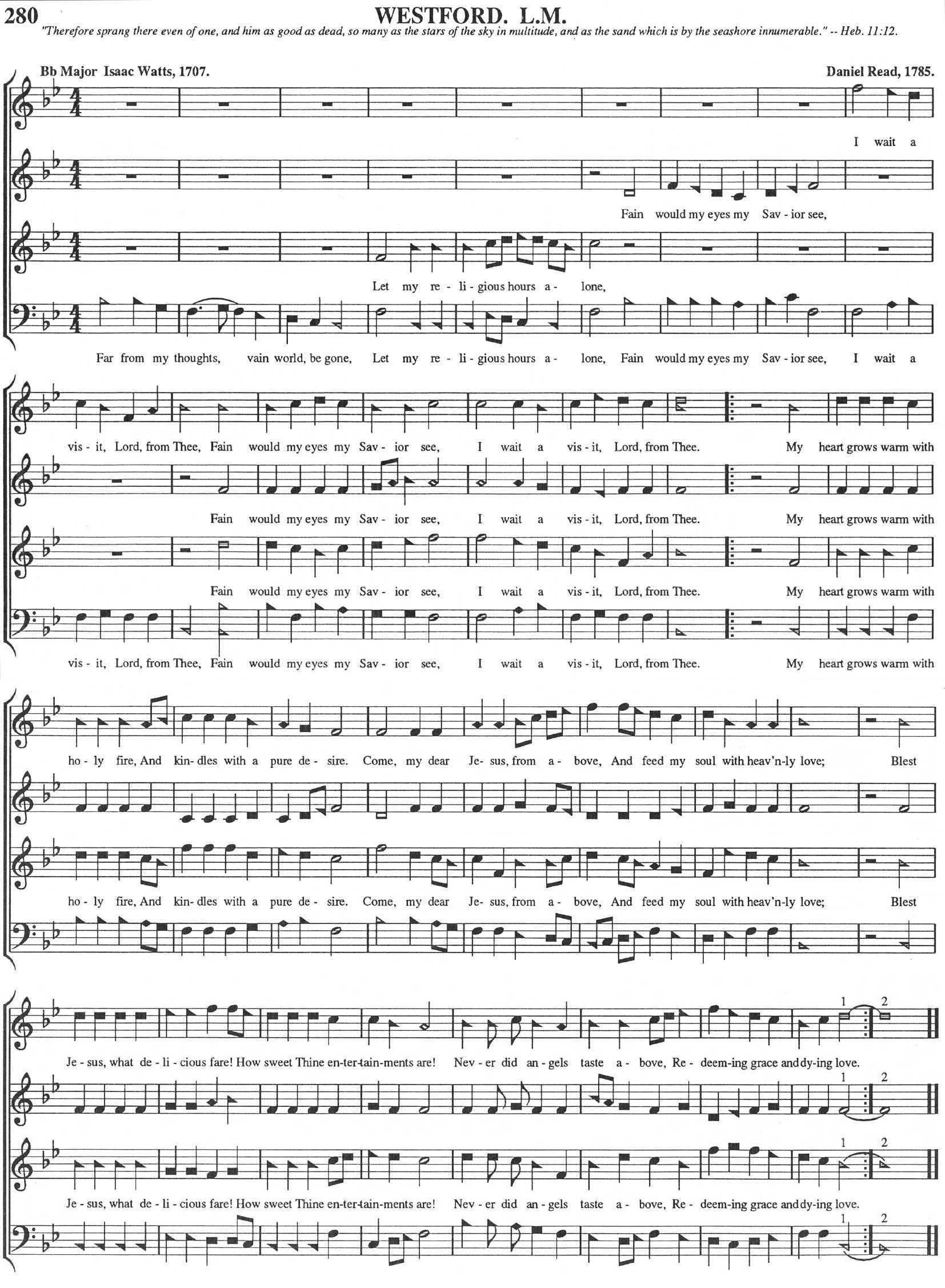
T. – Tripled; indicates a twelve-line stanza instead of four, as in L. M. T. – Long Meter Tripled (8/8/8/8/8/8/8/8/8/8/8/8). See Westford/Vain World Be Gone in The Sacred Harp. (“Tripled” is not very common.)

With Refrain – The hymn meter designation may be followed by the words “with refrain” – indicating a repeating refrain or chorus that does not follow the metrical pattern of the hymn itself. Similar designations are “With allelulias” and “With amens” indicating “allelulias” or “amen(s)” added to the end of the hymn.

Numerical Metrical Designations

7s. 6s. – Sevens and sixes; a quatrain with alternating lines of three and one-half feet and three feet, which rhymes in the second and fourth lines and sometimes in the first and third (7/6/7/6).

8s. 7s. 4s. – Eights, sevens and fours; a six-line stanza with alternating syllables of 8, 7, 8, 7, 4, and 7 (8/7/8/7/4/7). In practice (in singing) the four-syllable line is often repeated to create a line of eight syllables, and also the last two lines repeated. This enables the 8s. 7s. 4s. meter hymn to be sung with a doubled 8s. 7s. meter tune.

8s. 7s. – Eights and sevens; a trochaic quatrain with alternating lines of four feet and three and one-half feet, which rhymes in the second and fourth lines and sometimes in the first and third (8/7/8/7); also called Psalm Meter. Trochaic is one long syllable followed by one short syllable.

8s. – Eights; used to distinguish an eight-syllable quatrain that does not contain the iambic stress pattern characteristic of Long Meter (8/8/8/8). 

11s. – Elevens; used to distinguish an eleven-syllable quatrain (usually anapestic, which may rhyme in either the first and second, third and fourth lines, or first and third, second and fourth (11/11/11/11).

12s. 11s. – Twelves and elevens. A four-line stanza with alternating lines of twelve syllables and eleven syllables (12/11/12/11).

12s. – Twelves; see “M. T.” above.

Summary

The more common designations (C. M., L. M., S. M.) are almost universally standard across hymn books. “Common Meter” is what it appears to be – the most common hymn meter used in English hymnody. In relation: (1) “Long Meter” is longer than “Common Meter” in its second and fourth lines; (2) “Short Meter is shorter than “Common Meter” in its first line. Some designations vary by editors, geography, and time periods. For example, William Gadsby’s A Selection of Hymns, for Public Worship includes the following designations: 104th for the 10.10.11.11 pattern; 112th for L. P. M.; 122nd for S. P. M.; and 148th for H. M. These metrical patterns were related to old psalm tunes. H. M. (6.6.6.6.8.8.) was the meter for the Old Version Psalm 148, and so, often 148th was used to identify this pattern. The same sort of history applies to the designations 104th, 112th, and 122nd. Some hymn-meter variations made by editors may intend to encompass rhyme patterns as well, but rhyme patterns (though often prevalent in a certain way) are not inherent in hymn meter designations.

Most of the numerical meter designations are fairly intuitive (the number equals the number of syllables per line). 10s has ten syllables per line; 9s has nine. Some are not as intuitive, however. For example, many books use the label 8.7.4. The actual pattern of the hymn is 8.7.8.7.4.7. An almost endless combination of numerical designations of meter could be assembled. 

Both syllables and stress must be accounted for; but at the most basic level meter involves counting the number of syllables in a line of poetry. Amazing Grace is Common Meter: “A-ma-zing grace how sweet the sound” is 8 syllables; “That sav’d a wretch like me” is 6 syllables; “I once was lost but now am found” is 8 syllables; and “Was blind but now I see” is 6 syllables. Every Common Meter hymn and tune will follow that same pattern. If C. M. is written as C. M. D., or L. M. as L. M. D., etc., then that means the tune has enough music to sing two stanzas of a hymn instead of just one.

For another example, if you find a hymn labeled “11s”, a tune paired with the words “How firm a foundation, ye saints of the Lord” will likely work for singing that hymn.

Although any hymn of a particular meter can be sung with any tune of that same meter, the music of a particular song does not always seem fitting in mood for every hymn – even though it might work metrically. Also, the same number of syllables with different stress patterns will not fit well with the same tune. For example, compare “When I survey the wondrous cross” (Hamburg) with “How tedious and tasteless the hours” (Greenfields). They have the same number of syllables but different stress patterns.

In metrical hymn singing, there are tunes that have been passed down and have not been written down (or at least not in the forms in which they are sung). Songs from The Sacred Harp are good sources for tunes to set with the metrical hymns. Additionally, many hymnals will have a “Metrical Index” by which tunes may be found according to the meter in which they are written.

May the Lord bless this to be useful to someone.

Compiled by Robert Vaughn, initially in September 2006, with recent revisions and additions. Gathered from many sources over many years, so that little of what you read is original with me.


[i] Dactylic feet/stress is the reverse of Anapestic, having one long accented syllable followed by two short syllables, and might be found in some hymns.
[ii] “Irregular” or “Irr.” seems to now be the more commonly preferred designation rather than “P. M.” for lines and/or meters that are not standard. On occasion “P. M.” seems to be used in place of multiplying the number of designations in a hymn book. For example, I have seen “P. M.” used in place of “H. M.” (6/6/6/6/8/8). The Psalter (Grand Rapids, MI: Wm B. Eerdmans Publishing Co., 1912/1927) includes two alphabetical metrical designations I have not commonly found – Common Hallelujah Meter (C. H. M., 8/6/8/6/8/8) and Long Hallelujah Meter (L. H. M., 8/8/8/6/8/6).

Monday, January 06, 2025

Three great truths

There are three great truths,

1st, That there is a God;

2nd, That He has spoken to us in the Bible;

3rd, That He means what He says.

Oh, the joy of trusting Him!

J. Hudson Taylor (1832–1905) in Hudson Taylor and China’s Open Century, Book VI

Sunday, January 05, 2025

The legion dispossessed

Mark 5:18-19 And when he was come into the ship, he that had been possessed with the devil prayed him that he might be with him. Howbeit Jesus suffered him not, but saith unto him, Go home to thy friends, and tell them how great things the Lord hath done for thee, and hath had compassion on thee.

One of my favorite little-known John Newton hymns is “The legion dispossessed.” This is Hymn 92 in Olney Hymns, compiled by John Newton and William Cowper. The Olney Hymns is arranged in three “books,” this first being hymns “On Select Texts of Scriptures.” These hymns are placed in biblical book order. Hymn 92 appears in five 8-line stanzas on pages 104-106. The meter is 8s.7s.D. Newton poetically tells the deliverance of the man possessed, found in the tombs of Gadara. He relates the deliverance of the demoniac to the great deliverance of the sinner.

1. Legion was my name by nature,
Satan raged within my breast;
Never misery was greater,
Never sinner more possessed:
Mischievous to all around me,
To myself the greatest foe;
Thus I was, when Jesus found me,
Filled with madness, sin, and woe.

2. Yet in this forlorn condition,
When he came to see me free;
I replied, to my Physician,
“What have I to do with thee?”
But he would not be prevented,
Rescued me against my will;
Had he stayed till I consented,
I had been a captive still.

3. “Satan, though thou fain wouldst have it,
Know this soul is none of thine;
I have shed my blood to save it,
Now I challenge it for mine, (b)
Though it long has thee resembled,
Henceforth it shall me obey;”
Thus he spoke while Satan trembled,
Gnashed his teeth and fled away.

4. Thus my frantic soul he healèd,
Bid my sins and sorrows cease;
“Take, said he, my pardon sealèd,
I have saved thee, go in peace:”
Rather take me, Lord, to heaven,
Now thy love and grace I know;
Since thou hast my sins forgiven,
Why should I remain below!

5. “Love, he said, will sweeten labors,
Thou hast something yet to do;
Go and tell your friends and neighbours,
What my love has done for you:
Live to manifest my glory,
Wait for heaven a little space;
Sinners, when they hear thy story,
Will repent and seek my face.”

(b) Book 3, Hymn 54, “Hear what he has done for my soul!”

I wrote a tune for this hymn that was “inspired” by the song Hold to God’s Unchanging Hand. I was meditating over the words and started humming out something that might fit the words; and I came up with a variant, based on the basic run of that tune – converted into a minor tune for “Legion was my name by nature” (which I simply called Legion). The Hymnary.Org shows a tune by John Hughes, named Calon Lân, for use with this hymn, but I have never seen the two published in a hymnal together. It may be that Newton expresses a little too much “irresistible” in the grace toward the demoniac to suit some folks, and that this has limited its use. For my part, the Lord’s power over the legion speaks peace to my soul in his power over my disease of sin and death.
I think you can click and enlarge this picture.

Saturday, January 04, 2025

A Translational Observation, and other links

The posting of links does not constitute an endorsement of the sites linked, and not necessarily even agreement with the specific posts linked.

Friday, January 03, 2025

If there be any virtue

In the Facebook Textus Receptus Academy group, I pointed out a certain modus operandi that Mark Ward used in his video “Five False Friends Staring with ‘D’.” This is in the context of declaring a KJV word no longer means what it meant in 1611. I used “debate” to give the example. 

  1. Define a word in a way that limits its range of meaning. Debate = a formal discussion on a particular topic...
  2. Fail to include other definitions in the semantic range. Debate (1st definition in the modern Merriam-Webster online dictionary) = a contention by words or arguments. (Contention, one of the very words Mark said it “used to mean.”)
  3. Declare you proved your point.
  4. Easy peasy.

This is something that runs through his work (ergo, modus operandi). He did it on December 23 with the word “virtue” in the video “Virtue Went Out of Jesus?”[i]

  1. Define a word in a way that limits its range of meaning. Virtue = behavior showing high moral standards....
  2. Fail to include other definitions in the semantic range. Virtue (2nd definition in the modern Merriam-Webster online dictionary) = a beneficial quality or power of a thing. (Power, one of the very words Mark said it “used to mean.”)
  3. Declare you proved your point. 

In the New Testament (King James Bible), the word “virtue” occurs seven times in six verses. Four times it carries a meaning and connotation of moral excellence (ἀρετή; Philippians 4:8; 2 Peter 1:3, 5). The other three times, where virtue carries a meaning and connotation of power, representing the Greek word δύναμις.

  • Mark 5:30 And Jesus, immediately knowing in himself that virtue had gone out of him, turned him about in the press, and said, Who touched my clothes?
  • Luke 6:19 And the whole multitude sought to touch him: for there went virtue out of him, and healed them all.
  • Luke 8:46 And Jesus said, Somebody hath touched me: for I perceive that virtue is gone out of me.

In other places the King James translators translate the word δύναμις as power. I believe there are at least three reasons why they chose to use virtue instead of power in Mark 5:30, Luke 6:19, and Luke 8:46.

  1. The translators did not tie themselves to uniformity of phrasing, and Greek words might vary in connotation. “…we have not tied ourselves to an uniformity of phrasing, or to an identity of words, as some peradventure would wish that we had done, because they observe, that some learned men somewhere, have been as exact as they could that way. Truly, that we might not vary from the sense of that which we had translated before, if the word signified the same thing in both places (for there be some words that be not of the same sense everywhere) we were especially careful, and made a conscience, according to our duty.”
  2. The translators followed the wording of the English Bibles that came before them. The Bishops, Geneva, 1557 Geneva NT, Great Bible, Taverner, Matthew, Coverdale, and Tyndale had “virtue” in these three texts of Scripture. The only exception is that Coverdale had “the power” in Mark 5:30).
  3. The translators probably thought virtue carried some connotation useful to the context, such as “excellency” in connection with power, like the excellency of power inherent in Jesus as deity (see OED I.1, 1933, p. 238), or the effect of the power. Using “virtue” over and over in reference to the power of Jesus Christ versus the brazen serpent Ralph Robinson wrote, “Virtue doth really go forth from Christ to the Sin-bitten sinner, for the healing of him” and that “Christ excells the brazen Serpent in 11 particulars” (Christ All in All, 2nd edition, London: John Rothwell, 1660, p. 553).[ii]

One of Mark’s problems is that he thinks the “uppermost sense of” the word in a person’s mind governs the “meaning” of the word, and then sets out of prove that point in ways that often veer too far from consistently comprehensive inspection of sound words.[iii] We know that people (most all people) will normally travel to the first sense they know for a word to try to make sense of it. We deny that folks cannot and should not learn to interpret words in their context, and with much diligence.


[i] Mark did a modified version of his m.o. with the word “issue” in “Mr. Median Meets the Woman with the Issue of Blood.” If you check with discernment, you will see this kind of stuff occurs over and over.
  1. Define a word in a way that limits its range of meaning. Issue = personal difficulties or problems....
  2. Fail to include other definitions in the semantic range. Issue (4th definition in the modern Merriam-Webster online dictionary) = a discharge (as of blood) from the body. (Exactly the “issue” Mark is talking about in Leviticus 12:7 and Matthew 9:20. He eventually admits this one is slippery, but claims it is just too uncommon for modern folks to understand.)
  3. Declare you proved your point.
[ii] Ralph Robinson was pastor of St. Mary Wolnoth in London. The sermon “Christe the true brazen Serpent” was preached in January of 1654. Robinson specifically mentions Luke 6:19 and 8:46 in the context quoted.  In his sermon A Sermon of Spirituall Life and Death, John Preston used power and virtue (virtue) as synonyms, but several times in a way that suggests he sees a slightly different range of meaning. (London: T. C., 1630, pp. 17-19; preached in November 1626). He also writes, “when Iron comes neere the Load-stone, there goes a virtue from the Load-stone that draws the Iron to it…” In A Christian Dictionary, Thomas Wilson gives as “No. 2” meaning of “Virtue” – Power and might, or the effect of power, Luke 8, 46. Vertue is gone out of me; that is, there is some healthfull effect wrought by my power.” (London: William Iaggad, 1622).
[iii] For example, in “Three False Friends in One Important Verse” (Psalm 2:1), Mark fails to engage with a New Testament verse that refers to the verse he is discussing. He is so focused on his “word study,” that he does not engage in “Bible study.” How can we maintain consistency as Bible believers and not do that. Additionally, when building his false friend case he goes back to find what the OED might say a word meant in 1611 (looking for a definition to confirm his point), but he seldom, if ever, looks for sermons or commentary from that period to see how a contemporary might interpret or understand the word in its biblical context. It seems that Mark stops searching when he finds what he hopes to find.

Thursday, January 02, 2025

From the beginning of the year to the end of the year

Combining Acts Commentary and the New Year.

Acts 11:25 ...a whole year they assembled themselves with the church, and taught much people.

At Antioch Syria (some 150 miles southeast of Tarsus, where Barnabas found Saul), Luke summarizes an entire year in their assembling with the church at Antioch and teaching the people. This is about AD 41-44 – before the dearth “in the days of Claudius Cæsar.” They were first called Christians here.

Deuteronomy 11:12 ...a land which the Lord thy God careth for: the eyes of the Lord thy God are always upon it, from the beginning of the year even unto the end of the year.

The promised land is described as a land for which the Lord careth, so that the eyes of the Lord, which run to and fro throughout the whole earth, are on it all year long, from the beginning unto its end. casting all your care upon him; May we remember, as his people, that he careth for you, that his eyes watch over us all the year long. May we cast all our care upon him, and, among other things, find ourselves assembling with his people, edifying, exhorting, and teaching one another, and so much the more as we see the day approaching – and so much that we, like those at Antioch, be recognized as and called Christians.

The Lord bless thee, and keep thee: the Lord make his face shine upon thee, and be gracious unto thee: Numbers 6:24-25

Wednesday, January 01, 2025

Jesus Christ our Lord in Romans 1:3

Q. Where do the words “…Jesus Christ, our Lord…” come from in Romans 1:3?

A. This is a confusing conundrum created when merely comparing verses to verses in various translations. In what are verses 1 through 7, the words ιησοῦ χριστοῦ τοῦ κυρίου ἡμῶν (Jesus Christ the Lord of us, that is Jesus Christ our Lord) are found in the sentence, in what is verse 4 in the Greek once the sentence is divided into verses, but in verse 3 in some English translations and in verse 4 in other English translations.

This is an interesting question and find, and one that does not seem to have much discussion about it, either pro or con (as far as what I have been able to find). I had not noticed this before, and so had to take a careful look. “Jesus Christ our Lord” (or “our Lord Jesus Christ”) is also included in verse 3 in some translations outside of the King James line of texts, such as the CSB, CEV, ERV, NCV; so it is not just a King James Bible issue.

Observe: Verses 1-7 (in both KJV & ESV, from which I give excerpts below) are one long sentence. The words “Jesus Christ our Lord” are in the sentence in all versions – it is just placed differently in the sentence. This is best considered a translator’s decision as to how its reads best in English. Different decisions have been made by different translators. None of them delete “Jesus Christ our Lord.”

Here is the King James translation, where the words are in verse 3, and the ESV is used as a representative of the words being in verse 4.
  • AKJV vs. 3-4: concerning his Son Jesus Christ our Lord, which was made of the seed of David according to the flesh; and declared to be the Son of God with power, according to the spirit of holiness, by the resurrection from the dead:
  • ESV, vs. 3-4: concerning his Son, who was descended from David according to the flesh and was declared to be the Son of God in power according to the Spirit of holiness by his resurrection from the dead, Jesus Christ our Lord,
There is a description or designation of how English and Greek differ syntactically. Much of our language is governed by word placement in the sentence (syntax), whereas in Greek it is governed more by inflection; it is much more flexible regarding word order. English is an analytic language, in which syntactic roles are assigned to words primarily by word order (the words change order and relationship to convey grammatical information). It may also be called or considered configurational. Greek is a synthetic language, in which syntactic relationship between the words is achieved or assigned via inflection (the words change form to convey grammatical information). It may also be called or considered non-configurational.

I have studied Esperanto some in the past. (I am not good at it, because I have never needed to use it.) Esperanto is a created language and is more extreme than Greek for non-configuration. It is designed so that word order has little or no input toward the meaning of the sentence – you just have to put the right endings on the words and they mean the right thing regardless of placement in the sentence.

All this to say, where to best put “Jesus Christ, our Lord” in this long sentence is a translational consideration. It is not a textual difference in the Greek. To me it reads more smoothly in the KJV, but obviously part of that is that I have been reading it that way all my life.

My conclusion is:
  • that the words obviously belong somewhere in the long sentence
  • that we should not think of the sentence just in terms of verses for the purpose of understanding the issue here
  • that the difference is a translational choice
  • that the King James placement is best

Note: Seeing this as one long sentence will go a long way in understanding the problem. One can see below how that in the SBL Greek NT it is one sentence.

1 Παῦλος δοῦλος Χριστοῦ Ἰησοῦ, κλητὸς ἀπόστολος, ἀφωρισμένος εἰς εὐαγγέλιον θεοῦ 2 ὃ προεπηγγείλατο διὰ τῶν προφητῶν αὐτοῦ ἐν γραφαῖς ἁγίαις 3 περὶ τοῦ υἱοῦ αὐτοῦ, τοῦ γενομένου ἐκ σπέρματος Δαυὶδ κατὰ σάρκα, 4 τοῦ ὁρισθέντος υἱοῦ θεοῦ ἐν δυνάμει κατὰ πνεῦμα ἁγιωσύνης ἐξ ἀναστάσεως νεκρῶν, Ἰησοῦ Χριστοῦ τοῦ κυρίου ἡμῶν, 5 δι’ οὗ ἐλάβομεν χάριν καὶ ἀποστολὴν εἰς ὑπακοὴν πίστεως ἐν πᾶσιν τοῖς ἔθνεσιν ὑπὲρ τοῦ ὀνόματος αὐτοῦ, 6 ἐν οἷς ἐστε καὶ ὑμεῖς κλητοὶ Ἰησοῦ Χριστοῦ, 7 πᾶσιν τοῖς οὖσιν ἐν Ῥώμῃ ἀγαπητοῖς θεοῦ, κλητοῖς ἁγίοις· χάρις ὑμῖν καὶ εἰρήνη ἀπὸ θεοῦ πατρὸς ἡμῶν καὶ κυρίου Ἰησοῦ Χριστοῦ.