Translate

Showing posts with label Hymns. Show all posts

Thursday, April 16, 2026

Religious effect of a hymn

When Joshua Leavitt sent out The Christian Lyre, he testified that “the work is not designed to please scientific musicians, so much as to profit plain christians…” He generally gave a melody and bass for the tune, but sometimes only the melody, writing, “As the number of parts is apt to distract the attention of an audience, or to occupy them with the music instead of the sentiment, the tunes here printed will generally be accompanied with only a simple bass, and sometimes not even with that. In a vast multitude of cases the religious effect of a hymn is heightened by having all sing the air only.”

He also possesses a good attitude about its future: “Possessing no musical skill beyond that of ordinary plain singers, I send out my work, without pretensions. If it aids the progress of Christ’s cause, I shall be rewarded. If not, I shall be accepted according to what I had, and not according to what I had not. And it will prepare the way for some other person to do it better.” (Preface, page 3)

Tuesday, March 10, 2026

Hymns can mean anything

Hymns can mean anything ... or can they?

“I tend to tell people that whatever meaning or relevance they take from that is up to them.” unnamed Facebook commenter, cited in Sacred Harp Singing in Europe: Its Pathways, Spaces, and Meanings, Ellen Leuck, p. 226[i]

“Flexible interpretations of texts permit singers with diverse beliefs and experience to relate to Sacred Harp in personally meaningful ways…” Traveling Home: Sacred Harp Singing and American Pluralism, Kiri Miller, page 132

Regarding the texts and scriptural bases for the songs in the Sacred Harp tune books, it is important to understand that they have a context and underlying meaning. They cannot just mean whatever someone wants them to mean. Now, I understand that different texts may touch different folks in different ways, make us think different things, or make us feel different things. However, we must also understand that what we think and feel about a text is not part of the text itself, and does not become the standard for the meaning of the text. First and foremost (except for a few patriotic songs, e.g. “Behold, the smiling happy land,” “My country, ’tis of thee”) the texts are Christian texts.[ii] Therefore, the songs have a Christian worldview and meaning. That fact does not mean the texts cannot touch someone who is not Christian. That fact DOES mean that Christian hymns cannot be removed from their context and mean just anything and everything to everybody. That folks think they can have their own meaning and eat it to is a sad commentary on an age that does not understand or believe objective truth. May God help Christian singers not acquiesce to this falsehood. The Christian texts have Christian meaning.

There is a fountain filled with blood,
Drawn from Immanuel’s veins;
And sinners plunged beneath that flood
Lose all their guilty stains.


[i] A couple more quotes from Sacred Harp Singing in Europe: Its Pathways, Spaces, and Meanings: “…Sacred Harp singers in Europe who identify as generally non-religious…find other ways of internalizing the meaning of the texts outside of the realm of religious worship” (p. 220). “…the religious words in The Sacred Harp do have meaning for secular participants, though not a literal meaning. They have meaning within the context of the music, and they perhaps facilitate tapping into feelings of emotional and spiritual depth that secular lyrics can do less easily. Furthermore, it is understood by the community-at-large that the meaning of the texts is interpreted by participants privately” (pp. 222-223).
[ii] The Christians who included the patriotic songs doubtless understood them to fit within their Christian worldview.

Tuesday, February 17, 2026

Anapestic Meter

What? What is that?

Awhile back, I ran across on Archive.Org the hymn book Sacred Poetry and Music Reconciled, Or, A Collection of Hymns Original and Compiled, by Samuel Willard. (Boston, MA: Leonard C. Bowles, 1830). In it I noticed several hymns labeled with the meters “C.M.A.,” “L.M.A.,” “S.M.A.” I had never noticed that kind of labeling before...

And I am always up for learning more about the meter designations. The hymn meter is the pattern of syllables and stresses in the hymn text. I have posted a number of times on the subject. Here are most, if not all:

  1. Common Meter Extended hymns
  2. Explanation of Meter, from The Baptist Standard Hymnal
  3. Hymn meter
  4. Hymn Meter Again
  5. Hymn Meter Explanations and Information
  6. Metrical Index of Tunes
  7. Online metrical indices
  8. 50th hymn meter

Willard’s explanation of his designations are as follows:
  • L. M. A. - Long Meter Anapestic. 10.10.11.11. (usually, but not always; this also includes hymn with 4 lines of 11s. and one 8-line hymn that is 10.11.11.11.12.11.11.11.)
  • C. M. A. - Common Meter Anapestic. 11.8.11.8.
  • S. M. A. - Short Meter Anapestic. 8.8.11.8.

Some relevant excerpts from Willard’s book Sacred Poems:

A considerable number of hymns in this collection are in the anapestic measure, like the first, fourth, and eighteenth, containing in general three syllables for a measure or bar; while most of the tunes, which are named for them, have usually been sung in iambic verse, dividing each measure into two parts, the first a semibreve, or other notes equivalent to it, and the second a minim. If these hymns should be adopted in any society, where these tunes are not actually divided in the collections of music in use, the following rule will remove every difficulty in performing these or any other tunes of the kind, in the manner required; viz.

Let every measure, intended for three syllables, be divided into three equal parts, by splitting semibreves, or removing slurs, and let every part be sounded on the same tone, it would otherwise be. Thus, for instance, in the tune of Froome, named for the first hymn, let the slur be removed from the crotchets in the first full measure of the first line, and let the minim in the first measure of the second line be performed like two crotchets. The only exceptions to this rule are those, which are signified by numbers or points in several hymns, and which may be observed, or not, as may be found convenient. When the first syllable in a measure has the number 1 over it, it is to fill two thirds of the bar, and for the two following syllables, marked with the number 4, the last third of the bar. is to be divided, as in hymn 4. (pages 11-12)

Some of the metres are distinguished in this book into seven varieties, and are marked by the figures 1, 2, 3, &c. prefixed to the tunes, which are named. The first variety is pure iambic from the beginning to the end of every line. The second is precisely the same with the first, excepting a trochee in the beginning of the first line. With a little attention, the chorister will understand the other diversities, which, in the adaptation of tunes, are almost as important to be observed, as the difference of metre. (page 18)

Willard says that most of the named tunes in his book can be found in the Bridgewater, Handel and Haydn, and American Psalmody collections.

A little about Samuel Willard:

Samuel Willard, the son of William Willard and Catherine Wilder, was born April 18, 1775 (his daughter wrote 1776). His grandfather was a Congregational minister and his father a deacon. He graduated from Harvard College and became a Congregational minister. The initial council declined to ordain him due to his Unitarian tendencies, but a more liberal-thinking group was convened and ordained him. Willard became a long-time influential Unitarian in Massachusetts. He compiled two hymn books – Sacred Poems (1830), Regular Hymns: on a Great Variety of Evangelical Subjects and Important Occasions: with Musical Directions, for all the Varieties of Appropriate Expression (1824), and The Family Psalter (circa 1857). The latter may have never been published, and his other books probably found only limited use outside his region (and probably not much outside the Unitarian fold). His daughter writes:

…he gave much thought and time to the subject of sacred music. He composed many hymns; on his favorite plan of adapting the poetical to the musical emphasis. He left a manuscript collection of four hundred or more of these hymns;, about one hundred of which were composed in his eighty-second year. After his birthday of eighty-two he prepared an elaborate preface to this collection, in which he emphasized the idea, that sacred music and poetry, fitly adapted to each other, are to be among the great factors in harmonizing the discordant elements of the world. This collection he named ‘The Family Psalter’.” (Life of Samuel Willard, D.D. A.A.S. of Deerfield, Mass, Mary Willard, editor. Boston, MA: George H. Ellis, 1892, pp. 22-23)

As far as I have discovered, the C.M.A., L.M.A., and S.M.A. metrical designations seem to be limited in use to Willard’s work. They may have been created by him for his work, and not used elsewhere. In Regular Hymns, Willard does not use metrical designations, but simply gave tunes for the hymn. He wrote, “In general, I have named two tunes for each hymn, taken either from the third edition of Deerfield Collection, or the tenth of the Bridgewater Collection. Those from the former are marked with a star, and those from the latter with a cross; to prevent any mistake” (pp. x-xi).

Samuel Willard died October 8, 1859, and is buried at the Laurel Hill Cemetery in Deerfield, Franklin County, Massachusetts.

Friday, February 13, 2026

Traits of a good hymn

“A hymn ought to be as regular in its structure as any other poem; it should have a distinct subject, and that subject should be simple, not complicated, so that whatever skill or labour might be required in the author to develope his plan, there should be little or none required on the part of the reader to understand it. Consequently, a hymn should have a beginning, middle, and end.”

...

“A line is no more metre because it contains a certain concatenation of syllables, than so many crotchets and quavers, pricked at random, would constitute a bar of music.”
James Montgomery in his “Introductory Essay” to The Christian Psalmist; or, Hymns, Selected and Original, pp. xiv, xvi.

Wednesday, November 26, 2025

A Visit to Cowper’s Grave

Resting Wednesday is suspended for this tribute.

“A Visit to Cowper’s Grave” is a poem by an unknown author. This author began stanzas 2-6 with lines from William Cowper’s (1731-1800) hymns (“Far from the World,” “There Is a Fountain,” “When Darkness Long Has Veiled My Mind,” “O For a Closer Walk,” and “God Moves in a Mysterious Way”), and wove words from those hymns into these stanzas. A very interesting tribute.

1. I went alone. ’Twas summer time;
And, standing there before the shrine
Of that illustrious bard,
I read his own familiar name,
And thought of his extensive fame,
And felt devotion’s sacred flame,
Which we do well to guard.

2. “Far from the world, O Lord, I flee.”
How sweet the words appeared to me,
Like voices in a dream!
“The calm retreat, the silent shade”
Describe the spot where he was laid,
And where surviving friendships paid
Their tribute of esteem.

3. “There is a fountain.” As I stood
I thought I saw the crimson “flood,”
And some beneath the wave;
I thought the stream still rolled along,
And that I saw the ransomed throng,
And that I heard the “nobler song”
Of Jesus’ “power to save.”

4. “When darkness long has veiled my mind,”
And from these words I felt inclined
In sympathy to weep;
But “smiling day” has dawned at last,
And all his sorrows now are past;
No tempter now, no midnight blast,
To spoil the poet’s sleep.

5. “O for a closer”—even so,
For we who journey here below
Have lived too far from God.
Oh, for that holy life I said,
Which Enoch, Noah, Cowper led!
Oh, for that “purer light” to shed
Its brightness on “the road”!

6. “God moves in a mysterious way;”
But now the poet seemed to say,
No mysteries remain.
On earth I was a sufferer,
In Heav’n I am a conqueror;
“God is his own interpreter,”
And “he has made it plain.”

Tuesday, January 07, 2025

Hymn Meter Explanations and Information

Hymn Meter Explanations and Information

“Hymn meter” is the pattern of syllables and stress in the text of a hymn. The meter designations in hymn books relate to the syllables, meter, or “feet” of the poetry. A hymn of a certain meter (Common Meter = C. M., for example) can be sung with any tune of that same meter. Knowing the metrical symbols and matching hymns to tunes are knowledge and skills needed for hymn-book singing.

Alphabetical Metrical Designations

C. M. – Common Meter; a quatrain (four-line stanza) with alternating lines of iambic tetrameter and iambic trimeter, which usually rhymes in the second and fourth lines and sometimes in the first and third (8/6/8/6); also called Ballad Meter in other contexts. Iambic is one short or unaccented syllable followed by one long or accented syllable.

C. M. E. – Common Meter Extended; a five-line stanza in which most commonly the first, third, and fourth lines rhyme, and the second and fifth lines rhyme. C. M. E. is like C. M. except that it is “extended” with an extra line of 8 syllables (8/6/8/8/6). 

C. P. M. – Common Particular Meter; a six-line stanza of which the first, second, fourth and fifth lines are iambic tetrameter, and the third and sixth lines are iambic trimeter (8/8/6/8/8/6). 

D. – Doubled; indicates an eight-line stanza instead of four, as in C. M. D. or D. C. M. – Common Meter Doubled or Doubled Common Meter (8/6/8/6/8/6/8/6). 

H. M. – Hallelujah Meter; a six-line stanza of which the first four lines are trimeter and the last two are tetrameter, which rhymes most often in the second and fourth lines and the fifth and sixth lines (6/6/6/6/8/8). At times this may be instead listed as (6/6/6/6/4/4/4/4).

L. M. – Long Meter; a quatrain (four-line stanza) in iambic tetrameter, which usually rhymes in the second and fourth lines and often in the first and third (8/8/8/8).

L. P. M. – Long Particular Meter; a six-line stanza of iambic tetrameter (8/8/8/8/8/8). 

M. T. (or 12s.) – Meter Twelves; a quatrain in anapestic hexameter (12/12/12/12). Anapestic is two short syllables followed by one long syllable.[i] 

P. M. – Particular Meter, Peculiar Meter; Psalm Meter; sometimes may stand for Psalm Meter (but this is more commonly known as 8s. 7s.); it usually means Particular Meter, or Peculiar Meter (these two indicating poetry with its own particular, peculiar, or non-standard, meter).[ii]  

S. M. – Short Meter; iambic lines in the first, second, and fourth are in trimeter, and the third in tetrameter, which rhymes in the second and fourth lines and sometimes in the first and third (6/6/8/6). 

S. P. M. – Short Particular Meter; a six-line stanza of which the first, second, fourth and fifth lines are iambic trimeter, and the third and sixth lines are iambic tetrameter (6/6/8/6/6/8).

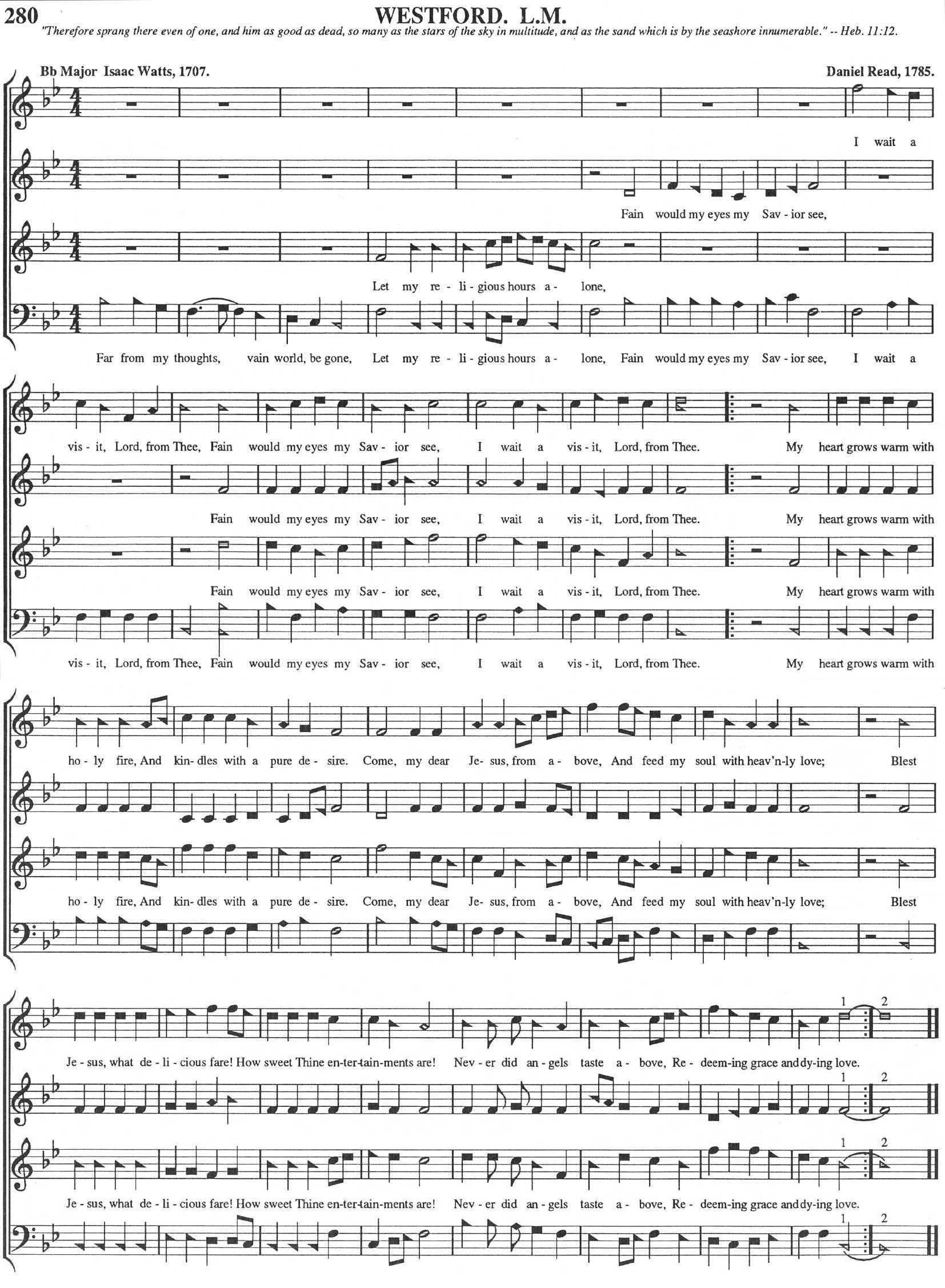
T. – Tripled; indicates a twelve-line stanza instead of four, as in L. M. T. – Long Meter Tripled (8/8/8/8/8/8/8/8/8/8/8/8). See Westford/Vain World Be Gone in The Sacred Harp. (“Tripled” is not very common.)

With Refrain – The hymn meter designation may be followed by the words “with refrain” – indicating a repeating refrain or chorus that does not follow the metrical pattern of the hymn itself. Similar designations are “With allelulias” and “With amens” indicating “allelulias” or “amen(s)” added to the end of the hymn.

Numerical Metrical Designations

7s. 6s. – Sevens and sixes; a quatrain with alternating lines of three and one-half feet and three feet, which rhymes in the second and fourth lines and sometimes in the first and third (7/6/7/6).

8s. 7s. 4s. – Eights, sevens and fours; a six-line stanza with alternating syllables of 8, 7, 8, 7, 4, and 7 (8/7/8/7/4/7). In practice (in singing) the four-syllable line is often repeated to create a line of eight syllables, and also the last two lines repeated. This enables the 8s. 7s. 4s. meter hymn to be sung with a doubled 8s. 7s. meter tune.

8s. 7s. – Eights and sevens; a trochaic quatrain with alternating lines of four feet and three and one-half feet, which rhymes in the second and fourth lines and sometimes in the first and third (8/7/8/7); also called Psalm Meter. Trochaic is one long syllable followed by one short syllable.

8s. – Eights; used to distinguish an eight-syllable quatrain that does not contain the iambic stress pattern characteristic of Long Meter (8/8/8/8). 

11s. – Elevens; used to distinguish an eleven-syllable quatrain (usually anapestic, which may rhyme in either the first and second, third and fourth lines, or first and third, second and fourth (11/11/11/11).

12s. 11s. – Twelves and elevens. A four-line stanza with alternating lines of twelve syllables and eleven syllables (12/11/12/11).

12s. – Twelves; see “M. T.” above.

Summary

The more common designations (C. M., L. M., S. M.) are almost universally standard across hymn books. “Common Meter” is what it appears to be – the most common hymn meter used in English hymnody. In relation: (1) “Long Meter” is longer than “Common Meter” in its second and fourth lines; (2) “Short Meter is shorter than “Common Meter” in its first line. Some designations vary by editors, geography, and time periods. For example, William Gadsby’s A Selection of Hymns, for Public Worship includes the following designations: 104th for the 10.10.11.11 pattern; 112th for L. P. M.; 122nd for S. P. M.; and 148th for H. M. These metrical patterns were related to old psalm tunes. H. M. (6.6.6.6.8.8.) was the meter for the Old Version Psalm 148, and so, often 148th was used to identify this pattern. The same sort of history applies to the designations 104th, 112th, and 122nd. Some hymn-meter variations made by editors may intend to encompass rhyme patterns as well, but rhyme patterns (though often prevalent in a certain way) are not inherent in hymn meter designations.

Most of the numerical meter designations are fairly intuitive (the number equals the number of syllables per line). 10s has ten syllables per line; 9s has nine. Some are not as intuitive, however. For example, many books use the label 8.7.4. The actual pattern of the hymn is 8.7.8.7.4.7. An almost endless combination of numerical designations of meter could be assembled. 

Both syllables and stress must be accounted for; but at the most basic level meter involves counting the number of syllables in a line of poetry. Amazing Grace is Common Meter: “A-ma-zing grace how sweet the sound” is 8 syllables; “That sav’d a wretch like me” is 6 syllables; “I once was lost but now am found” is 8 syllables; and “Was blind but now I see” is 6 syllables. Every Common Meter hymn and tune will follow that same pattern. If C. M. is written as C. M. D., or L. M. as L. M. D., etc., then that means the tune has enough music to sing two stanzas of a hymn instead of just one.

For another example, if you find a hymn labeled “11s”, a tune paired with the words “How firm a foundation, ye saints of the Lord” will likely work for singing that hymn.

Although any hymn of a particular meter can be sung with any tune of that same meter, the music of a particular song does not always seem fitting in mood for every hymn – even though it might work metrically. Also, the same number of syllables with different stress patterns will not fit well with the same tune. For example, compare “When I survey the wondrous cross” (Hamburg) with “How tedious and tasteless the hours” (Greenfields). They have the same number of syllables but different stress patterns.

In metrical hymn singing, there are tunes that have been passed down and have not been written down (or at least not in the forms in which they are sung). Songs from The Sacred Harp are good sources for tunes to set with the metrical hymns. Additionally, many hymnals will have a “Metrical Index” by which tunes may be found according to the meter in which they are written.

May the Lord bless this to be useful to someone.

Compiled by Robert Vaughn, initially in September 2006, with recent revisions and additions. Gathered from many sources over many years, so that little of what you read is original with me.


[i] Dactylic feet/stress is the reverse of Anapestic, having one long accented syllable followed by two short syllables, and might be found in some hymns.
[ii] “Irregular” or “Irr.” seems to now be the more commonly preferred designation rather than “P. M.” for lines and/or meters that are not standard. On occasion “P. M.” seems to be used in place of multiplying the number of designations in a hymn book. For example, I have seen “P. M.” used in place of “H. M.” (6/6/6/6/8/8). The Psalter (Grand Rapids, MI: Wm B. Eerdmans Publishing Co., 1912/1927) includes two alphabetical metrical designations I have not commonly found – Common Hallelujah Meter (C. H. M., 8/6/8/6/8/8) and Long Hallelujah Meter (L. H. M., 8/8/8/6/8/6).

Tuesday, September 17, 2024

Worship in Hymns

WORSHIP IN HYMNS 
By Robert Inman Johnson

This essay first appeared in The Tie, a monthly publication of Southern Baptist Theological Seminary, Louisville, Kentucky, circa 1948. The Seminary’s professor of Music, R. Inman Johnson, wrote “Worship In Hymns.”. I have not seen the original, but have taken this digested version from The Word and Work, April 1948, Volume XLII, pp. 88-90. Posting this is not an endorsement of everything Johnson writes in the essay. Nevertheless, he makes some good points, and I think you will find it an interesting representation of music and hymnology taught by Southern Baptists in the mid-20th century. Everything below is by R. Inman Johnson.

Hymns have been said to be directed toward God, toward the Christian (including ourselves), or toward the sinner. To God we sing our praise and thanksgiving and pour out our songs of aspiration, petition, and promise of faithfulness. For the Christian we sing songs of encouragement and lift each other in prayerful tones to God. To the sinner we show our love for God, His love for the sinner, and plead for the sinner’s acceptance of this love. These are high and holy ideals. Hence, we should give attention to the singing part of the service. 

We do not undertake to define “worship service” beyond saying it should result in an awareness of our relationship to God and His purpose for our lives. True it is that God may be met anywhere, in the sanctuary, in the street, or in the field. We may worship alone or as a component part of a congregation. To be a member of a congregation which gives itself to intense worship is a thrilling experience. We go away saying that God has been with us. 

Corporate worship must be directed through man by the Holy Spirit. There must be both preparation and correct performance. A real worship period does not just happen. We need to know how to prepare a service and the people need instruction in their responsibilities. The fact is, the preachers have not taught the people how to worship. Surely it is worthwhile, for only true worship promotes real spiritual growth. 

In choosing hymns for a service, we need to know the contents of the hymnal as related to the needs of the people. And, they should be chosen for a definite purpose, with some relationship of ideas. This idea may correspond with the ideas in the sermon or it may not. Certainly it should not be foreign or antagonistic to the sermon. Seldom do I know the sermon subject beforehand and I am often amazed at the fitness of my selections. If you ask, the Holy Spirit will help you choose the hymns. In evangelistic meetings, I usually wait to choose the invitation hymn until I see where the sermon is headed. 

In preparing ourselves to sing we need to remember that most good hymns represent a spiritual experience in the life of the writer. By our singing we make this experience our own. We should thrill with the idea that thousands of saints before us have sung the text and thousands will sing it after us. Thus we are members of one great choir which one day shall be gathered before the throne of God to sing eternal hallelujahs. What a privilege to join that choir of heavenly witnesses. 

If, then, in corporate singing we share the spiritual life of others, we should see to it that we grow in grace through a wide variety of experience. Often we fail here because we want good singing; hence, we choose over and over a few hymns the people sing well. New hymns and tunes should be introduced to deepen our Christian experience. 

For instance, in 58 chapel services and broadcasts we have sung 157 different hymns. This is a large number when compared with the average church repertoire. I have a typewritten copy of the index of the hymnal. When a hymn is selected, the date is written after it on this copy. Thus, too frequent repetition is prevented. In the limited church program, a hymn should not appear more than once per month. 

Many ideas may be followed in selecting hymns. Usually, when three hymns are used before the sermon, the first is a strong hymn of praise. The second spot may be used to introduce new or less familiar texts and tunes. Also, I like here the short hymns of definite worship value set to such tunes as Manoah, Bera, Belmont, St. Agnes, etc. They have both beauty and strength. The third hymn may be more subjective with a sense of individual devotion, consecration or aspiration. It should be thoroughly familiar. The fine gospel hymns are well placed here. 

Remember also that these three hymns should vary in key signature, mood and pace. It is tiring to sing consecutive songs in the same key and at the same rate of speed. Start with a good tempo, the next may be slower. The mood may change from objective praise to subjective examination of our own hearts. For instance, using the idea of serving Christ: 1. We praise Him with “Crown Him with Many Crowns.” 2. In a slower tempo and quite different quality of tone, we consider our relation to Him in “Must Jesus Bear the Cross Alone.” 3. In a stronger rhythm we make our promise in “O Jesus, I have promised to serve thee to the end.” 

The manner of our singing has much to do with its effectiveness for ourselves and for others. Ineffective singing is by no means confined to the small rural church but is to be found in all classes of churches. It most often is the result of a lack of understanding on the part of the people of the worship value of hymns. God desires our hearts and minds, not merely the sacrifice of attendance on His services. Many of us go to church merely to hear the sermon, having no interest in the praise service. Many are too tired physically and mentally to sing, not realizing that a thrilling spiritual experience by means of a great hymn will completely remove this burden of fatigue. Our poor singing may be due sometimes to the hymns themselves, which may depict experiences quite foreign to our own and which, furthermore, give a situation in which we cannot conceive ourselves. Hence, congregational hymns should contain universal experiences, those to which we are all subject. This is true of the hymns which survive the test of years. A song which is local or limited in subject matter to a small group may be popular for a time but not for long. 

Again, poor singing may result from a poor fit of hymn and tune. A joyful hymn set to a doleful tune loses much of its worth for us. Likewise, a superficial tune may destroy the value of a noble hymn. 

…Many other things may enter to cause poor singing, such as acoustics, temperature, stuffy atmosphere, etc. I am convinced that the most intelligent congregational singing requires a director or precentor. By this I mean a person who can direct the people in their worship in song… 

Effective singing, solo or group, takes cognizance of the fact that music rises in intensity to a climax somewhere in the composition. All good hymn tunes progress in some way from the first chord to a climax. The hymn itself also reaches a point where emotion is most intense. Ideally these points in text and tune should coincide. This climax may result in more volume or in more intensity at the same level of volume. Certainly it should keenly intensify the meaning of the text in our consciousness. For after all, the text is the hymn. The tune makes easier and more emphatic the entry of its meaning into our hearts. 

It is the director’s problem to interpret text and tune for the congregation. One chief method is a change in dynamics from loud to soft or vice versa. Frequently we hear a leader say, “Sing the second verse softly.” Few stanzas call for quiet singing throughout at the same level. They demand a change of dynamics within themselves. This calls for controlled directing, not just “time-beating.” 

A good example may be found in the hymn, “Jesus, Lover of My Soul,” to the tune, Martyn. Beginning from the first stanza, quietly increase the volume and intensity until the words, “Guide me, O my Savior hide,” are poured out with all of our being. Diminish from “Safe into the haven, guide” to the end. The tune is well-suited to the stanzas. … There is no place here for lifeless singing. Let us by no means, though, confuse loud singing with intensified singing. Quiet singing with awareness of our purpose can be beautiful and thrilling. 

The goal of congregational singing is the participation of every individual present, suitable hymns varied in mood and tempo, a variation inside the hymn itself, and often a variation inside the stanzas. This demands a competent director and a responsive audience. 

Good “church music” may not always be good music, for the purpose of church music is spiritual growth. This then, which may also be said of preaching, is my answer: “Good church music is that music which in a given situation intensifies and promotes spiritual growth.” 

“In the midst of the congregation will I sing thy praise.”— Heb. 2:12.

Sunday, July 30, 2023

The Old-Time Songs

“The Old-Time Songs” poem describes a (perhaps imaginary) singing that uses Christian Harmony, Sacred Harp, and Temple Star song books. It is not unrealistic to believe a singing in 1913 could have used all three of these popular books. However, the page numbers and words (though real song words) do not correspond with the songs in these books on the numbers mentioned. Perhaps “D. G. B.” simply intended to be humourous.

The Athens (Georgia) Banner, Sunday, August 17, 1913, page 4

Will the Waters Be Chilly was never in The Christian Harmony, so far as I know, but it is a good song.


Thursday, March 23, 2023

Grace Abounding

In his book Strictures on the Plymouth Antinomians, Joseph Cottle attributed the following story to one he charged as being an antinomian preacher, which preacher spoke as follows to one of his congregants who was in a state of intoxication.

“Ah! Judith! I see you have forgotten your Lord, but he has not forgotten you.”

Cottle was aghast at the reply, condemning it, while I might say that a different Saviour would do me no good. No, grace does not lead us to continue in sin, but grace is greater than all our sin!

“Grace, grace, God’s grace, Grace that is greater than all our sin!” (From the chorus of “Marvelous Grace” by Julia Harriete Johnston, 1849-1919)

Romans 5:20

“…But where sin abounded, grace did much more abound”

Romans 6:1-2

“What shall we say then? Shall we continue in sin, that grace may abound? God forbid…”

Isaiah 49:15

“Can a woman forget her sucking child, that she should not have compassion on the son of her womb? yea, they may forget, yet will I not forget thee.”

1 John 3:20

“For if our heart condemn us, God is greater than our heart, and knoweth all things.”

Sunday, November 21, 2021

Say “Amen” to God

AMEN.
 
I cannot say,
Beneath the pressure of life’s cares today,
I joy in these;
But I can say
That I would rather walk this rugged way,
If Him it please.
 
I cannot feel
That all is well, when dark’ning clouds conceal
The shining sun;
But then I know
God lives and loves, and say, since it is so,
“Thy will be done.”
 
I cannot speak
In happy tone, the tear-drops on my cheek
Show I am sad;
But I can speak
Of grace to suffer with submission meek,
Until made glad.
 
I do not see
Why God should e’en permit some things to be,
When He is love;
But I can see,
Though often dimly through the mystery,
His hand above.
 
I do not look
Upon the present, nor in nature’s book,
To read my fate;
But I do look
For promised blessings in God’s Holy book,
And I can wait.
 
The above poem was published Thursday, July 6, 1893, in the Baptist and Reflector (Nashville, Tennessee), page 8. The next stanza was not printed in Baptist and Reflector. I ran across it elsewhere, when searching for information on the poem.
 
I may not try
To keep the hot tears back; but hush that sigh,
“It might have been;”
And try to still
Each rising murmur, and to God’s sweet will
Respond—“AMEN.”

Sunday, May 23, 2021

I’ve Found a Friend


James Grindlay Small was born in Edinburgh in 1817, and died at Renfrew in 1888. He joined the Church of Scotland in 1834, and became minister of the Free Church at Bervie in 1847.

1. I’ve found a Friend, oh, such a Friend!
He loved me ere I knew Him;
He drew me with the cords of love,
And thus He bound me to Him.
And round my heart still closely twine
Those ties which naught can sever,
For I am His, and He is mine,
Forever and forever.

2. I’ve found a Friend, oh, such a Friend!
He bled, He died to save me;
And not alone the gift of life,
But His own self He gave me.
Naught that I have my own I call,
I hold it for the Giver;
My heart, my strength, my life, my all,
Are His, and His forever.

3. I’ve found a friend, O such a friend!
All pow’r to Him is given,
To guard me on my onward course,
And bring me safe to heaven:
Th’eternal glories gleam afar
To nerve my faint endeavor;
So now to watch, to work, to war,
And then to rest forever.

4. I’ve found a Friend, oh, such a Friend!
So kind, and true, and tender,
So wise a Counsellor and Guide,
So mighty a Defender!
From Him who loves me now so well,
What power my soul can sever?
Shall life or death, or earth or hell?
No? I am His forever.

By James Grindlay Small (1817-1888). Jesus, the Friend was first published in The Revival Hymn Book in 1863 and then in Small’s Psalms & Sacred Songs, 1866.

Sunday, February 21, 2021

How wondrous are the works of God

1. How wondrous are the works of God,
Displayed through all the world abroad!
Immensely great! Immensely small!
Yet one strange work exceeds them all.

2. He formed the sun, fair fount of light;
The moon, and stars to rule the night;
But night, and stars, and moon, and sun,
Are little works compared with one.

3. He rolled the seas and spread the skies;
Made valleys sink and mountains rise;
The meadows clothed with native green;
And bade the rivers glide between.

4. But what are seas, or skies, or hills;
Or verdant vales,or gliding rills,
To wonders man was born to prove?
The wonders of redeeming love!

5. ’Tis far beyond what words express,
What saints can feel,or angels guess;
Angels, that hymn the great I Am,
Fall down and veil before the Lamb.

6. The highest heavens are short of this,
’Tis deeper then than the vast abyss,
’Tis more than thought can e’er conceive,
Or hope expect, or faith believe.

7. Almighty God sighed human breath,
The Lord of life experienced death;
How it was done we can’t discuss;
But this we know, ‘twas done for us.

8. Blest with this faith then let us raise
Our hearts in love, our voice in praise,
All things to us must work for good,
For whom the Lord hath shed his blood.

9. Trials may press of every sort;
They may be sore; they must be shore,
We now believe but soon shall view,
The greatest glories God can show.

Joseph Hart, in The Christian’s duty, Exhibited in a Series of Hymns, 1791

Thursday, November 12, 2020

50th hymn meter

I recently discovered a new hymn meter designation – 50th meter – that I do not recall seeing before (Thanks to Matt Bell.) The 50th meter was a meter for the 50th Psalm. Similarly, William Gadsby uses Psalm Tune names for several of his hymn meters – 104th for the 10.10.11.11 pattern, 112th for L. P. M., 122nd for S. P. M., and 148th for H. M.

According to Richard Crawford in The Core Repertory of Early American Psalmody (Volumes 11-12, pp. xxxix, xl), the “old” 50th meter was 10.10.10.10.11.11. (as in the tune Lyons), and the “new” 50th meter was 6 lines of 10 (as in the tune Wordsworth).

Sunday, June 21, 2020

Psalm 139, Watts

Isaac Watts, hymn on Psalm 139

1. ‘Twas from thy hand, my God, I came,
A work of such a curious frame
In me thy fearful wonders shine,
And each proclaims thy skill divine.

2. Thine eyes did all my limbs survey,
Which yet in dark confusion lay;
Thou saw’st the daily growth they took,
Formed by the model of thy book.

3. By thee my growing parts were named,
And what thy sovereign counsels framed-
The breathing lungs, the beating heart-
Was copied with unerring art.

4. At last, to show my Maker’s name,
God stamped his image on my frame,
And in some unknown moment joined
The finished members to the mind.

5. There the young seeds of thought began,
And all the passions of the man:
Great God, our infant nature pays
Immortal tribute to thy praise.

6. Lord, since in my advancing age
I’ve acted on life’s busy stage,
Thy thoughts of love to me surmount
The power of numbers to recount.

7. I could survey the ocean o’er,
And count each sand that makes the shore,
Before my swiftest thoughts could trace
The num’rous wonders of thy grace.

8. These on my heart are still impressed,
With these I give my eyes to rest;
And at my waking hour I find
God and his love possess my mind.

Sunday, May 31, 2020

Come, thou long-expected Jesus

1. Come, thou long-expected Jesus,
Born to set thy people free;
From our fears and sins release us,
Let us find our rest in thee.
Israel's strength and consolation,
Hope of all the earth thou art;
Dear desire of every nation,
Joy of every longing heart.

2. Born thy people to deliver,
Born a child and yet a King,
Born to reign in us forever,
Now thy gracious kingdom bring.
By thine own eternal spirit
Rule in all our hearts alone;
By thine all sufficient merit,
Raise us to thy glorious throne.

By Charles Wesley, Hymns for the Nativity of Our Lord

Sunday, May 24, 2020

Home Above

Galatians 4:26 But Jerusalem which is above is free, which is the mother of us all.

The first hymn is found in The Sacred Harp. It appears with Home Above, a tune by J. L. Hinton, No. 441b in The Sacred Harp, 1870. This common meter text is unattributed.

Home Above
Oh for a light to guide my feet
In heav’n’s alluring way,
To that celestial bright retreat,
Where smiles can ne’er decay.
Eternal Father, Shine around
And spread thy silken love,
And flit all o’er this spacious mound,
To bring us home above.

This following hymn is credited to Elder Aaron Brooks Whatley in The Pilgrim’s Hymnal by W. H. Crouse in 1908. It has the same first line, but is not the same hymn as the one in The Sacred Harp.

Prayer and Praise
O for a light to guide my feet,
While in this world below;
And in my Saviour be complete,
His love and mercy know.

O may he guide me in his truth,
His grace to me impart;
His righteousness to me impute,
Dwell richly in my heart.

By faith I’ll mount on eagle’s wings,
And soar away on high;
My Saviour’s love and mercy sing,
With rapture till I die.

Then from this world I’ll take my flight,
To reign with Christ above;
And wear a robe of spotless white,
With the redeemed in love.

Sunday, February 23, 2020

Wake the Song

“Wake the song,” “or Anniversary Song,” was written by William Fisk Sherman.  A Baptist, Sherman was born in 1826 in Masschusetts and died in 1886.

1. Wake the song of joy and gladness,
Hither bring your noblest lays;
Banish ev’ry tho’t of sadness,
Pouring forth your highest praise,
Sing to him whose care has brought us
Once again with friends to meet,
And whose loving voice has taught us
Of the way to Jesus’ feet.

2. Joyfully with songs and banners,
We will greet the festal day;
Shout aloud our glad hosannas,
And our grateful homage pay.
We will change our Saviour’s glory
While our tho’ts we raise above,
Telling still “the old, old story,”
Precious theme Redeeming love!

3. Thanks to thee, O holy Father, 
For the mercies of the year;
May each heart, as here we gather,
Swell with gratitude sincere,
Thanks to thee, O loving Saviour,
For redemption thro’ thy blood:
Breathe upon us, Holy Spirit,
Sweetly draw us near to God.

Sunday, February 16, 2020

From the Heavenly Choir

The following words were arranged for A. N. Whitten for his song, From the Heavenly Choir, No. 127 in the Harp of Ages.

1. When shall I reach those mansions fair,
My Savior has prepared,
I long to reach my heavenly home
Where all is peace and love.

2. There shall I bathe my weary soul, 
In peaceful heavenly rest,
Where Jesus Christ my Savior dwells
Where all is peace and love.

3. Come, Holy Spirit, Faithful Guide,
And bear my soul away,
To that celestial home above
Where all is peace and love.

Chorus:
Where all is peace and love,
We’ll sing God’s praise in endless day,
Where all is peace and love.

Sunday, January 12, 2020

We are Come unto Mount Zion

Isaac Watts, We are Come unto Mount Zion, Common Meter

1. Not to the terrors of the Lord,
The tempest, fire, and smoke:
Not to the thunder of that word
Which God on Sinai spoke:

2. But we are come to Sion’s hill,
The city of our God;
Where milder words declare His will,
And spread His love abroad.

3. Behold th’ innumerable host
Of angels clothed in light:
Behold the spirits of the just,
Whose faith is turned to sight.

4. Behold the blest assembly there
Whose names are writ in heaven;
Hear God, the Judge of all, declare
Their sins, through Christ, forgiven.

5. The saints on earth, and all the dead
But one communion make:
All join in Christ, their living Head,
And of His grace partake.

6. In such society as this
Our weary souls would rest;
The man who dwells where Jesus is,
Must be forever blest.

Sunday, January 05, 2020

The Change

Hymn 44, The Change, by John Newton, in 7s. meter with 6 lines.

1. Savior shine and cheer my soul,
Bid my dying hopes revive;
Make my wounded spirit whole,
Far away the tempter drive:
Speak the word and set me free,
Let me live alone to thee.

2. Shall I sigh and pray in vain,
Wilt thou still refuse to hear;
Wilt thou not return again,
Must I yield to black despair?
Thou hast taught my heart to pray,
Canst thou turn thy face away?

3. Once I thought my mountain strong,
Firmly fixed no more to move;
Then thy grace was all my song,
Then my soul was filled with love:
Those were happy golden days,
Sweetly spent in prayer and praise.

4. When my friends have said, “Beware,
Soon or late you’ll find a change;”
I could see no cause for fear,
Vain their caution seemed and strange:
Not a cloud obscured my sky,
Could I think a tempest nigh?

5. Little, then, myself I knew,
Little thought of Satan’s pow’r;
Now I find their words were true,
Now I feel the stormy hour!
Sin has put my joys to flight,
Sin has changed my day to night.

6. Satan asks, and mocks my woe,
“Boaster, where is now your God?”
Silence, Lord, this cruel foe,
Let him know I’m bought with blood:
Tell him, since I know thy name,
Though I change thou art the same.

This hymn by John Newton, is often presented this way, with only 3 stanzas and in this order:

1. Once I thought my mountain strong,
Firmly fixed no more to move;
Then my Saviour was my song,
Then my soul was filled with love;
Those were happy, golden days,
Sweetly spent in prayer and praise.

2. Little then myself I knew,
Little thought of Satan’s power;
Now I feel my sins anew,
Now I feel the stormy hour!
Sin has put my joys to flight;
Sin has turned my day to night.

3. Saviour, shine and cheer my soul,
Bid my dying hopes revive;
Make my wounded spirit whole,
Far away the tempter drive;
Speak the word and set me free,
Let me live alone to thee.