- What AI Exposes About Our Songs and Our Souls -- “Can a soul-less artist produce a soul-full act of worship”
- The Case for Shorter Hymnals -- “The truth is, congregations love repetition. We all do, whether we know it or not. Repetition is what makes music music and what makes good music good music.”
- Styles – Sacred Harp Singing -- “...regardless of location or voices, Sacred Harp sounds unlike academic choral singing or gospel singing in which melody dominates and harmony embellishes and supports it.”
- Shape-Note Singing in Mississippi: A Preliminary History -- “Sacred Harp singing in Mississippi, especially in Calhoun, Chickasaw, Webster and adjoining counties, has long been identified by a unique practice not found elsewhere: the use of seven syllables (doremi) to name the four shaped notes.”
- Scripture References found in Hymns. New Lists -- “I have begun to create a cross references between hymns and Scripture which those hymns reference.”
- Sacred Harp Museum Catalog -- “Listing of items held at the Sacred Harp Museum, Carrollton, Georgia.”
- ‘Sacred Harp Singing’ Goes Gay: Should You Mark and Avoid? -- “The other is the Cooper revision, known as the ‘Blue Book,’ published by the Sacred Harp Book Company, which is the older of the two and which has not (yet) been hijacked by the queer contingent.”
- Sacred Harp and Related Shape-Note Music Resources: Tunebooks, Music Books, and Hymnals -- “This guide focuses on music stylistically related to that in The Sacred Harp tunebooks but not on shape-note gospel music.”
- Rethinkin’ Our Thinkin’ -- “The first 15 pages of Rethinkin’ Our Thinkin’: Thoughts on Sacred Harp ‘Myths’.”
- Jamie MacDonald, Christian pop singer -- “Jamie MacDonald was among the new class of Artists named to watch as Spotify presented the rising stars of 2026.”
- Gon’ Act Like A Preacher, Ride From Town to Town -- “This article is an initial ‘testing the water’ on a subject in earlier African American song which has rarely been considered in print up to this point in time – the preacher in the late 19th and early 20th centuries.”
- Be Still, My Soul -- “Two gifted women from two different countries gave the English-speaking world this beautiful hymn of comfort.”
- Approaching 150 -- “The first 15 pages of Approaching 150: A Brief History of the East Texas Musical Convention and Sacred Harp in East Texas.”
- Anchor Hymns Makes Old Things New -- “The group’s tagline, ‘songs that will outlast us,’ nods to its mission to offer the church newly composed songs and newly arranged hymns that feel both historically rooted and forward-looking.”
- An Argument for Heartier Hymnals -- “Allowing room for growth means having songs you can grow into, as well as songs that fit your people currently.”
“Ask for the old paths, where is the good way, and walk therein.” Caveat lector
Translate
Saturday, April 11, 2026
What AI exposes, and other music links
Tuesday, February 17, 2026
Anapestic Meter
What? What is that?
Awhile back, I ran across on Archive.Org the hymn book Sacred Poetry and Music Reconciled, Or, A Collection of Hymns Original and Compiled, by Samuel Willard. (Boston, MA: Leonard C. Bowles, 1830). In it I noticed several hymns labeled with the meters “C.M.A.,” “L.M.A.,” “S.M.A.” I had never noticed that kind of labeling before...
And I am always up for learning more about the meter designations. The hymn meter is the pattern of syllables and stresses in the hymn text. I have posted a number of times on the subject. Here are most, if not all:
- Common Meter Extended hymns
- Explanation of Meter, from The Baptist Standard Hymnal
- Hymn meter
- Hymn Meter Again
- Hymn Meter Explanations and Information
- Metrical Index of Tunes
- Online metrical indices
- 50th hymn meter
- L. M. A. - Long Meter Anapestic. 10.10.11.11. (usually, but not always; this also includes hymn with 4 lines of 11s. and one 8-line hymn that is 10.11.11.11.12.11.11.11.)
- C. M. A. - Common Meter Anapestic. 11.8.11.8.
- S. M. A. - Short Meter Anapestic. 8.8.11.8.
Some relevant excerpts from Willard’s book Sacred Poems:
A considerable number of hymns in this collection are in the anapestic measure, like the first, fourth, and eighteenth, containing in general three syllables for a measure or bar; while most of the tunes, which are named for them, have usually been sung in iambic verse, dividing each measure into two parts, the first a semibreve, or other notes equivalent to it, and the second a minim. If these hymns should be adopted in any society, where these tunes are not actually divided in the collections of music in use, the following rule will remove every difficulty in performing these or any other tunes of the kind, in the manner required; viz.
Let every measure, intended for three syllables, be divided into three equal parts, by splitting semibreves, or removing slurs, and let every part be sounded on the same tone, it would otherwise be. Thus, for instance, in the tune of Froome, named for the first hymn, let the slur be removed from the crotchets in the first full measure of the first line, and let the minim in the first measure of the second line be performed like two crotchets. The only exceptions to this rule are those, which are signified by numbers or points in several hymns, and which may be observed, or not, as may be found convenient. When the first syllable in a measure has the number 1 over it, it is to fill two thirds of the bar, and for the two following syllables, marked with the number 4, the last third of the bar. is to be divided, as in hymn 4. (pages 11-12)
Some of the metres are distinguished in this book into seven varieties, and are marked by the figures 1, 2, 3, &c. prefixed to the tunes, which are named. The first variety is pure iambic from the beginning to the end of every line. The second is precisely the same with the first, excepting a trochee in the beginning of the first line. With a little attention, the chorister will understand the other diversities, which, in the adaptation of tunes, are almost as important to be observed, as the difference of metre. (page 18)
Willard says that most of the named tunes in his book can be found in the Bridgewater, Handel and Haydn, and American Psalmody collections.
A little about Samuel Willard:
Samuel Willard, the son of William Willard and Catherine Wilder, was born April 18, 1775 (his daughter wrote 1776). His grandfather was a Congregational minister and his father a deacon. He graduated from Harvard College and became a Congregational minister. The initial council declined to ordain him due to his Unitarian tendencies, but a more liberal-thinking group was convened and ordained him. Willard became a long-time influential Unitarian in Massachusetts. He compiled two hymn books – Sacred Poems (1830), Regular Hymns: on a Great Variety of Evangelical Subjects and Important Occasions: with Musical Directions, for all the Varieties of Appropriate Expression (1824), and The Family Psalter (circa 1857). The latter may have never been published, and his other books probably found only limited use outside his region (and probably not much outside the Unitarian fold). His daughter writes:
…he gave much thought and time to the subject of sacred music. He composed many hymns; on his favorite plan of adapting the poetical to the musical emphasis. He left a manuscript collection of four hundred or more of these hymns;, about one hundred of which were composed in his eighty-second year. After his birthday of eighty-two he prepared an elaborate preface to this collection, in which he emphasized the idea, that sacred music and poetry, fitly adapted to each other, are to be among the great factors in harmonizing the discordant elements of the world. This collection he named ‘The Family Psalter’.” (Life of Samuel Willard, D.D. A.A.S. of Deerfield, Mass, Mary Willard, editor. Boston, MA: George H. Ellis, 1892, pp. 22-23)
As far as I have discovered, the C.M.A., L.M.A., and S.M.A. metrical designations seem to be limited in use to Willard’s work. They may have been created by him for his work, and not used elsewhere. In Regular Hymns, Willard does not use metrical designations, but simply gave tunes for the hymn. He wrote, “In general, I have named two tunes for each hymn, taken either from the third edition of Deerfield Collection, or the tenth of the Bridgewater Collection. Those from the former are marked with a star, and those from the latter with a cross; to prevent any mistake” (pp. x-xi).
Samuel Willard died October 8, 1859, and is buried at the Laurel Hill Cemetery in Deerfield, Franklin County, Massachusetts.
Saturday, December 27, 2025
Why We Sing, and other music links
- Why We Sing—and Why a Hymnal -- “A hymnal speaks to the context in which it is produced and lives.”
- There’s a reason every hit worship song sounds the same -- “A new study found that the most popular worship songs come from a handful of megachurches with a knack for writing pop songs about what God will do for you.”
- The Value of Hymn Singing -- “Singing hymns like these [biblically faithful hymns] reinforces the Bible’s teaching on God’s love for us while also helping us give expression to our love for God.”
- The Matter of Tempo in The Sacred Harp -- “...folkways, to be folkways, should be the free-flowing expression of the folk.”
- Shape Note Books and Singings -- “I got to thinking about a better way to list singings so that it could be searched more easily than pure text listings.”
- One Way to Make Sure Worship Songs Don’t Sound the Same -- “The only way to change the current state of worship songwriting and production is to create something different.”
- Mississippi's African American Shape Note Tradition -- “I attended a singing once, where a man said, "I've been coming to singing all my life—in fact, I started coming nine months before I was born."”
- How Can I Make the Most of Musical Worship If I’m Not Musical? -- “While the other members of my family joined confidently in musical worship, my dad sang steadily through his shyness.”
- Can the Church Save Singing? Three Simple Recommendations -- “What do you want to remember when you’ve forgotten virtually everything else? Sing that.”
- Biblical Principles for Church Music (3) -- “A Biblical principle requires study and thought about how it should be applied. It places great responsibility on us.”
- Biblical Principles for Church Music (2) -- “The contented Christian finds reasons to praise God in all situations.”
- Biblical Principles for Church Music (1) -- “Church music should aid and not impede us in worshipping God in spirit and in truth.”
- African American Rural Hymnody & The Sacred Harp -- “When Bill Tallmadge and Milton Rogovin journeyed from Buffalo, NY to rural southeast Alabama in the early summer of 1968, they tapped into an African-American religious and musical tradition that dated back to the late-19th century.”
Saturday, August 09, 2025
Almost Forgotten, and other music links
- A Neglected American Classic -- “The Sacred Harp is a deeply communal form of prayer in the churches where it has been, and in some cases still is, practiced.”
- A Very Basic Introduction To Four-Part Singing -- “If you have no idea about what part you are – guess, and then change if you need to!”
- Almost Forgotten Sacred Harp Memory -- “After about 10 years of applying what was learned and observing how the music was written, I tried my hand at composing songs.”
- Baylor Digital Hymnals Collection -- “Currently, seventy-five hymnals have been digitized with complete metadata, including their respective tunes and first lines of text.”
- English Particular Baptist Singing and Congregational Worship Practices to 1700 -- “A large number of early Particulars generally did not practice congregational singing at all; this is apparent from Francis Cornwell’s 1646 Some Reasons Against Stinted Form of Praising God in Psalms...”
- Implications from Isaac Watts’s Trinitarian Controversy -- “A church’s songs do indeed more potently impact the theology of a congregation than that church’s Confessional statements.”
- In Praise of Low-Budget, Non-Professional Music Ministries -- “The ministry of music in our churches is vast and deep and wonderful.”
- Introducing “Collins,” a New Shape-Note Music Typeface for The Sacred Harp: 2025 Edition -- “The new music typeface is named “Collins” in honor of the T. K. & P. G. Collins printing firm of Philadelphia who produced the first edition of The Sacred Harp in 1844.”
- Manifesto on Psalms and Hymns -- “Whatever our differences, no one maintains as a point of doctrine that we are prohibited from singing psalms.”
- Nine Choices for a Healthy Music Ministry -- “...some Christians listening to a subset of their number sing is nowhere commanded or exampled in New Testament churches.”
- Page Tracking Table -- “Songs of the Denson tradition Sacred Harp book, on different pages where they have appeared”
- Remembering Squire Parsons -- “Mr. Parsons was also ordained as a minister in 1979 at his home church, Trinity Baptist Church in Asheville, North Carolina.”
- The Page 37 Test: Identifying Basic Editions of The Sacred Harp -- “I’ve devised what I call the “Page 37 Test,” a simple way to distinguish between seven different editions of The Sacred Harp.”
- Why Music Thrives in Our Universities -- “Music isn’t necessarily an antidote to the many cognitive distortions that trouble our campuses, but it has enormous latent power...”
Saturday, January 18, 2025
Art that accords, and other music links
- Welcome To The Home of Gospel Singing Conventions -- “GospelConventions.com offers the most comprehensive listing of singing conventions, singing schools, and gospel music publishers available anywhere on the internet today.”
- The Timelessness of Black Gospel Christmas Music -- “The spirituals reflect a people who believe they're in the middle of the Bible story. I think that gives them a power that's hard for others to match”
- Thanksgiving hymns are a few centuries old, tops – but biblical psalms of gratitude and praise go back thousands of years -- “Interestingly, for songs associated with a distinctly American holiday, none [of these] have American origins.”
- Tennessee State Officials Recognize 70th Anniversary of Sunday Tradition -- “Sunday Tradition is a television program that was started in 1954 by J. Bazzel Mull, who was a prominent preacher, radio personality and promoter in the Knoxville area for decades.”
- NYC priest who allowed Sabrina Carpenter to shoot a music video in church stripped of duties -- “Church officials said they were appalled Monsignor Jamie Gigantiello permitted Carpenter to film the provocative video last year for her hit song ‘Feather.’”
- In Loving Memory Of Dottie Leonard Miller – Founder & CEO Of Daywind Records -- “Dottie later added Daywind Music Publishing, now the predominant music publisher in Southern Gospel and Bluegrass music genres...”
- Girls’ choir fills in ‘missing piece of the puzzle’ -- “At the end of June a new choir was formed - the first choir made up entirely of girls.”
- FOR OR AGAINST: Style-Based Worship Services -- “People are not starved for the greatness of our music, they are starved for the greatness of our God.”
- Does Music Have Meaning? -- “Music mimics what emotions feel like and how they express themselves, and in this way music is able to express what words alone cannot.”
- Dire hissings -- “I am writing this on the eve of the day Americans celebrate a day of Thanksgiving, and it puts me in mind of William Billings’s delightful An Anthem, for Thanksgiving.”
- Art that Accords with Sound Doctrine -- “For Christians, making or evaluating culture must always be measured against God’s special revelation.”
- African American Gospel -- “The precursor to black Gospel music is the African American spiritual, which had already been around for well over a century before Gospel music began its rise to popularity starting in the 1930s.”
- A Common Meter Christmas -- “Today I want to briefly highlight four Christmas carols to show one aspect of how Christmas traditions have changed over the centuries.”
- A Brief Overview of Sacred Harp Music -- “Sacred harp survives both in church services in the South, as well as conventions where singers travel long distances...”
Tuesday, January 07, 2025
Hymn Meter Explanations and Information
“Hymn meter” is the pattern of syllables and stress in the text of a hymn. The meter designations in hymn books relate to the syllables, meter, or “feet” of the poetry. A hymn of a certain meter (Common Meter = C. M., for example) can be sung with any tune of that same meter. Knowing the metrical symbols and matching hymns to tunes are knowledge and skills needed for hymn-book singing.
Alphabetical Metrical Designations
C. M. – Common Meter; a quatrain (four-line stanza) with alternating lines of iambic tetrameter and iambic trimeter, which usually rhymes in the second and fourth lines and sometimes in the first and third (8/6/8/6); also called Ballad Meter in other contexts. Iambic is one short or unaccented syllable followed by one long or accented syllable.
C. M. E. – Common Meter Extended; a five-line stanza in which most commonly the first, third, and fourth lines rhyme, and the second and fifth lines rhyme. C. M. E. is like C. M. except that it is “extended” with an extra line of 8 syllables (8/6/8/8/6).
C. P. M. – Common Particular Meter; a six-line stanza of which the first, second, fourth and fifth lines are iambic tetrameter, and the third and sixth lines are iambic trimeter (8/8/6/8/8/6).
D. – Doubled; indicates an eight-line stanza instead of four, as in C. M. D. or D. C. M. – Common Meter Doubled or Doubled Common Meter (8/6/8/6/8/6/8/6).
H. M. – Hallelujah Meter; a six-line stanza of which the first four lines are trimeter and the last two are tetrameter, which rhymes most often in the second and fourth lines and the fifth and sixth lines (6/6/6/6/8/8). At times this may be instead listed as (6/6/6/6/4/4/4/4).
L. M. – Long Meter; a quatrain (four-line stanza) in iambic tetrameter, which usually rhymes in the second and fourth lines and often in the first and third (8/8/8/8).
L. P. M. – Long Particular Meter; a six-line stanza of iambic tetrameter (8/8/8/8/8/8).
M. T. (or 12s.) – Meter Twelves; a quatrain in anapestic hexameter (12/12/12/12). Anapestic is two short syllables followed by one long syllable.[i]
P. M. – Particular Meter, Peculiar Meter; Psalm Meter; sometimes may stand for Psalm Meter (but this is more commonly known as 8s. 7s.); it usually means Particular Meter, or Peculiar Meter (these two indicating poetry with its own particular, peculiar, or non-standard, meter).[ii]
S. M. – Short Meter; iambic lines in the first, second, and fourth are in trimeter, and the third in tetrameter, which rhymes in the second and fourth lines and sometimes in the first and third (6/6/8/6).
S. P. M. – Short Particular Meter; a six-line stanza of which the first, second, fourth and fifth lines are iambic trimeter, and the third and sixth lines are iambic tetrameter (6/6/8/6/6/8).
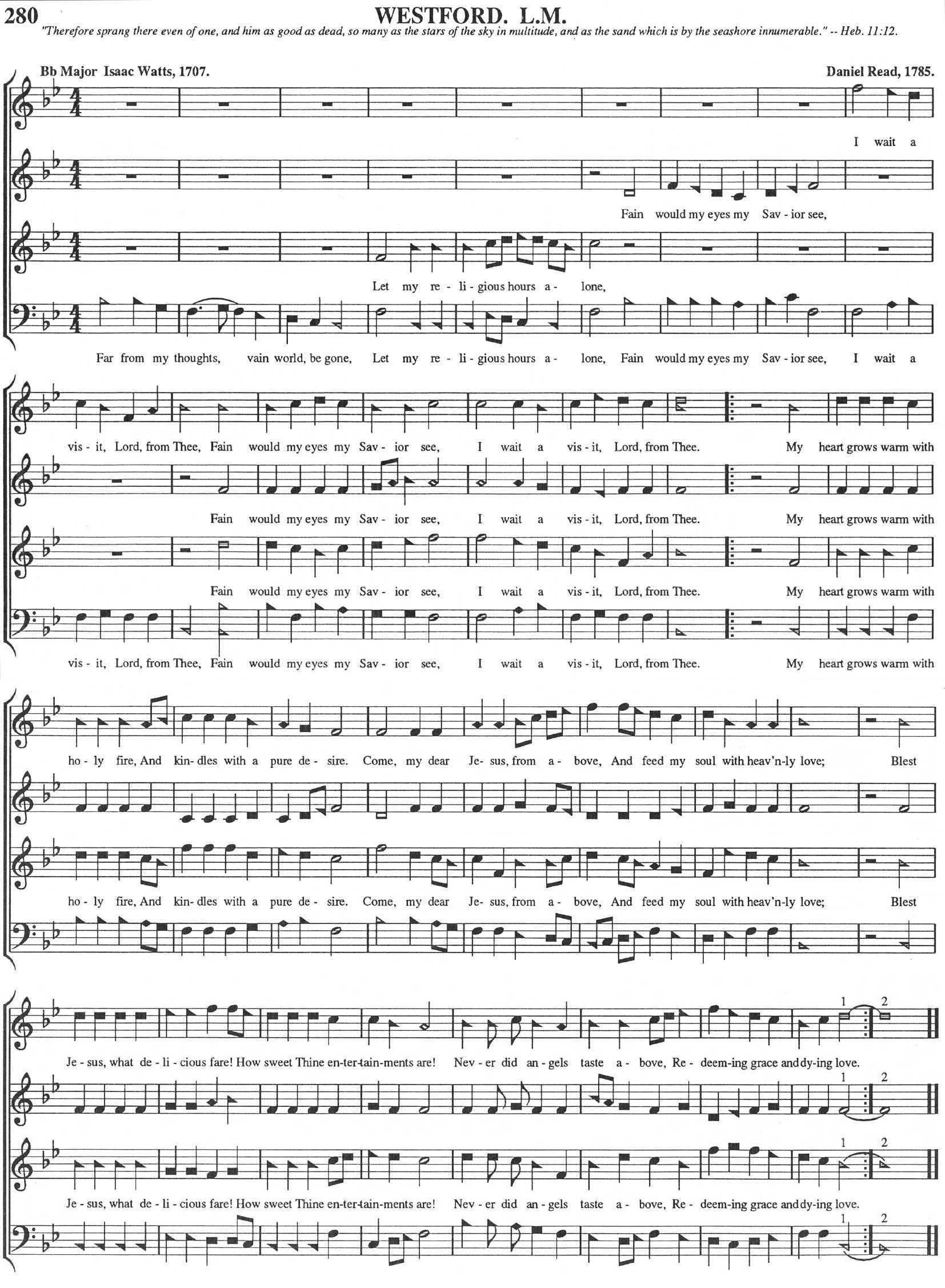
T. – Tripled; indicates a twelve-line stanza instead of four, as in L. M. T. – Long Meter Tripled (8/8/8/8/8/8/8/8/8/8/8/8). See Westford/Vain World Be Gone in The Sacred Harp. (“Tripled” is not very common.)
With Refrain – The hymn meter designation may be followed by the words “with refrain” – indicating a repeating refrain or chorus that does not follow the metrical pattern of the hymn itself. Similar designations are “With allelulias” and “With amens” indicating “allelulias” or “amen(s)” added to the end of the hymn.
Numerical Metrical Designations
7s. 6s. – Sevens and sixes; a quatrain with alternating lines of three and one-half feet and three feet, which rhymes in the second and fourth lines and sometimes in the first and third (7/6/7/6).
8s. 7s. 4s. – Eights, sevens and fours; a six-line stanza with alternating syllables of 8, 7, 8, 7, 4, and 7 (8/7/8/7/4/7). In practice (in singing) the four-syllable line is often repeated to create a line of eight syllables, and also the last two lines repeated. This enables the 8s. 7s. 4s. meter hymn to be sung with a doubled 8s. 7s. meter tune.
8s. 7s. – Eights and sevens; a trochaic quatrain with alternating lines of four feet and three and one-half feet, which rhymes in the second and fourth lines and sometimes in the first and third (8/7/8/7); also called Psalm Meter. Trochaic is one long syllable followed by one short syllable.
8s. – Eights; used to distinguish an eight-syllable quatrain that does not contain the iambic stress pattern characteristic of Long Meter (8/8/8/8).
11s. – Elevens; used to distinguish an eleven-syllable quatrain (usually anapestic, which may rhyme in either the first and second, third and fourth lines, or first and third, second and fourth (11/11/11/11).
12s. 11s. – Twelves and elevens. A four-line stanza with alternating lines of twelve syllables and eleven syllables (12/11/12/11).
12s. – Twelves; see “M. T.” above.
Summary
The more common designations (C. M., L. M., S. M.) are almost universally standard across hymn books. “Common Meter” is what it appears to be – the most common hymn meter used in English hymnody. In relation: (1) “Long Meter” is longer than “Common Meter” in its second and fourth lines; (2) “Short Meter is shorter than “Common Meter” in its first line. Some designations vary by editors, geography, and time periods. For example, William Gadsby’s A Selection of Hymns, for Public Worship includes the following designations: 104th for the 10.10.11.11 pattern; 112th for L. P. M.; 122nd for S. P. M.; and 148th for H. M. These metrical patterns were related to old psalm tunes. H. M. (6.6.6.6.8.8.) was the meter for the Old Version Psalm 148, and so, often 148th was used to identify this pattern. The same sort of history applies to the designations 104th, 112th, and 122nd. Some hymn-meter variations made by editors may intend to encompass rhyme patterns as well, but rhyme patterns (though often prevalent in a certain way) are not inherent in hymn meter designations.
Most of the numerical meter designations are fairly intuitive (the number equals the number of syllables per line). 10s has ten syllables per line; 9s has nine. Some are not as intuitive, however. For example, many books use the label 8.7.4. The actual pattern of the hymn is 8.7.8.7.4.7. An almost endless combination of numerical designations of meter could be assembled.
Both syllables and stress must be accounted for; but at the most basic level meter involves counting the number of syllables in a line of poetry. Amazing Grace is Common Meter: “A-ma-zing grace how sweet the sound” is 8 syllables; “That sav’d a wretch like me” is 6 syllables; “I once was lost but now am found” is 8 syllables; and “Was blind but now I see” is 6 syllables. Every Common Meter hymn and tune will follow that same pattern. If C. M. is written as C. M. D., or L. M. as L. M. D., etc., then that means the tune has enough music to sing two stanzas of a hymn instead of just one.
For another example, if you find a hymn labeled “11s”, a tune paired with the words “How firm a foundation, ye saints of the Lord” will likely work for singing that hymn.
Although any hymn of a particular meter can be sung with any tune of that same meter, the music of a particular song does not always seem fitting in mood for every hymn – even though it might work metrically. Also, the same number of syllables with different stress patterns will not fit well with the same tune. For example, compare “When I survey the wondrous cross” (Hamburg) with “How tedious and tasteless the hours” (Greenfields). They have the same number of syllables but different stress patterns.
In metrical hymn singing, there are tunes that have been passed down and have not been written down (or at least not in the forms in which they are sung). Songs from The Sacred Harp are good sources for tunes to set with the metrical hymns. Additionally, many hymnals will have a “Metrical Index” by which tunes may be found according to the meter in which they are written.
May the Lord bless this to be useful to someone.
Compiled by Robert Vaughn, initially in September 2006, with recent revisions and additions. Gathered from many sources over many years, so that little of what you read is original with me.
[ii] “Irregular” or “Irr.” seems to now be the more commonly preferred designation rather than “P. M.” for lines and/or meters that are not standard. On occasion “P. M.” seems to be used in place of multiplying the number of designations in a hymn book. For example, I have seen “P. M.” used in place of “H. M.” (6/6/6/6/8/8). The Psalter (Grand Rapids, MI: Wm B. Eerdmans Publishing Co., 1912/1927) includes two alphabetical metrical designations I have not commonly found – Common Hallelujah Meter (C. H. M., 8/6/8/6/8/8) and Long Hallelujah Meter (L. H. M., 8/8/8/6/8/6).
Sunday, December 15, 2024
God music did at once supply
“Johann Walter was the first Lutheran kantor, and was an advisor and colleague of Martin Luther. He desired that a holy and proper use of music in worship prevail in German churches. A poet as well as composer, Walter produced a lengthy, rhymed poem of 324 lines which describe his view of music’s importance in liturgy.” Cynthia Pock
“In 1538, while at Torgau, he published a rhymed homage to music, Lob und Preis der loeblichen Kunst Musica (In Praise of the Noble Art of Music), a didactic poem of 324 lines, in which he developed an entire theology of music, following the ideas of Luther’s scattered remarks on the subject. . . .
“Luther himself provided a rhymed introduction to this poem entitled ‘Vorrhede auff all gute Gesangbuecher’ (‘A Preface for All Good Hymnals’). Luther put his preface on the lips of Frau Musica (Lady Music) and had her extol her own gifts. Luther’s introduction, together with Walter’s more elaborately conceived poem, provide remarkable insights into the early Reformation’s view of music.” Carl Schalk
Johann Walter was born in 1496 at Thuringia, Germany. He died in 1570 at Torgau, Germany. He believed God created music; and his work influenced congregational participation in worship services. The stanza’s below are from an English translation of Walter’s hymn praising God and his music. As far as I know, it has not been used as a church hymn.
(Which God from love for all our race
Had promised in his word) might be
Kept fresh in human memory
And move the heart to high delight
In praising God both day and night—
God music did at once supply.
Then too, since sin acquired at birth
Would bring to Adam’s seed on earth
Much woe and—earth itself now spoiled—
Small joy in all for which they toiled,
As antidote against that blight,
To keep man’s life from wilting quite,
And also to rejoice the heart,
God soon supplied sweet music’s art.
Saturday, September 28, 2024
An Explanation, and other music links
- An Explanation of The Sacred Harp -- “J. S. James shares his opinion concerning his and the other Sacred Harp revisions.”
- Awake Thy Soul: Singing the Centuries-Old ‘Sacred Harp’ in Baltimore -- “Raucous at times, haunting at others, shape-note singing can come across as an indecipherable wall of sound at first because of its polyphonic harmony singing.”
- Biblical Standards for Musical Choices -- “Our music should also be spiritual rather than carnal. Much of today’s music is simply Pop, Rock and Roll, or Country Music repackaged with a religious theme.”
- Bruce Johnson Sacred Harp Recordings -- “Recordings made by Bruce Johnson of Morgan County, Alabama, in the 1950s.”
- Buck Owens: From Sherman Sharecropper to the Bakersfield King -- “...during the 1960s and 1970s Owens soared to a level of success and influence that had scarcely been experienced by other country stars.”
- Charles Wesley and the Hymns of Methodism -- “The hymnody of the Wesley brothers, Charles and John, has resulted in some of the best-loved hymns within the Christian tradition.”
- Earthquake hymn 354t LEBANON -- “In the final months of 1755...a great earthquake in Lisbon that killed tens of thousands of people and destroyed most of the city...”
- How Sacred Harp Singing Took Shape in Texas -- “For Texan singers, culinary hospitality is a point of pride. Anyone fortunate enough to attend a Texas all-day singing or convention will be hard-pressed to come away hungry.”
- J. T. Allison’s Sacred Harp Singers -- “...the 1927-1928 recordings by J. T. Allison’s ensemble represent a curious anomaly...of the convergence of two important cultural movements of the southeastern U.S.-the emerging country music recording industry and the impressive tradition of singing religious folk music from shape-note tunebooks...”
- Our Treasury of Medieval Hymns -- “By the fifteenth century, themes congenial to Luther’s coming Reformation were already being sung, such as the text attributed to the Imitation of Christ author Thomas à Kempis.”
- Singing is good for you. Singing with others may be even better. -- “The ‘Sing With Us’ study...linked singing in the choir to reduced stress hormones and increased cytokines, proteins that can boost the body’s ability to fight serious illness.”
- The Colored Sacred Harp -- “Compiled by Judge Jackson of Ozark, Alabama.”
- The Sacred Harp Cookbook? Which one? -- “But there’s not just ONE, I know of THREE different ‘Sacred Harp Cookbooks’...”
- Traveling to Camp -- “The camp meeting was an innovation of the Second Great Awakening in the United States in the early 19th century.”
Saturday, August 24, 2024
No melody without music, and other music quotes
The posting of quotes by human authors does not constitute agreement with either the quotes or their sources. (I try to confirm the sources that I give, but may miss on occasion; please verify when possible.)
“The best, most beautiful, and most perfect way that we have of expressing a sweet concord of mind to each other is by music.” -- Jonathan Edwards
“We cannot have a melody without music, nor can we have divine record of God speaking without words.” -- John MacArthur
“Since the largest book in the Bible is a songbook, we see the importance of sacred music before God.” -- David Cloud
“The hymn was the prayer of the penitent, and the hallelujah of the redeemed.” -- George C. Loud, Evangelized America
“Music is God’s gift to man, the only art of Heaven given to earth, the only art of earth we take to Heaven.” -- Walter Savage
“Next to the Word of God, the noble art of music is the greatest treasure in the world.” -- Martin Luther
Saturday, June 15, 2024
A mega-mechanism, and other music & worship links
- ‘A mega-mechanism for bonding’: why singing together does us good -- “What draws people to singing, and the benefits it brings, have been the subject of research for centuries.”
- Amazing Grace: The Story of William “Singing Billy” Walker -- “‘Singing Billy’ Walker” was a South Carolinian, a Baptist church member, song-leader, music teacher, composer, and tunebook compiler.
- Elton Britt - New London School Tragedy [1937] -- “Written by Bob Miller, and recorded 24 March 1937 in ARC Recording Studio by Elton Britt.”
- Glorious Things of Thee Are Spoken, by John Newton -- “John Newton and William Cowper wrote hymns to be sung at the weekly evening prayer meetings. John suggested that the two of them compile a collection of hymns.”
- “If Thou but Suffer God to Guide Thee”: The Journey of a Lutheran Hymn. -- “Neumark’s hymn was apparently based ont only on Psalm 55:23, but also on the Epistle for the fifth Sunday after Trinity, 1 Peter 3:8-15.”
- J. H. Carter Sacred Harp Recordings -- “Playlist of Sacred Harp recordings made by J. H. Carter of Jamestown, Alabama, 1955-1959.”
- Jeffress/Phillips Music Company -- “The Jeffress/Phillips Music Company, located in Crossett (Ashley County), is one of the five remaining seven-shape gospel publishing companies in the United States and is the sole seven-shape gospel publisher in the state of Arkansas.”
- Losing the Songs of Zion -- “We often reveal how man is perverting the words of God in the new versions of the Bible, but our old hymns are also changing.”
- Luther’s Battle Song “Ein feste Burg ist unser Gott” -- “In looking over the translations of our hymn, we find that the largest number was made into English.”
- Sacred Harp Singing: History & Tradition -- “While ‘harp’ is an old word for a sacred tunebook containing music, in a broader sense, the ‘sacred harp’ is the human voice or ensemble of voices.”
- Shape Note Singing: Christian Harmony in Newton County, Mississippi -- “The Newton County Christian Harmony Convention was organized in 1875 and is believed to be the oldest continuing Christian Harmony convention.”
- Singing Billy Walker and Amazing Grace -- “From footnotes to several songs in Walker’s hymnbooks, we learn that Susan Jackson Walker taught him songs when he was a small child, and he apparently listened deep and long.”
- The History Of Singing Hymns -- “The Goat Yard church now entered a period of strife which was to last well over a decade in which Keach argued that ‘singing in rhyme’ was the ‘public duty’ of all Christians and Marlow argued just as energetically that the New Testament recognized no such duty.”
Wednesday, May 29, 2024
The Socialist Singing Orator: Prof. E. F. Stanton
Introduction
“Rev. E. F. Stanton is styled the ‘singing orator’ and is an ordained minister of the Baptist church.”[i]
In my rambles of research, I ran across an “odd duck” – a preacher and music teacher who was also a lecturer on the Socialist circuit in the early 1900s. This seemed sort of incongruous to me. Here is a bit of the story of Ernest F. Stanton.
Birth/Family/Marriage/Children
Ernest F. Stanton was born in Alabama in March of 1864, to parents William Henry Stanton and Elmyra Antoinette Phillips. Born in Georgia, they married in Alabama, before eventually coming to Arkansas and finally Comanche County, Texas.
E. F. married Florence Zeriah Sturkie of neighboring Erath County, on May 12, 1887 in Erath County, Texas. They had nine children, including Henry Eugene Stanton (1892–1956), Paul Otis Stanton (1894–1969), Cora Stanton Wattenberger (1898–1949), Lawrence Edwin Moore Stanton (1900–1996), Emmette Owen/Olen Stanton (1903–1965), and four whose names are lost to posterity. Based on the 1900 and 1910 censuses, the Stantons lost four children between the time of their marriage in 1887 and the 1900 census taken June 9, 1900.[ii]
Ernest and Florence Stanton made an unfortunate splash in Oklahoma newspapers in the second decade of the 20th century, when he filed for divorce in February 1916.[iii] This was reported all across the state. This action may have been dismissed, as his wife later sued for divorce in 1919 “on the grounds of Desertion and gross neglect of duty.”[iv]
Ernest F. Stanton in U. S. Federal Censuses:
- 1870 Opelika, Lee County, Alabama; At home
- 1880 6th district, Comanche County, Texas; At home, farmer
- 1900 Duke, Greer County, Oklahoma; Music, vocal & instrumental
- 1910 Wellington, Collingsworth County, Texas; Teacher of music
- 1920 War Eagle, Benton County, Arkansas; Music Teacher
- 1930 Precinct 5, Smith County, Texas; Teacher, music
Newspaper mentions suggest Stanton moved a lot and lived in a number of other places, including in Arkansas: Larue (ca 1923); Oklahoma: Duke (ca 1902);[v] Davidson (ca 1907),[vi] Oklahoma City (ca 1907), Altus (ca 1911),[vii] Hobart (ca 1916) Lone Wolf (1918); Texas: Gorman (ca 1905), Wellington (ca 1910),[viii] Hamlin (ca 1912), Rochester (ca 1912), Smith County (1914). It is possible, however, that the newspaper reports could have gotten some of the locations wrong. Additionally, this may indicate places he lived temporarily as he traveled to teach and lecture. His death certificate (1934) states, suggests, or at least implies that his residence was in Hood County, Texas before he entered the Austin State Hospital.[ix] He had been a resident at the State Hospital for four months and 10 days (from 6/27/1934) at the time of his death (11/7/1934).
His Work
Ernest F. Stanton was a music teacher, songwriter, Baptist minister, debater, and socialist lecturer (he was listed as a farmer in the 1880 census). He actively participated in gospel singing conventions. He compiled the song book Home and Church Songs, and perhaps others. He served as an assistant editor on some other songbooks, such as Our Thankful Songs: a New Collection of Choice Gospel Songs for Prayer, Praise, and Gospel Meetings, by the A. J. Showalter Company.
Singing schools.
In connection with his music work, Stanton itinerated to teaching singing schools. For example, he taught in Proctor, Texas in 1892; Prairie Home, Oklahoma in 1900; Quartz, Oklahoma in 1902; Martha, Oklahoma in 1904: Durant, Oklahoma in 1913; Cameron, Oklahoma in 1923; Fairview, Oklahoma in 1925. These probably only represent a small portion of the singing schools he taught. In connection with this work, he was often called “Professor E. F. Stanton.” His primary fields of labor were Texas and Oklahoma.
Orator.
E. F. Stanton is labeled as a Baptist minister on several occasions. There is no evidence that he was ever a pastor, and his primary religious work was probably itinerant evangelism. Additionally, most newspaper accounts of his oratory skills refer to lectures on the subject of Socialism – suggesting he was more of an evangelist for social reform than religious revival.
When Stanton lectured at the schoolhouse at Texola, Oklahoma in 1907, the reporter found the auditors listening attentively to the entire speech, except for a “few of the younger persons who like fiction more than facts, fun more than logic” who left the building when the lectures began.[x] Likewise a Socialist Justice periodical that same year described that in a courthouse speech “For two hours the ‘Singing Orator’ held the audience spell-bound with the glorious Gospel of Socialism.” Stanton himself wrote that he “Lectured at one place before a large audience. Every man was converted to Socialism except one old man who just returned from the asylum.”[xi]
A blurb in a Pentecostal Church of the Nazarene periodical in 1918 suggests that E. F. Stanton might have been connected with that denomination at the time. On the other hand, it may be that Stanton was only ever loosely connected to the Baptists, and that his moving ministry was inclusive of all denominations.
Herald of Holiness (Kansas City, Missouri), Vol. 6, No. 45, February 13, 1918, p. 16
Debate.
Stanton engaged in debates promoting Socialism. (Newspapers mention some that failed to make.) In 1910 a four-days debate with J. L. Davis rendered for Socialism “a powerful victory,” gaining 20 new members to the Wilmoth, Oklahoma local Socialist group.[xii] I found no records of religious debates.
Other.
E. F. Stanton authored several booklets, including The Fall of Babylon (possibly a poem) and What Socialism Is and Why It Should Prevail (Gerard, KS: Appeal to Reason, 1909).
In 1910, Stanton applied for and received a patent on a crude oil burner.
In 1918, the Herald of Holiness blurb calls Stanton the president of the Stanton Art Company.
- Report of the Eastland County Singing Convention, April 8, 1905
- Report of the Nickle Hill Singing Convention, May 20-21, 1905
- Report of the Carbon District Singing Convention, May 27-28, 1905
Death
Ernest F. Stanton traveled extensively in Oklahoma, Texas, and Arkansas – and perhaps other places not now known. He seems to have been most active in Oklahoma. Perhaps the people of this young state overall were more friendly to his Socialist views. It is not hard to imagine how this belief could have hindered him in this period. Many Christians associated Socialism with atheism. In the context of challenging Stanton to debate, Luther Roberts also announced an address on the subject in which he would “charge, and prove, that socialism was hatched in atheism and that it is today atheistic and anti-religious.” [xiii]
Stanton’s life ended in the state where it began, Texas. He spent the last four months (and 10 days) of his life at the Austin State Hospital, Travis County, Texas, and died while there. His death certificate says he is buried there in the State Asylum Cemetery. Thus ended the career of the Socialist Singing Orator.
Three songs by E. F. Stanton
[ii] I searched Find-A-Grave and did not find any likely burials on that site for these children.
[iii] He complained that she was “nervous, quarrelsome and irritably disposed” to such a degree “to break up his health and injure his mental equilibrium and physical health.” “Enough After 29 Years,” The Weekly Democrat-Chief (Hobart, Oklahoma), Thursday, February 17, 1916, p. 1.
[iv] “Suit for Divorce,” The Mangum Star, Thursday, December 18, 1919, p. 3. The divorce may have been granted, as he is not in the censuses with his wife in 1920 and 1930, or they may have simply lived as separated. E. F. Stanton is listed as “widowed” in those censuses (his wife was not dead), and “separated” on his death certificate.
[v] “23 Years Ago,” Altus Times-Democrat, Friday, December 25, 1925, p. 10.
[vi] “Who Opposes Socialism,” Justice (Duncan Oklahoma), Friday, June 7, 1907, p. 6. It is possible that Davidson was not where he lived, but where he was on his lecture circuit when he wrote to the newspaper. (Justice appears to be a Socialist newspaper.)
[vii] Altus Weekly News, Thursday, June 8, 1911, p. 2.
[viii] Ibid.
[ix] “Hood County, Texas” is entered over the line “If non-residence give city, or town and state.” For profession, the death certificate lists “Laborer.” This must be information collected from his records at the hospital, since the informant is “Austin State Hospital Records.”
[x] “Noted Musician Lectures Here,” The Texola Herald, Friday, August 9, 1907, p. 1.
[xi] “Who Opposes Socialism,” Justice (Duncan Oklahoma), Friday, June 7, 1907, p. 6.
[xii] “Debate At Wilmoth,” The Oklahoma Pioneer (Oklahoma City), Saturday, December 17, 1910, p. 3; The debate was held at the Cottonwood Schoolhouse near Wilmoth, beginning November 21, 1910, “on the question: ‘Resolved, That Socialism Would be to the Best Interest of the People of the United States.” Stanton favored, and Rev. J. L. Davis of Bluffdale, Texas opposed. “Debate Near Wilmoth,” The Oklahoma Pioneer, Saturday, November 12, 1901, p. 4.
[xiii] “Speaking at Teacross,” Hollis Post-Herald, Thursday, January 26, 1911, p. 1.
Wednesday, April 10, 2024
A Church’s Music
It seems to a large degree I have lost or failed to keep up with a part of the original focus of this blog – “Music.” Below is an interesting exposition of the church music at Refuge Reformed Church of Ogden, Utah. Pastor Brian Sauvé explains the church’s Sunday music program. I do not know this church or its pastors. (Therefore, this is not intended as a personal recommendation. It is a topic of interest.)
[Q.] “How do you do music at your church on Sundays?”
[A.] Here’s the breakdown:
We sing almost exclusively from the Cantus Christi 2020 hymnal, accompanied by a piano. Most of the settings are in four-part harmony.
We don’t amplify anything. I conduct the congregation from the front, but don’t sing into a microphone. Sometimes I sing the melody, but often I sing the Tenor part.
We sing 10 songs per service. Three of them stay the same each week (David Erb’s setting of Psalm 134, The Lord’s Prayer, and the Doxology).
The other seven usually consist of about five Psalms and two hymns. These are scattered at different points of the service, including two that we sing seated during the distribution of the bread and wine for Communion.
Why we sing in four parts:
1. It allows men to sing like men, women to sing like women, children to sing like children.
2. It takes effort. We don’t want to offer to the Lord that which costs nothing.
3. It is objectively beautiful, far more so than the best contemporary worship band I’ve ever heard—and we’re not even particularly gifted or anything.
4. Much of the great musical inheritance of the Church is in parts. Lose this skill and you lose access to the richness of that blessing.
How we learn to sing songs in parts:
Every Tuesday evening, barring the last Tuesday of the month, we have a potluck followed by a Psalm-singing workshop. I use the “Sing Your Part” app to teach each group their parts, then we practice. The actual practice is only 45 minutes, so the whole thing only takes 90 minutes each week.
We typically have about 50% of our Sunday attendance at Psalm sing on Tuesdays. This lets us learn, on average, one new song per month.
I couldn’t even read music when we started learning this stuff. Any church [can] do this if they decide to.
[Originally written in an X post on July 24, 2023, by Brian Sauvé.]
Saturday, February 10, 2024
3rd Annual Sacred Harp Singing, and other music links
- 3rd Annual Sacred Harp Singing -- “Following is a report of 3rd Annual Sacred Harp Singing, held at Campbell’s Cross Roads, Clay county, Ala., July 18th, 1926.”
- All Hail the Power of Jesus’ Name! - Edward Perronet -- “This hymn’s popularity is evident because it appears in many hymnals with three different tunes.”
- Benson Collection of Hymnals and Hymnology -- “A list of links to books in the Benson Collection.”
- Hebrew Shema / Deuteronomy 6:4-6 Chant / Trope / Cantillated -- “So what does the Shema and the following two verses sound like when sung or chanted following the Hebrew accent marks?”
- Kardia Music -- “Kardia Music Theory Resources and Courses.”
- Little Is Much When God Is in It - Kittie Suffield -- “The place of service may seem insignificant, but ‘it is great if God is in it.’”
- McGough Family Documents -- “Shown below are two portions of John McGough’s son-in-law’s (Perry Nelson) 1818 song book.”
- Praise, My Soul, the King of Heaven, by Henry Francis Lyte -- “Published in 1834, ‘Praise, My Soul, the King of Heaven’ was inspired by Psalm 103. The opening stanza reflects on the first five verses of the Psalm.”
- Reformation Hymns -- “‘Bar form’ was a common musical form that was nurtured in the Church. It is a form consisting of two identical musical lines followed by a contrasting section: AAB. Many of Luther’s hymns, like ‘A Might Fortress,’ are written in this form, which has nothing to do with taverns.”
- Sacred Harp Sing Returns to Baylor University Joining Voices in Four-Part Harmony -- “Human voices come together without instruments or rehearsal...is returning to Baylor University after a two-year hiatus.”
- Silent Night! Holy Night! - Josef Mohr -- “Just before Christmas in 1818, in the small village of Oberndorf, Austria, it was discovered the church’s organ was broken.”
- Singing the Psalms -- “Since the largest book in the Bible is a songbook, we see the importance of sacred music before God.”
- Strings Attached -- “David Getman was working in a music store in Brooklyn, New York, in 1997 when a friend gave him a box of banjo parts. The friend suggested that he see what he could make with the pieces.”
- The Christian’s song, written by a young lady: together with a hymn called Love to Christ -- “The claim on the broadside that the song was ‘written by a young lady’ applies to the second song on this sheet, ‘Love to Christ.’”
Saturday, September 09, 2023
Pilsbury’s The United States Sacred Harmony
A recent addition to the Archive.org book family:
- The United States Sacred Harmony, Amos Pilsbury, Boston, MA: Isaiah Thomas and Ebenezer Andrews, 1799.
Additionally, there is an article about this book in The Hymn, July 1981:
- “A Yankee Tunebook from the Old South: Amos Pilsbury’s The United States Sacred Harmony,” by Karl Kroeger.
And this one is American Music, Winter 1995:
- “Seven ‘New’ Tunes in Amos Pilsbury’s United States’ Sacred Harmony (1799) and Their Use in Four-Shape Shape-Note Tunebooks of the Southern United States before 1860,” by David W. Music (must log in to JSTOR.org to read)
Thanks to Barry Johnston!
Amos Pilsbury was born in Massachusetts in 1772, and died in 1812 in Charleston, South Carolina. In addition to being a composer and book compiler, he was a schoolteacher, silversmith, and a clerk in the Presbyterian Church. In 1809 he published a collection of hymn texts titled The Sacred Songster: or, a Collection of Hymns and Spiritual Songs, For the Use of Religious Assemblies (Charleston, SC: G. M. Bounetheau). Apparently he was also a music teacher, and his Find-A-Grave memorial suggests he preached at the Methodist Church in the years prior to his death.
The Charleston Mercury, November 3, 1828, p 3