Translate

Showing posts with label Hymnody. Show all posts

Thursday, April 16, 2026

Religious effect of a hymn

When Joshua Leavitt sent out The Christian Lyre, he testified that “the work is not designed to please scientific musicians, so much as to profit plain christians…” He generally gave a melody and bass for the tune, but sometimes only the melody, writing, “As the number of parts is apt to distract the attention of an audience, or to occupy them with the music instead of the sentiment, the tunes here printed will generally be accompanied with only a simple bass, and sometimes not even with that. In a vast multitude of cases the religious effect of a hymn is heightened by having all sing the air only.”

He also possesses a good attitude about its future: “Possessing no musical skill beyond that of ordinary plain singers, I send out my work, without pretensions. If it aids the progress of Christ’s cause, I shall be rewarded. If not, I shall be accepted according to what I had, and not according to what I had not. And it will prepare the way for some other person to do it better.” (Preface, page 3)

Tuesday, January 07, 2025

Hymn Meter Explanations and Information

Hymn Meter Explanations and Information

“Hymn meter” is the pattern of syllables and stress in the text of a hymn. The meter designations in hymn books relate to the syllables, meter, or “feet” of the poetry. A hymn of a certain meter (Common Meter = C. M., for example) can be sung with any tune of that same meter. Knowing the metrical symbols and matching hymns to tunes are knowledge and skills needed for hymn-book singing.

Alphabetical Metrical Designations

C. M. – Common Meter; a quatrain (four-line stanza) with alternating lines of iambic tetrameter and iambic trimeter, which usually rhymes in the second and fourth lines and sometimes in the first and third (8/6/8/6); also called Ballad Meter in other contexts. Iambic is one short or unaccented syllable followed by one long or accented syllable.

C. M. E. – Common Meter Extended; a five-line stanza in which most commonly the first, third, and fourth lines rhyme, and the second and fifth lines rhyme. C. M. E. is like C. M. except that it is “extended” with an extra line of 8 syllables (8/6/8/8/6). 

C. P. M. – Common Particular Meter; a six-line stanza of which the first, second, fourth and fifth lines are iambic tetrameter, and the third and sixth lines are iambic trimeter (8/8/6/8/8/6). 

D. – Doubled; indicates an eight-line stanza instead of four, as in C. M. D. or D. C. M. – Common Meter Doubled or Doubled Common Meter (8/6/8/6/8/6/8/6). 

H. M. – Hallelujah Meter; a six-line stanza of which the first four lines are trimeter and the last two are tetrameter, which rhymes most often in the second and fourth lines and the fifth and sixth lines (6/6/6/6/8/8). At times this may be instead listed as (6/6/6/6/4/4/4/4).

L. M. – Long Meter; a quatrain (four-line stanza) in iambic tetrameter, which usually rhymes in the second and fourth lines and often in the first and third (8/8/8/8).

L. P. M. – Long Particular Meter; a six-line stanza of iambic tetrameter (8/8/8/8/8/8). 

M. T. (or 12s.) – Meter Twelves; a quatrain in anapestic hexameter (12/12/12/12). Anapestic is two short syllables followed by one long syllable.[i] 

P. M. – Particular Meter, Peculiar Meter; Psalm Meter; sometimes may stand for Psalm Meter (but this is more commonly known as 8s. 7s.); it usually means Particular Meter, or Peculiar Meter (these two indicating poetry with its own particular, peculiar, or non-standard, meter).[ii]  

S. M. – Short Meter; iambic lines in the first, second, and fourth are in trimeter, and the third in tetrameter, which rhymes in the second and fourth lines and sometimes in the first and third (6/6/8/6). 

S. P. M. – Short Particular Meter; a six-line stanza of which the first, second, fourth and fifth lines are iambic trimeter, and the third and sixth lines are iambic tetrameter (6/6/8/6/6/8).

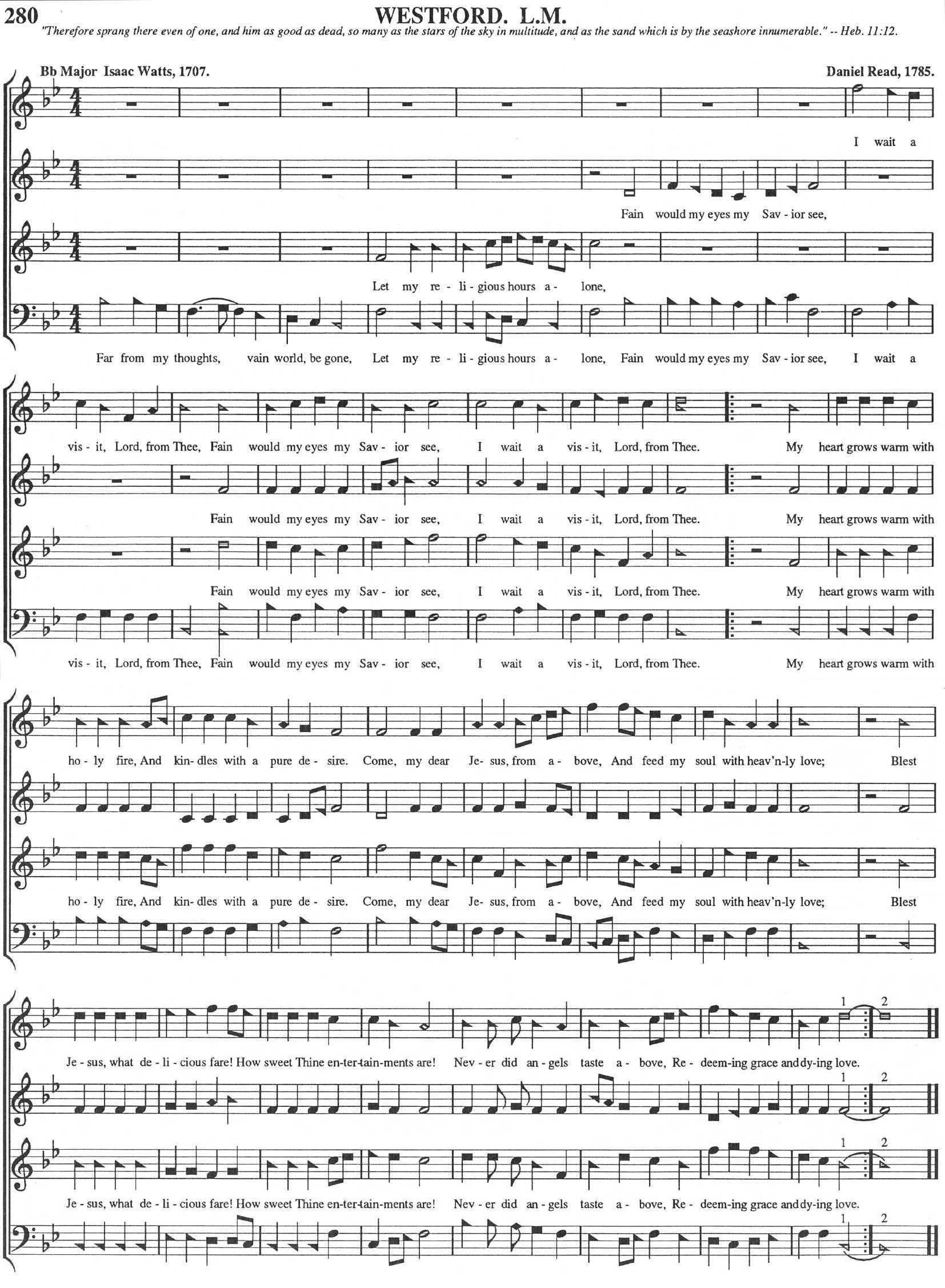
T. – Tripled; indicates a twelve-line stanza instead of four, as in L. M. T. – Long Meter Tripled (8/8/8/8/8/8/8/8/8/8/8/8). See Westford/Vain World Be Gone in The Sacred Harp. (“Tripled” is not very common.)

With Refrain – The hymn meter designation may be followed by the words “with refrain” – indicating a repeating refrain or chorus that does not follow the metrical pattern of the hymn itself. Similar designations are “With allelulias” and “With amens” indicating “allelulias” or “amen(s)” added to the end of the hymn.

Numerical Metrical Designations

7s. 6s. – Sevens and sixes; a quatrain with alternating lines of three and one-half feet and three feet, which rhymes in the second and fourth lines and sometimes in the first and third (7/6/7/6).

8s. 7s. 4s. – Eights, sevens and fours; a six-line stanza with alternating syllables of 8, 7, 8, 7, 4, and 7 (8/7/8/7/4/7). In practice (in singing) the four-syllable line is often repeated to create a line of eight syllables, and also the last two lines repeated. This enables the 8s. 7s. 4s. meter hymn to be sung with a doubled 8s. 7s. meter tune.

8s. 7s. – Eights and sevens; a trochaic quatrain with alternating lines of four feet and three and one-half feet, which rhymes in the second and fourth lines and sometimes in the first and third (8/7/8/7); also called Psalm Meter. Trochaic is one long syllable followed by one short syllable.

8s. – Eights; used to distinguish an eight-syllable quatrain that does not contain the iambic stress pattern characteristic of Long Meter (8/8/8/8). 

11s. – Elevens; used to distinguish an eleven-syllable quatrain (usually anapestic, which may rhyme in either the first and second, third and fourth lines, or first and third, second and fourth (11/11/11/11).

12s. 11s. – Twelves and elevens. A four-line stanza with alternating lines of twelve syllables and eleven syllables (12/11/12/11).

12s. – Twelves; see “M. T.” above.

Summary

The more common designations (C. M., L. M., S. M.) are almost universally standard across hymn books. “Common Meter” is what it appears to be – the most common hymn meter used in English hymnody. In relation: (1) “Long Meter” is longer than “Common Meter” in its second and fourth lines; (2) “Short Meter is shorter than “Common Meter” in its first line. Some designations vary by editors, geography, and time periods. For example, William Gadsby’s A Selection of Hymns, for Public Worship includes the following designations: 104th for the 10.10.11.11 pattern; 112th for L. P. M.; 122nd for S. P. M.; and 148th for H. M. These metrical patterns were related to old psalm tunes. H. M. (6.6.6.6.8.8.) was the meter for the Old Version Psalm 148, and so, often 148th was used to identify this pattern. The same sort of history applies to the designations 104th, 112th, and 122nd. Some hymn-meter variations made by editors may intend to encompass rhyme patterns as well, but rhyme patterns (though often prevalent in a certain way) are not inherent in hymn meter designations.

Most of the numerical meter designations are fairly intuitive (the number equals the number of syllables per line). 10s has ten syllables per line; 9s has nine. Some are not as intuitive, however. For example, many books use the label 8.7.4. The actual pattern of the hymn is 8.7.8.7.4.7. An almost endless combination of numerical designations of meter could be assembled. 

Both syllables and stress must be accounted for; but at the most basic level meter involves counting the number of syllables in a line of poetry. Amazing Grace is Common Meter: “A-ma-zing grace how sweet the sound” is 8 syllables; “That sav’d a wretch like me” is 6 syllables; “I once was lost but now am found” is 8 syllables; and “Was blind but now I see” is 6 syllables. Every Common Meter hymn and tune will follow that same pattern. If C. M. is written as C. M. D., or L. M. as L. M. D., etc., then that means the tune has enough music to sing two stanzas of a hymn instead of just one.

For another example, if you find a hymn labeled “11s”, a tune paired with the words “How firm a foundation, ye saints of the Lord” will likely work for singing that hymn.

Although any hymn of a particular meter can be sung with any tune of that same meter, the music of a particular song does not always seem fitting in mood for every hymn – even though it might work metrically. Also, the same number of syllables with different stress patterns will not fit well with the same tune. For example, compare “When I survey the wondrous cross” (Hamburg) with “How tedious and tasteless the hours” (Greenfields). They have the same number of syllables but different stress patterns.

In metrical hymn singing, there are tunes that have been passed down and have not been written down (or at least not in the forms in which they are sung). Songs from The Sacred Harp are good sources for tunes to set with the metrical hymns. Additionally, many hymnals will have a “Metrical Index” by which tunes may be found according to the meter in which they are written.

May the Lord bless this to be useful to someone.

Compiled by Robert Vaughn, initially in September 2006, with recent revisions and additions. Gathered from many sources over many years, so that little of what you read is original with me.


[i] Dactylic feet/stress is the reverse of Anapestic, having one long accented syllable followed by two short syllables, and might be found in some hymns.
[ii] “Irregular” or “Irr.” seems to now be the more commonly preferred designation rather than “P. M.” for lines and/or meters that are not standard. On occasion “P. M.” seems to be used in place of multiplying the number of designations in a hymn book. For example, I have seen “P. M.” used in place of “H. M.” (6/6/6/6/8/8). The Psalter (Grand Rapids, MI: Wm B. Eerdmans Publishing Co., 1912/1927) includes two alphabetical metrical designations I have not commonly found – Common Hallelujah Meter (C. H. M., 8/6/8/6/8/8) and Long Hallelujah Meter (L. H. M., 8/8/8/6/8/6).

Tuesday, September 17, 2024

Worship in Hymns

WORSHIP IN HYMNS 
By Robert Inman Johnson

This essay first appeared in The Tie, a monthly publication of Southern Baptist Theological Seminary, Louisville, Kentucky, circa 1948. The Seminary’s professor of Music, R. Inman Johnson, wrote “Worship In Hymns.”. I have not seen the original, but have taken this digested version from The Word and Work, April 1948, Volume XLII, pp. 88-90. Posting this is not an endorsement of everything Johnson writes in the essay. Nevertheless, he makes some good points, and I think you will find it an interesting representation of music and hymnology taught by Southern Baptists in the mid-20th century. Everything below is by R. Inman Johnson.

Hymns have been said to be directed toward God, toward the Christian (including ourselves), or toward the sinner. To God we sing our praise and thanksgiving and pour out our songs of aspiration, petition, and promise of faithfulness. For the Christian we sing songs of encouragement and lift each other in prayerful tones to God. To the sinner we show our love for God, His love for the sinner, and plead for the sinner’s acceptance of this love. These are high and holy ideals. Hence, we should give attention to the singing part of the service. 

We do not undertake to define “worship service” beyond saying it should result in an awareness of our relationship to God and His purpose for our lives. True it is that God may be met anywhere, in the sanctuary, in the street, or in the field. We may worship alone or as a component part of a congregation. To be a member of a congregation which gives itself to intense worship is a thrilling experience. We go away saying that God has been with us. 

Corporate worship must be directed through man by the Holy Spirit. There must be both preparation and correct performance. A real worship period does not just happen. We need to know how to prepare a service and the people need instruction in their responsibilities. The fact is, the preachers have not taught the people how to worship. Surely it is worthwhile, for only true worship promotes real spiritual growth. 

In choosing hymns for a service, we need to know the contents of the hymnal as related to the needs of the people. And, they should be chosen for a definite purpose, with some relationship of ideas. This idea may correspond with the ideas in the sermon or it may not. Certainly it should not be foreign or antagonistic to the sermon. Seldom do I know the sermon subject beforehand and I am often amazed at the fitness of my selections. If you ask, the Holy Spirit will help you choose the hymns. In evangelistic meetings, I usually wait to choose the invitation hymn until I see where the sermon is headed. 

In preparing ourselves to sing we need to remember that most good hymns represent a spiritual experience in the life of the writer. By our singing we make this experience our own. We should thrill with the idea that thousands of saints before us have sung the text and thousands will sing it after us. Thus we are members of one great choir which one day shall be gathered before the throne of God to sing eternal hallelujahs. What a privilege to join that choir of heavenly witnesses. 

If, then, in corporate singing we share the spiritual life of others, we should see to it that we grow in grace through a wide variety of experience. Often we fail here because we want good singing; hence, we choose over and over a few hymns the people sing well. New hymns and tunes should be introduced to deepen our Christian experience. 

For instance, in 58 chapel services and broadcasts we have sung 157 different hymns. This is a large number when compared with the average church repertoire. I have a typewritten copy of the index of the hymnal. When a hymn is selected, the date is written after it on this copy. Thus, too frequent repetition is prevented. In the limited church program, a hymn should not appear more than once per month. 

Many ideas may be followed in selecting hymns. Usually, when three hymns are used before the sermon, the first is a strong hymn of praise. The second spot may be used to introduce new or less familiar texts and tunes. Also, I like here the short hymns of definite worship value set to such tunes as Manoah, Bera, Belmont, St. Agnes, etc. They have both beauty and strength. The third hymn may be more subjective with a sense of individual devotion, consecration or aspiration. It should be thoroughly familiar. The fine gospel hymns are well placed here. 

Remember also that these three hymns should vary in key signature, mood and pace. It is tiring to sing consecutive songs in the same key and at the same rate of speed. Start with a good tempo, the next may be slower. The mood may change from objective praise to subjective examination of our own hearts. For instance, using the idea of serving Christ: 1. We praise Him with “Crown Him with Many Crowns.” 2. In a slower tempo and quite different quality of tone, we consider our relation to Him in “Must Jesus Bear the Cross Alone.” 3. In a stronger rhythm we make our promise in “O Jesus, I have promised to serve thee to the end.” 

The manner of our singing has much to do with its effectiveness for ourselves and for others. Ineffective singing is by no means confined to the small rural church but is to be found in all classes of churches. It most often is the result of a lack of understanding on the part of the people of the worship value of hymns. God desires our hearts and minds, not merely the sacrifice of attendance on His services. Many of us go to church merely to hear the sermon, having no interest in the praise service. Many are too tired physically and mentally to sing, not realizing that a thrilling spiritual experience by means of a great hymn will completely remove this burden of fatigue. Our poor singing may be due sometimes to the hymns themselves, which may depict experiences quite foreign to our own and which, furthermore, give a situation in which we cannot conceive ourselves. Hence, congregational hymns should contain universal experiences, those to which we are all subject. This is true of the hymns which survive the test of years. A song which is local or limited in subject matter to a small group may be popular for a time but not for long. 

Again, poor singing may result from a poor fit of hymn and tune. A joyful hymn set to a doleful tune loses much of its worth for us. Likewise, a superficial tune may destroy the value of a noble hymn. 

…Many other things may enter to cause poor singing, such as acoustics, temperature, stuffy atmosphere, etc. I am convinced that the most intelligent congregational singing requires a director or precentor. By this I mean a person who can direct the people in their worship in song… 

Effective singing, solo or group, takes cognizance of the fact that music rises in intensity to a climax somewhere in the composition. All good hymn tunes progress in some way from the first chord to a climax. The hymn itself also reaches a point where emotion is most intense. Ideally these points in text and tune should coincide. This climax may result in more volume or in more intensity at the same level of volume. Certainly it should keenly intensify the meaning of the text in our consciousness. For after all, the text is the hymn. The tune makes easier and more emphatic the entry of its meaning into our hearts. 

It is the director’s problem to interpret text and tune for the congregation. One chief method is a change in dynamics from loud to soft or vice versa. Frequently we hear a leader say, “Sing the second verse softly.” Few stanzas call for quiet singing throughout at the same level. They demand a change of dynamics within themselves. This calls for controlled directing, not just “time-beating.” 

A good example may be found in the hymn, “Jesus, Lover of My Soul,” to the tune, Martyn. Beginning from the first stanza, quietly increase the volume and intensity until the words, “Guide me, O my Savior hide,” are poured out with all of our being. Diminish from “Safe into the haven, guide” to the end. The tune is well-suited to the stanzas. … There is no place here for lifeless singing. Let us by no means, though, confuse loud singing with intensified singing. Quiet singing with awareness of our purpose can be beautiful and thrilling. 

The goal of congregational singing is the participation of every individual present, suitable hymns varied in mood and tempo, a variation inside the hymn itself, and often a variation inside the stanzas. This demands a competent director and a responsive audience. 

Good “church music” may not always be good music, for the purpose of church music is spiritual growth. This then, which may also be said of preaching, is my answer: “Good church music is that music which in a given situation intensifies and promotes spiritual growth.” 

“In the midst of the congregation will I sing thy praise.”— Heb. 2:12.

Tuesday, June 21, 2022

Hymnwriter: Mrs. J. M. Hunter is Laura Bell Ogilvie Hunter

Last July, I posted the hymn “My Dearest Friend”, by Mrs. J. M. Hunter. Though she wrote hundreds of hymns, her identity has eluded researchers. Her picture appeared in The Best Gospel Songs and Their Composers (Anthony Johnson Showalter, editor. Dalton, GA: A. J. Showalter Co., 1904), but there was no biography. (Dick Adams at Cyber Hymnal says “The hymnology community has been trying to identify her for decades”) As others, I had been unsuccessful in my attempts to identify her. That changed last week. A friend asked for some help on this for someone who had noticed some critical pieces of information about Mrs. Hunter – that when she copyrighted “A Glimpse of Home” in 1901, Mrs. J. M. Hunter was living in Morristown, Hamblen County, Tennessee, and that an advertisement about that hymn in 1906 in The Herald and Presbyter indicated she was then living Maryville, Blount County, Tennessee. Armed with this new information, I set out to identify any Mr. & Mrs. J. M. Hunter who may have lived in those places at those times.

Long story short, a Mrs. J. M. Hunter turned up in these places, and subsequent research of the family movements left me with no doubt this was the hymn writer. Mrs. J. M. Hunter is the former Laura Bell Ogilvie, daughter of Thomas J. Ogilvie and Mary Ann Bell. She was born in Bedford County, Tennessee September 3, 1860. She married John Madison Hunter on December 16, 1879 in Bedford County.

Below is family information based on census and other records.

1870 - Bedford County, Tennessee
In 1870, Laura Bell is living with her parents and four siblings in District 6, Bedford County, Tennessee.

1880 - Marshall County, Tennessee
J. M. and Laura Bell are living with his mother, sister, and brother in District 16, Marshall County, Tennessee in 1880. J. M. Is listed as a farmer.
  • M. B. Hunter 62 Self (Head)
  • M. S. Hunter 28 Daughter
  • J. M. Hunter 27 Son
  • L. B. Hunter 19 Daughter-in-law
  • W. W. Hunter 30 Son
  • Robert Hunter 3 Grandson born in Kentucky
1882-1883 - Newton County, Missouri
Marion Bertram is born in Neosho, Missouri in 1882. See also the Springfield Daily Herald, May 20, 1883, page 3.

1885 - Miami County, Kansas
I found them in a Kansas State census in 1885, living in Louisburg, Miami County, Kansas. John is listed as a minister of the gospel. He and Laura have three children: M. B. (Marion Bertram), Laureola, and R. E. W. (It is assumed that R. E. W. is the same as Robert in the 1880 census, though he is only identified there as a grandson of the mother of J. M. Hunter, and not necessarily the child of J. M. and Laura. He is the right age, but shown as born in Tennessee rather than Kentucky.) I found a newspaper with a poem written by Laura when the daughter Laureola died in 1886. (This poem is attached to her Find-A-Grave memorial.)

1886-1887 - Anderson County, Kansas
Evidently the family was living in Anderson County, Kansas in 1886 when Laureola died, based on information in the obituary. See The Presbyterian Monthly Record (Volume 37, No. 2, February 1886, page 43) See also the Garnett (Kansas) Eagle (June 17, 1887, p. 3), where it mentions “Rev. J. M. Hunter has resigned his pastoral duties [in Central City, Kansas] and contemplates seeking a healthier climate.”

1888 - Florida
Florine Hunter was born in Florida, October 24, 1888.

Circa 1893-1898 - Monroe County, Tennessee
J. M. Hunter pastored the Madisonville Presbyterian Church. See The Knoxville Sentinel, Thursday, October 27, 1898, page 6; The Morristown Gazette, Wednesday, December 7, 1898, page 3; and The Chattanooga News, Sunday, December 8, 1929, page 5-C.

1900 - Hamblen County, Tennessee
J. M. Hunter was called to the Presbyterian Church in White Pine, Tennessee in December 1898. See The Journal and Tribune, Sunday, December 25, 1898, page 6. In the 1900 census, John M. and Laura B. Hunter are listed in Civil District 8, Hamblen County, Tennessee. They have two children, listed as Maryan B. (Marion Bertram) and Florine. The census also indicates that Laura had two children who have died previous to the census (mother of 4, 2 living). John is listed as a minister.

1905-1906 - Blount County, Tennessee
The Herald and Presbyter periodical, as well as the birth location of Herbert L. Hunter.

1910 - Highland County, Ohio
In 1910, they are in Jackson, Highland County, Ohio. Florine is still living at home, and they have a another son, Herbert L. Hunter. His delayed birth record says he was born March 16, 1905 at Maryville, Blount County, Tennessee (same place The Herald and Presbyter shows the family living in 1906). John is listed as a preacher. Laura is the mother of 5 children, 3 living.

1916-1918 - Howell County, Missouri
A passport application of Marion Bertram Hunter in December 1918 shows his parents live in Willow Springs, Missouri. See also The Chattanooga News, March 28, 1919, page 6 and The Herald and Presbyter, December 8, 1915, page 14.

1920 - Cecil County, Maryland
In 1920, they are in North East, Cecil County, Maryland. Herbert is still living at home. John is listed as a farmer.

1930 - Cecil County, Maryland
In 1930, they are in Election District 5, Cecil County, Maryland. Florine is living with them again, listed as a school teacher. John is 77, and no occupation is listed.

1940 - Chester County, Pennsylvania
In 1940, Laura and Florine are living in Oxford, Chester County, Pennsylvania. John is deceased. Neither have an occupation listed.

1942 - Cecil County, Maryland
Laura Bell Ogilvie Hunter died February 5, 1942, at her home near Rising Sun, Cecil County, Maryland. She and her husband are buried at the Zion Presbyterian Cemetery located on the Old Zion Road in Cecil County, Maryland.

The family moved quite a bit, as John Madison Hunter pastored Presbyterian churches in Kansas, Missouri, Florida, Ohio, Tennessee, and Maryland. He was originally affiliated with the Cumberland Presbyterian Church (St. Louis Globe-Democrat, October 29, 1882, p. 2), but later the Presbyterian Church USA – probably when he became pastor of the Presbyterian Church in Neosho, Missouri in 1883 and was “received by the Ozark Presbytery from the Cumberland Presbyterian Church” (The Neosho Times, November 8, 1917, p. 2).

Family Memorials on Find-A-Grave:
Herbert Leaman Hunter was born 16 March 16, 1905 in Maryville, Blount County, Tennessee. He died sometime after the death of his sister Florine in August 1976, since he is listed as a surviving brother in her obituary. His date of death and location of burial are unknown at this time.

Robert or R. E. W. Hunter may have been the son of John Madison Hunter by a previous marriage. According to the 1880 U. S. Census and 1885 Kansas Census, he was born about 1877 (3 years old in 1880 & 8 years old in 1885). John and Laura married in 1879. It is likely that John had previously married and his first wife died in childbirth. However, I have yet to locate a record of a previous marriage or a death of his first wife. If Robert is a child by a previous marriage, then there is also another child of John and Laura in addition to Laureola who died sometime between 1879 and 1900.

The movements of this family coincide with what is known of the poetess Mrs. J. M. Hunter. In addition at least two newspaper pieces identify her as a “writer of words for sacred music” and “the author of a number of gospel hymns.”

“Mrs. J. M. Hunter and little son, Herbert L. Hunter, of Willow Spring, Mo., spent Thursday and Friday in the city enroute to northeastern Maryland, where they will reside. Mrs. Hunter is a writer of words for sacred music and while in the city visited her publishers.” (The Chattanooga News, Friday, March 28, 1919, p. 6)

It is not clear to me, but I believe that Mrs. Laura Bell Hunter probably received some compensation from a publisher for her hymns, who in turn supplied them for use to composers. Most of the songs with words by Mrs. Hunter appear to be copyrighted by the authors of the music.

A Prominent Gospel Hymn Writer

Many gospel songwriters used Laura’s hymns. In The Best Gospel Songs and Their Composers, A. J. Showalter considers her among the “Prominent Gospel Hymn Writers” – along with Fanny J. Crosby, Jennie Wilson, Johnson Oatman, and J. S. Kimbrough. The Gospel Way (Anthony Johnson Showalter, editor. Dalton, GA: A. J. Showalter Co., 1923) includes 14 of her hymns, third only after prolific writer James Rowe (credited with over 9,000 published hymns, poems, etc.) and the editor, A. J. Showalter. The Maryville College Monthly, 1902-1903 has two hymns not in the lists Cyber Hymnal and Hymnary (this also has a poem written by Florine Hunter). The 1906 Herald and Presbyter has a poem and an hymn by Mrs. Hunter. She compiled at least one booklet of poems – Queen Fashion and Other Poems – mentioned in the Maryville College Monthly, 1899-1900. The Catalogue of Copyright Entries for 1909 (Part 3: Musical Compositions January-December, Washington, DC: Government Printing Office, 1909) contains at least 46 copyrighted songs with Mrs. Hunter’s hymns.

Currently (19 June 2022), Hymnary.org lists 353 hymn texts by Mrs. Hunter, which does not represent her total output. Some of her hymns are included in various periodicals and probably were never set to music. Hymn Time/Cyber Hymnal lists 312 (19 June 2022). This needs closer examination, but it appears that perhaps 20 of the hymns at Cyber Hymnal may not be in the 353 listed on Hymnary. In addition I have found in newspapers and periodicals some two dozens hymns and poems that do not appear to be on either of these lists. Likely her poetic output is over 400.

Two Sacred Harp composers used hymns by Laura Bell (Mrs. J. M.) Hunter – God’s Unchanging Hand by B. F. Faust and I Have a Precious Friend by T. J. Allen. Both songs were added to the Cooper Edition of The Sacred Harp in 1927.

I received the information from which I started through a third party, so I do not know whom to credit for the initial information that led me to confirm who was Mrs. J. M. Hunter.

Friday, February 09, 2018

Frederick William Pitt: short bio

Nearly four years ago I posted F. W. Pitt’s hymn “The Rock.” I found that there was not much biographical information available on Pitt. Recently I resorted to Ancestry.com to see what I could find there. Unfortunately, English records come at an extra charge – and the genealogical information freely available was somewhat confused and contradictory. Below is what I feel is accurate.

Frederick William Pitt was a British pastor. He was born in Bristol, Gloucestershire, England in 1859 to Thomas Pitt and Mary Tutcher. He married Alice Mary Heels/Hills/Willis, and after her death married Florence James. He passed away in 1943 in London.

Frederick William Pitt was a prolific writer, of both doctrine/theology/polemics and poetry. About a dozen titles show up on WorldCat.org (under Frederick William and F. W.), and the University of Manchester Library online has 11 different titles. Combined, this produces a list of 17 distinct titles (some of which went through several editions). They are:
  • Coming Events Cast their Shadows in the Air
  • Date Fixing Fallacies
  • Faith Healing Tragedies
  • Morning Meditations: Selections compiled from the Word of God and Thirty-one Poems composed by F.W. Pitt
  • New Light on the Tongues Baptism
  • New Light on the Virgin Birth of our Lord Jesus Christ
  • Second Coming Truth Simplified: a Manual for Beginners
  • The Found Ten Tribes: a Proof that British Israelism is Impossible
  • The Human Touch; Poems
  • The Lure of Spiritualism
  • The Prophecies of Daniel Simplified
  • The Romance of Women Hymn Writers
  • The Son Question
  • They Took up Stones to Stone Him
  • Twelve Original Poems, with Appropriate Scripture Texts
  • Windows on the World: a Record of the Life of A. H. Burton, with Selections from His Writings
  • Wonder-working Prayer
The title page of the 1938 biography of Alfred Henry Burton identifies Pitt as the “Hon. Sec.” (Honorary Secretary) of the West London Bible Institute. In the “Foreword” of The Romance of Women Hymn Writers, William L. Pettingill says that Pitt was “one of the chief leaders in the Advent Testimony and Preparation Movement[i] in England, and was for many years editor of its official organ, ‘The Advent Witness’.”[ii]

From old newspapers I was able to find that Pitt pastored the following Congregational churches: Forest Hill at London, Goring Church near Reading;[iii] Teignmouth;[iv] and Horbury Church at Bayswater.[v]

I found online two articles available from the Journal of the Transactions of the Victoria Institute, Vols. 60 - 79 (1928 - 1947).


[i] Established in 1917 by Frederick Brotherton Meyer (1847-1929) and others (perhaps including Pitt), it is today known as the Prophetic Witness Movement International.
[ii] Now called the Prophetic Witness.
[iii] The Manchester Guardian, Friday, April 4, 1902, p. 9
[iv] The (London) Times, Thursday, August 29, 1907, p. 9
[v] The (London) Times, Thursday, April 20, 1911, p. 5

Monday, May 04, 2015

Continuous singing, lining or not?

Warren Steel pointed out to me the following interesting piece about "continuous singing".

It is often objected that the reading of the line interrupts the singing and "spoils the music." Well, the singing is indeed necessarily and temporarily interrupted; but edification is thereby promoted; and suppose the music marred, or even "spoiled," what then? Is the chief end now to worship the music? This is idolatry, however refined. It is, I believe, the uniform testimony of those who from this country visit the churches of the reformation in the British Isles, that the united voices of the worshippers in the great congregation there, where all "sing praises with understanding;" far excel all the choirs, solos or quartets in American churches.

Again, it is said that "all our people ought to be so well acquainted with the Psalms as to be able to sing them without a book." Suppose this to be the case with adults; it is not to be expected of children, whom God commands, as we have shown, to concur in this part of his service. But it is proper to add, that perhaps those who bring this objection, may be found as deficient in this part of Christian acquisition as some of their brethren. Besides, there is a vast difference between committing the Psalms to memory, and "getting them by heart." Satan himself excels in the former as we see (Ps. 91:11, Matt. 4:6): but the latter is beyond his power. I have known a young man who excelled all the members in a fellowship meeting, in committing to memory all the Psalms and both Catechisms! He married a Papist, and went to mass! His memory was not at fault; but "his heart was not right with God." "Five words" outweighed with Paul, "ten thousand words in an unknown tongue," or what is equivalent, absolute silence, (1 Cor. 14:16).

David Steele in Continuous Singing in the Ordinary Public Worship of God, Considered in the Light of Scripture and ...

Wednesday, August 07, 2013

An odd debate

Or maybe I should say an old debate.

When 17th century Baptist Benjamin Keach tried to "repair a breach in the worship of God" -- to incite his non-singing brothers and sisters to experience the joy of song -- a rancorous debate insued. So much so that the Baptist association censured some of the individuals involved. 

For most modern Baptists, any debate about whether or not to sing is musty history. I've known a few preachers who seemed to merely endure the singing until they could have their time in the limelight. And while I've known some folks who abstained from singing in church, I've known none in modern times who advocated the end of all singing together in church.

Keach's chief opponent was Isaac Marlow. Keach believed congregational singing was commanded by God, an "ordinance" to be observed by His people. Marlow chaffed under such innovation -- and it was innovation, because the English Baptists had not been singing. Marlow's arguments may sound strange in the ears of singing Baptists today, but they resonated with many of his contemporary 17th century Baptists. 

Here is my attempt to explain Isaac Marlow's approach to singing. I hope it is accurate.
Eph. 5:19 does not command congregational singing; vocal singing not to be understood here; this is about singing in your hearts and making melody in your hearts. Heart-singing is done without the tongue.
Col. 3:16 does mean vocal singing, but this is not engaged in by all the church together, but rather by those in the ministerial office who use it for teaching and admonishing.
I Cor. 14:26-34 supports the Col. 3:16 conclusion, showing singing is to be done one by one -- one after the other -- and not by many people singing at once.
The Psalms were part of the ceremonial law, and limited in singing to the Levites. There is no New Testament evidence of anyone in the church singing David's Psalms.
Prayer and praise are spiritual exercises that cannot be contained in pre-composed or pre-limited forms. As one prays in the Spirit, choosing his own words, so one much sing in the Spirit and not recite words that were composed by someone else.
Women should keep silent in the church, including singing. 
A view like Marlow's would probably rise from an understanding of the regulative principle of worship, even though it is miles apart from even the next most stringent view, Exclusive Psalmody.

Tuesday, August 06, 2013

New Testament singing

New Testament singing: Why the New Covenant revelation should be included in hymning the Lamb

I advocate “New Testament singing” – singing that recognizes the entire word of God (all 66 books from Genesis to Revelation) as inspired and teaches from the whole counsel of God.
Colossians 3:16  Let the word of Christ dwell in you richly in all wisdom; teaching and admonishing one another in psalms and hymns and spiritual songs, singing with grace in your hearts to the Lord.
Ephesians 5:19 Speaking to yourselves in psalms and hymns and spiritual songs, singing and making melody in your heart to the Lord;
1. New Testament singing emphasizes that God has spoken to us by His Son. That God in these last days has spoken to us by His Son demands due consideration.
Hebrews 1:1-2 God, who at sundry times and in divers manners spake in time past unto the fathers by the prophets, Hath in these last days spoken unto us by his Son, whom he hath appointed heir of all things, by whom also he made the worlds...
The constant refrain of the book of Hebrews is that the substance is better than the types and shadows, that the New Covenant is better than the Old, that Jesus the mediator of the new covenant and His blood “speaketh better things.” Under the Exclusive Psalmody doctrine the very words spoken by Jesus Christ Himself are rejected as an appropriate singing subject matter for the New Testament churches.

2. New Testament singing teaches the whole counsel of God. The teaching aspect of singing requires including New Testament revelation in our songs. Ephesians 5:19 and Colossians 3:16 are unequivocal. Inherent in the singing of psalms, hymns and spiritual songs is “teaching and admonishing one another.” If we shun to teach the full New Covenant revelation, we shun to teach the whole counsel of God. In Matthew 28:20 Jesus commanded His disciples to go and make disciples, baptizing and “Teaching them to observe all things whatsoever I have commanded you: and, lo, I am with you alway, even unto the end of the world. Amen.” Singing only the 150 Psalms of the Old Testament is not teaching “all things” Jesus commanded. We are taught that “All scripture is given by inspiration of God, and is profitable for doctrine, for reproof, for correction, for instruction in righteousness: that the man of God may be perfect, throughly furnished unto all good works (2 Timothy 3:16-17).” To sing only the Psalms and exclude the New Covenant revelation implies that “all scripture” is not profitable “for instruction in righteousness.”

If we are to faithfully teach Christ and Him crucified in our singing, and we should – “Whom we preach, warning every man, and teaching every man in all wisdom; that we may present every man perfect in Christ Jesus: (Colossians 1:28)” – we must faithfully sing the words of the New Testament as well as the Old! New Testament singing speaks in words that communicate the entire teaching of Scripture and is not conscribed to teaching less than 10% of Scripture.

3. New Testament singing obeys the command to speak, teach and admonish in “psalms and hymns and spiritual songs.” Mountains have been piled upon molehills to prove that God has commanded New Covenant Christians to sing exclusively from the Old Testament book of Psalms. Blood, sweat and pious pedantry have been enlisted to prove the point. But when all the smoke has cleared and the vapor has vanished away, the commands of Ephesians 5:19 and Colossians 3:16 have never said and still do not say “sing the book of Psalms”! This command specifies that we sing “psalms and hymns and spiritual songs.” Babes and simple believers can see it even if the scholar cannot.*

Should we be surprised that the Hebrew and Greek Old Testaments use the words that can be translated “psalms” or “hymns” or “songs” in the book of Psalms? Of course not, since these are “psalms” and “hymns” and “songs”! It is no surprise that in a book about God, most of the references to songs and singing are in the context of praise to God – whether in the book of Psalms or elsewhere. Neither should we be surprised that words for uninspired songs in the Bible are the same as words for inspired songs – just as a modern Westerner could use “song” to describe the products of Led Zeppelin, the Mormon Tabernacle Choir or “Amazing Grace” lined in a Baptist Church.
Scott Sanborn explains it this way: “We are suggesting that Exclusive Psalmists make a category error. They do not recognize that these terms refer to the Psalter simply because it is one species of the broader genus “psalms, hymns and spiritual songs.” In other words, as a set of terms referring to a genus, these terms refer to all the species within that genus just as “cat” refers to both lions and house cats. As everyone knows, just because “cats” refers to house cats that does not necessarily mean it refers to them alone. So also, just because “psalms, hymns, and spiritual songs” refer to the Psalter, this does not necessarily mean that they refer to the Psalter alone.” -- From Inclusive Psalmody: Why ‘psalms, hymns, and spiritual songs’ Refers to More Than the Old Testament Psalter
There is no disagreement whether the terms “psalms,” “hymns” or “spiritual songs” can refer to the songs in the book of Psalms. What remains unproven is that they refer exclusively to the book of Psalms. In the end, the Old Testament words argument cuts both ways. It proves that these words are used for the songs in the Psalms, but it also proves that elsewhere there are psalms, hymns and songs that are not part of the book of Psalms. Rather than teaching it, the command to sing “psalms, hymns and spiritual songs” actually excludes Exclusive Psalmody. Exclusively singing the 150 Psalms disobeys the singing commands of the New Testament.**

In addition to these 3 main points, I think the two following peripheral issues could be enlightening.

4. Old Testament singing indicates that Exclusive Psalmody was never the command or rule under the Old Covenant. Songs not in the book of Psalms were sung in public assembly. It seems strange that God would not limit Old Covenant singers to the book of Psalms, but then limit New Covenant singers to the book of Psalms.

5. The comparison and contrast of James 5:13 implies the use of appropriate and timely non-inspired text.
James 5:13 Is any among you afflicted? let him pray. Is any merry? let him sing psalms.
The afflicted are to pray and the merry are to sing. Though this only suggests and does not prove, to compose or sing an appropriate hymn that speaks to the specific occasion of happiness could be as likely as composing a prayer that speaks to one’s specific affliction.

The regulative principle teaches us to follow in worship what God has commanded. Exclusive Psalmody limits what God has commanded – psalms, hymns and spiritual songs – to what the Exclusive Psalmist demands – the book of Psalms only. 

* In fairness we must admit that scholars who are not Exclusive Psalmists have also written complicated tomes on psalmody and hymnody.
** Curiously, we could ask why Isaiah’s inspired song in Chapter 5 or the inspired Song of Solomon are not spiritual songs?!

Monday, August 05, 2013

Two other musical debates

Other aspects of the debate surrounding the regulative principle of worship include: (1) whether we should sing a cappella, with instrumental accompaniment, or both, and (2) whether singing should only be congregational, or is “special music” allowed (solos, quartets, choirs, etc.).

A cappella versus Instrumental Accompaniment
One approach often cited in favor of instrumentally accompanied singing in church is the Greek verb psallo (and the related noun psalmos).
“Furthermore, in Eph 5:19, the phrase "making melody" is the Greek word, psallo which means, "1) to pluck off, pull out, 2) to cause to vibrate by touching, to twang, 2a) to touch or strike the chord, to twang the strings of a musical instrument so that they gently vibrate, 2b) to play on a stringed instrument, to play, the harp, etc. 2c) to sing to the music of the harp 2d) in the NT to sing a hymn, to celebrate the praises of God in song." We can see that the making melody to the Lord involves the use of musical instruments.”* 
Psallo is used 5 times in 4 verses in the New Testament, translated “sing” in Rom. 15:9 and 1 Cor. 14:15, “sing psalms” in Jas. 5:13, and “making melody” in Eph. 5:19.**  Pointing to the etymology of the word (to pluck a string), advocates say the command to "psallo" means to sing with the accompaniment of musical instruments. I'll not labor long here, but this is an etymological fallacy that attaches a word's etymology to its usage. For example, the etymology of the word "goodbye" tells us it means "God be with you". Nevertheless, most people who utter the word "goodbye" simply mean to express courtesy upon a departure. So with "psallo". A look at a couple of New Testament scriptures will expose the fallacy to what should be a sudden and final death. No need to mine the depths of the Greek language; a little logic will go a long way. 

If a musical instrument inheres in psallo – if it always means to sing with musical accompaniment – then the command to psallo demands a mandatory obedience of singing with musical accompaniment. A cappella singing would be ruled out when the command is "to psallo". So the merry one of James 5:13 must hold her peace if she does not have or does not know how to play an instrument. The spirit-filled believer of 1 Corinthians 14:26 who "hath a psalm" must remain silent if he left his accompaniment at home! Who can believe it?

In addition to the psallo argument, the next often cited argument probably derives from the normative principle:
"The fact that the New Testament nowhere condemns musical instruments indicates that the Old Testament practice was continued in the New Testament church."*** 
This is simply a misreading and misapplication of the Scriptures, and an application of the normative principle – whatever is not forbidden is acceptable. This argument should remind us, though, that musical instruments are no inherently sinful, and that God has accepted worship by and with them in the past. So it is not a matter of moral “right or wrong,” but rather a matter of what is commanded. However much we might enjoy musical instruments, however much God may be worshipped with them in the past or in the future, there is no command, precept or example – neither necessary inference – for it in the New Testament.

Interestingly, exclusive psalmodists who forbid musical instruments place themselves in the peculiar position to sing the commands to use of musical instruments in public worship, but cannot use them because the New Testament church is not commanded to use musical instruments.

Congregational singing versus choirs, solos and “special” music
"The people in the pews have become spectators enjoying a show rather than worshipers entering into the spiritual activity of praising God and admonishing brethren." -- Ken Green in "Balancing Faith and Tradition: Congregational Singing"

The command to sing in Ephesians 5:18-19 and Colossians 3:16 is addressed to churches (congregations). In the immediate context of both texts, a plurality of individuals is commanded to “be filled” and “let dwell.” The participles further address this plurality (the congregation) –“speaking,” “singing,” “making melody,” “teaching,” “admonishing”. Taken together this indicates the participation of the whole church.

The terms “to yourselves” and “one another” (heautou) are reciprocal, reflexive pronouns. According to Dana and Mantey's "Grammar" (in which they give Eph. 5:19 and Col. 3:16 as examples), this is "When a plural subject is represented as affected by an interchange of action signified by the verb..."  If an individual or select group of singers are active and the rest of the church is passively listening, then there is no "interchange of action" as Dana and Mantey suggest.

Besides the Bible command for the churches to sing, we have an example of the disciples singing together. This is found in Matthew 26:30 (Cf. Mark 14:26). The apostles sang an hymn with Jesus after the institution of the Lord's Supper before going out to the Mount of Olives. The context and construction of the sentence leave no doubt that they sang together. They sang. They went out. The participle humnasantes (translated “they had sung an hymn”) is plural as well as the 3rd person plural verb exelthon (translated “they went out”). The people who went out to the Mount of Olives are the same ones who had sung an hymn. This incident is alluded to in Hebrews 2:12.

In addition to both command and example, congregational singing is supported by a New Testament worship principle – New Covenant believers are “an holy priesthood, to offer up spiritual sacrifices, acceptable to God through Jesus Christ (1 Peter 2:5).” The spiritual sacrifices include “the sacrifice of praise to God, that is, the fruit of our lips (Hebrews 13:15).” Our worship is a personal spiritual sacrifice to God offered up by a priesthood of believers – not a few believers who offer up worship for others.

Afterthoughts
I will not extend the already lengthy comments further, except to add that these are two areas where I have not been willing to draw a line of fellowship.

* From "Can we use musical instruments in the church?" by Matt Slick
** “Sing” in Ephesians 5:19 is ado.
*** From  "Are we supposed to use musical instruments in church?" at GotQuestions.Org
**** Dana, H. E. and Julius R. Mantey, A Manual Grammar of the Greek New Testament, Toronto, ONT: The Macmillan Co., 1955, pp. 131-132

Sunday, August 04, 2013

Gathering in one

In this post I am gathering in one the links that I have used about regulative principle, exclusive psalmody, hymnody and so forth (and some I expect to use in the next few days.

An Examination of Exclusive Psalmody
A Short Essay toward the Improvement of Psalmody
Dever on Congregational Singing
Exclusive or Inclusive? (Part 1)
Exclusive or Inclusive? (Part 2)
Exclusive Psalmody, A Biblical Defense
Exclusive Psalmody Churches web site
Exclusive Psalmody or New Covenant Hymnody?
Ezra 3, Union with Christ, and Exclusive Psalmody
Ezra 3, Union with Christ, and Exclusive Psalmody (Concluded)
Hymn Fragments in the New Testament: Hellenistic Jewish and Greco-Roman Parallels
Implications of the Greek Term Psallo
Inclusive Psalmody: Why “psalms, hymns, and spiritual songs” Refer to More Than the Old Testament Psalter
Instrumental Music in Worship: Commanded or Not Commanded?
Is Church Music Exclusively Congregational Singing?
Missing More Than Music: When Disputable Matters Eclipse Worship and Unity
Puritan Worship and the Regulative Principle
Psalms or Hymns in Public Worship
Regulative Principle: Resources Pro and Con
The Regulative Principle of Worship
The Regulative Principle of Worship: Explained and Applied
The Singing of Psalms in the Worship of God
What Should We Sing?
Why do so few Baptists practice exclusive Psalmody?
Why I’ve Stopped Singing in Your Church

Friday, August 02, 2013

Exclusive Psalmody, categorization and inspiration

Another categorization
Yesterday’s post contains two possible categorizations of approaches to worship through singing in the church, by Michael Kearney and myself. I just found another. In Ezra 3, Union with Christ, and Exclusive Psalmody Vern S. Poythress lists what he believes are the five most popular answers to/views on what words ought to be used for congregational singing in the public worship:
(1) words of a translation of the 150 psalms (the exclusive-psalmody position)
(2) words of a translation of any song of Scripture, viz. the 150 psalms plus Exod. 15, Deut. 32, Judg. 5, etc. (the “inspired-song” position)
(3) words of a translation of Scripture (the “inspired-words” position)
(4) words that communicate the teaching (didascalia) of Scripture (the didascalia position)
(5) any words which are “edifying,” whether or not they go beyond Scripture (the edification position). Positions 1, 3, and 4 are frequently held in Reformed circles; position 5 is frequent in non-Reformed churches.
In his footnote to position 5, Poythress writes, "Many congregations have not even consciously reflected on the question, what songs should be sung. Thus it is in some sense fairer to assign them no position at all..."

Is Exclusive Psalmody inspired? A misdirection.
"The worship of Jehovah is so important that nothing less than infallible Spirit-inspired lyrics are acceptable for praise in the church." – From Chapter 2 of Exclusive Psalmody, A Biblical Defense by Brian Schwertley

The average Exclusive Psalmodist makes a strong play on singing inspired songs rather than uninspired hymns. Yet, carefully examined, we find that on the one hand they would exclude a huge amount of inspired material and on the other hand do not dogmatically hold that the songs they sing are inspired!

Roughly 6% of all the words that God inspired are found in the book of Psalms.* For the sake of argument let us move the number favorably towards our opponents and assume the Psalms might be as much as 10% of the Bible. At that rate Exclusive Psalmodists exclude 90% of the Bible as optional singing material for assembled Christians. Yes, 90% of God's inspired words cannot be sung!! This emphasizes that the inspired versus uninspired argument is simply a diversion. It does not matter that it is inspired. It matters whether or not it is commanded.

Those caught in their own inspired psalmody argument must hem-haw around and build a straw man argument, because they do not really believe a metrical arrangement of a translation of the original tongue is inspired. For example, Brian Schwertley is quick to remind us that "Anyone familiar with Bible translation understands that a strictly word for word, absolutely literal translation of the Hebrew and Greek text is impossible...What is important is that Christ’s church be as faithful as possible to the original language as it translates God’s word." (Exclusive psalmody, the metrical Psalms, and Translation)  Few would argue with Schwertley’s desire that translations “be as faithful as possible to the original language.” What should be caught, though, is that Schwertley doesn't believe translations (Or Psalters) are inspired. In The Regulative Principle of Worship: Explained and Applied (p. 224), Daniel F. N. Ritchie speaks of those who "demand that metrical psalm versions be absolutely brilliant before they can be sung" and refers to Schwertley's claim that those who use this argument "would ultimately require the Scripture reading in public worship be done in the original languages." But, in fact, it is only the exclusive psalmodist who has made any claim that the Psalter from which they sing is inspired.**

Oh, that those who befoul the internet with their ubiquitous urgings against uninspired hymns would speak plainly and honestly! Do they really believe their metrical versifications of English translations of the Hebrew Scriptures are inspired? Pin them in a corner and let them admit, "No!" Then wonder why all the squawking about inspired psalms versus uninspired hymns if they will not claim inspiration for the versifications? This is a misdirection, plain and simple.

* If an English Bible contains approximately 780,000 words in the whole Bible and about 44,000 in the book of Psalms.
** A Psalter is another name for the Psalms or a volume containing the Book of Psalms. In modern psalmody discussions it usually means a translated metrical version of the Psalms with musical settings.
[Note: Regarding this issue and "spiritual songs" in Eph. 5:19 and Col. 3:16, it is worth noticing that pneumatikos ‘spiritual’ and theopneustos ‘inspired’ are not the same.]