Translate

Showing posts with label Tunes. Show all posts

Tuesday, January 07, 2025

Hymn Meter Explanations and Information

Hymn Meter Explanations and Information

“Hymn meter” is the pattern of syllables and stress in the text of a hymn. The meter designations in hymn books relate to the syllables, meter, or “feet” of the poetry. A hymn of a certain meter (Common Meter = C. M., for example) can be sung with any tune of that same meter. Knowing the metrical symbols and matching hymns to tunes are knowledge and skills needed for hymn-book singing.

Alphabetical Metrical Designations

C. M. – Common Meter; a quatrain (four-line stanza) with alternating lines of iambic tetrameter and iambic trimeter, which usually rhymes in the second and fourth lines and sometimes in the first and third (8/6/8/6); also called Ballad Meter in other contexts. Iambic is one short or unaccented syllable followed by one long or accented syllable.

C. M. E. – Common Meter Extended; a five-line stanza in which most commonly the first, third, and fourth lines rhyme, and the second and fifth lines rhyme. C. M. E. is like C. M. except that it is “extended” with an extra line of 8 syllables (8/6/8/8/6). 

C. P. M. – Common Particular Meter; a six-line stanza of which the first, second, fourth and fifth lines are iambic tetrameter, and the third and sixth lines are iambic trimeter (8/8/6/8/8/6). 

D. – Doubled; indicates an eight-line stanza instead of four, as in C. M. D. or D. C. M. – Common Meter Doubled or Doubled Common Meter (8/6/8/6/8/6/8/6). 

H. M. – Hallelujah Meter; a six-line stanza of which the first four lines are trimeter and the last two are tetrameter, which rhymes most often in the second and fourth lines and the fifth and sixth lines (6/6/6/6/8/8). At times this may be instead listed as (6/6/6/6/4/4/4/4).

L. M. – Long Meter; a quatrain (four-line stanza) in iambic tetrameter, which usually rhymes in the second and fourth lines and often in the first and third (8/8/8/8).

L. P. M. – Long Particular Meter; a six-line stanza of iambic tetrameter (8/8/8/8/8/8). 

M. T. (or 12s.) – Meter Twelves; a quatrain in anapestic hexameter (12/12/12/12). Anapestic is two short syllables followed by one long syllable.[i] 

P. M. – Particular Meter, Peculiar Meter; Psalm Meter; sometimes may stand for Psalm Meter (but this is more commonly known as 8s. 7s.); it usually means Particular Meter, or Peculiar Meter (these two indicating poetry with its own particular, peculiar, or non-standard, meter).[ii]  

S. M. – Short Meter; iambic lines in the first, second, and fourth are in trimeter, and the third in tetrameter, which rhymes in the second and fourth lines and sometimes in the first and third (6/6/8/6). 

S. P. M. – Short Particular Meter; a six-line stanza of which the first, second, fourth and fifth lines are iambic trimeter, and the third and sixth lines are iambic tetrameter (6/6/8/6/6/8).

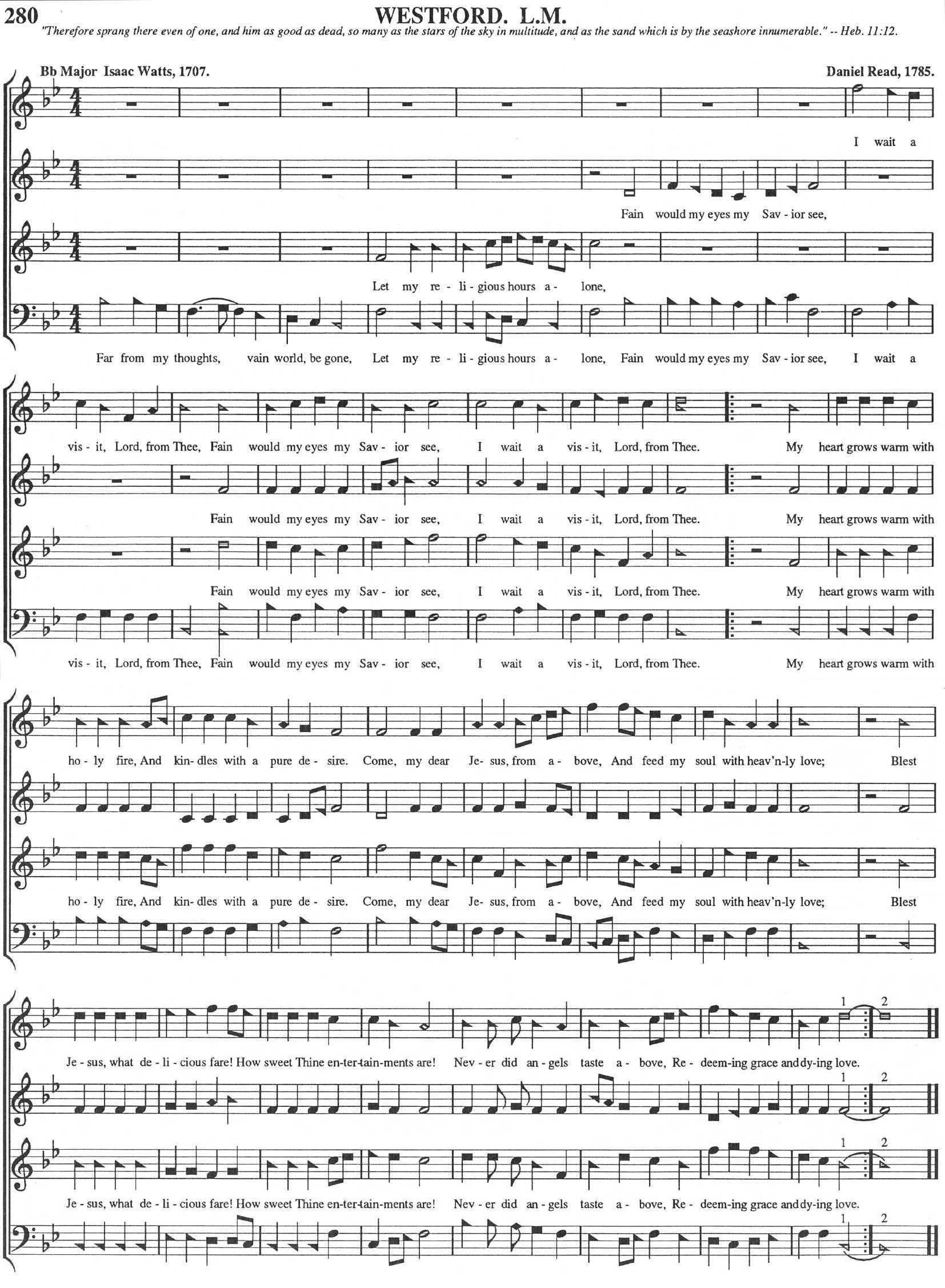
T. – Tripled; indicates a twelve-line stanza instead of four, as in L. M. T. – Long Meter Tripled (8/8/8/8/8/8/8/8/8/8/8/8). See Westford/Vain World Be Gone in The Sacred Harp. (“Tripled” is not very common.)

With Refrain – The hymn meter designation may be followed by the words “with refrain” – indicating a repeating refrain or chorus that does not follow the metrical pattern of the hymn itself. Similar designations are “With allelulias” and “With amens” indicating “allelulias” or “amen(s)” added to the end of the hymn.

Numerical Metrical Designations

7s. 6s. – Sevens and sixes; a quatrain with alternating lines of three and one-half feet and three feet, which rhymes in the second and fourth lines and sometimes in the first and third (7/6/7/6).

8s. 7s. 4s. – Eights, sevens and fours; a six-line stanza with alternating syllables of 8, 7, 8, 7, 4, and 7 (8/7/8/7/4/7). In practice (in singing) the four-syllable line is often repeated to create a line of eight syllables, and also the last two lines repeated. This enables the 8s. 7s. 4s. meter hymn to be sung with a doubled 8s. 7s. meter tune.

8s. 7s. – Eights and sevens; a trochaic quatrain with alternating lines of four feet and three and one-half feet, which rhymes in the second and fourth lines and sometimes in the first and third (8/7/8/7); also called Psalm Meter. Trochaic is one long syllable followed by one short syllable.

8s. – Eights; used to distinguish an eight-syllable quatrain that does not contain the iambic stress pattern characteristic of Long Meter (8/8/8/8). 

11s. – Elevens; used to distinguish an eleven-syllable quatrain (usually anapestic, which may rhyme in either the first and second, third and fourth lines, or first and third, second and fourth (11/11/11/11).

12s. 11s. – Twelves and elevens. A four-line stanza with alternating lines of twelve syllables and eleven syllables (12/11/12/11).

12s. – Twelves; see “M. T.” above.

Summary

The more common designations (C. M., L. M., S. M.) are almost universally standard across hymn books. “Common Meter” is what it appears to be – the most common hymn meter used in English hymnody. In relation: (1) “Long Meter” is longer than “Common Meter” in its second and fourth lines; (2) “Short Meter is shorter than “Common Meter” in its first line. Some designations vary by editors, geography, and time periods. For example, William Gadsby’s A Selection of Hymns, for Public Worship includes the following designations: 104th for the 10.10.11.11 pattern; 112th for L. P. M.; 122nd for S. P. M.; and 148th for H. M. These metrical patterns were related to old psalm tunes. H. M. (6.6.6.6.8.8.) was the meter for the Old Version Psalm 148, and so, often 148th was used to identify this pattern. The same sort of history applies to the designations 104th, 112th, and 122nd. Some hymn-meter variations made by editors may intend to encompass rhyme patterns as well, but rhyme patterns (though often prevalent in a certain way) are not inherent in hymn meter designations.

Most of the numerical meter designations are fairly intuitive (the number equals the number of syllables per line). 10s has ten syllables per line; 9s has nine. Some are not as intuitive, however. For example, many books use the label 8.7.4. The actual pattern of the hymn is 8.7.8.7.4.7. An almost endless combination of numerical designations of meter could be assembled. 

Both syllables and stress must be accounted for; but at the most basic level meter involves counting the number of syllables in a line of poetry. Amazing Grace is Common Meter: “A-ma-zing grace how sweet the sound” is 8 syllables; “That sav’d a wretch like me” is 6 syllables; “I once was lost but now am found” is 8 syllables; and “Was blind but now I see” is 6 syllables. Every Common Meter hymn and tune will follow that same pattern. If C. M. is written as C. M. D., or L. M. as L. M. D., etc., then that means the tune has enough music to sing two stanzas of a hymn instead of just one.

For another example, if you find a hymn labeled “11s”, a tune paired with the words “How firm a foundation, ye saints of the Lord” will likely work for singing that hymn.

Although any hymn of a particular meter can be sung with any tune of that same meter, the music of a particular song does not always seem fitting in mood for every hymn – even though it might work metrically. Also, the same number of syllables with different stress patterns will not fit well with the same tune. For example, compare “When I survey the wondrous cross” (Hamburg) with “How tedious and tasteless the hours” (Greenfields). They have the same number of syllables but different stress patterns.

In metrical hymn singing, there are tunes that have been passed down and have not been written down (or at least not in the forms in which they are sung). Songs from The Sacred Harp are good sources for tunes to set with the metrical hymns. Additionally, many hymnals will have a “Metrical Index” by which tunes may be found according to the meter in which they are written.

May the Lord bless this to be useful to someone.

Compiled by Robert Vaughn, initially in September 2006, with recent revisions and additions. Gathered from many sources over many years, so that little of what you read is original with me.


[i] Dactylic feet/stress is the reverse of Anapestic, having one long accented syllable followed by two short syllables, and might be found in some hymns.
[ii] “Irregular” or “Irr.” seems to now be the more commonly preferred designation rather than “P. M.” for lines and/or meters that are not standard. On occasion “P. M.” seems to be used in place of multiplying the number of designations in a hymn book. For example, I have seen “P. M.” used in place of “H. M.” (6/6/6/6/8/8). The Psalter (Grand Rapids, MI: Wm B. Eerdmans Publishing Co., 1912/1927) includes two alphabetical metrical designations I have not commonly found – Common Hallelujah Meter (C. H. M., 8/6/8/6/8/8) and Long Hallelujah Meter (L. H. M., 8/8/8/6/8/6).

Sunday, January 03, 2021

O God, be merciful to me

Magnus Brostrup Landstad wrote the hymn posted below. Landstad was born October 7, 1802 in Måsøy, Norway, the son of Hans Landstad (1771-1838), a minister, and Margrethe Elisabeth Schnitler (1768-1850). Magnus Landstad married Wilhelmine Margrete Marie Lassen (1808-1892) in 1828 or 1829. They had twelve children.

In his early years, Landstad was educated by his father. He then studied at the University of Christiania (Oslo), earning a theology degree in 1827. He was a Norwegian Lutheran minister, psalmist, poet, and collector of traditional Norwegian ballads. Landstad compiled and published the first collection of authentic Norwegian traditional ballads in 1853, Norske Folkeviser (or Norwegian Folk Ballads). He also prepared a national hymnal (Kirkesalmebog, or Church Hymn Book), which included about fifty of his own hymns. Magnus B. Landstad died October 8, 1880 and is buried in Vår Frelsers Gravlund at Oslo, Norway.

Carl Døving translated a number of Scandinavian and German hymns into English, including in 1909 this hymn by Magnus B. Landstad. Døving was born March 21, 1867, in Norway, and died October 2, 1937, Chicago, Cook County, Illinois. He is buried at the Lutheran Cemetery, Decorah, Winneshiek County, Iowa. Carl Døving was a Lutheran minister. There are two versions of the hymn (below) both of which I have seen credited to . One is probably his original translation and the other reflecting changes made in it. (I do not know which is which.)

English version 1

1. To thee, omniscient Lord of all,
In grief and shame I humbly call;
I see my sins against Thee, Lord,
The sins of thought and deed and word.
They press me sore; I cry to Thee:
O God, be merciful to me!

2. O Lord, my God, to Thee I pray;
O cast me not in wrath away!
Let Thy good Spirit ne’er depart,
But let Him draw to Thee my heart
That truly penitent I be:
O God, be merciful to me!

3. O Jesus, let Thy precious blood
Be to my soul a cleansing flood.
Turn not, O Lord, Thy guest away, 
But grant that justified I may 
Go to my house, at peace with Thee:
O God, be merciful to me!

English version 2

1. To Thee, O Lord, the God of all,
With contrite heart I humbly call,
And view my sins against thee, Lord,
The sins of thought and deed and word;
In my distress I cry to Thee,
O God, be merciful to me!

2. My Lord and God, to thee I pray,
Oh, cast me not in wrath away;
Let thy good Spirit ne’er depart,
But draw me closer to thy heart;
This is my penitential plea,
O God, be merciful to me!

3. Let thy beloved Precious Blood
Be to my soul a cleansing flood,
To wash my sins and guilt away;
That, pardoned by thy grace, I may
Go to my house with peace from thee;
O God, be merciful to me!

The hymn is in meter of 8s, 6 lines, and usually sung to the tune Vater Unser. Vater Unser is named for the first words in Martin Luther’s German hymn “Vater unser im Himmelreich” (“Our Father in Heaven,” a paraphrase of the Lord’s Prayer from 1538). Valentin Schumann paired this hymn with Luther’s words in Geistliche Lieder, a hymnal he produced in 1539. This tune is called Old 112th in some hymnals, where it was used as a setting for Psalm 112.

Wednesday, December 09, 2009

Writing songs

For almost 30 years I have been "piddling" with the hobby of writing songs. Not that writing songs is a waste of time; but mine might be. I do not consider myself a songwriter, but rather someone who enjoys experimenting with songs and songwriting. All my attempts, save one, are intended to be "Sacred Harp style" songs (that is, songs for Sacred Harp singers).

My oldest left in written record, though undated, is from around 1980. It is not an original composition. It is an arrangement merging parts of Old Hundred and Coronation. "Praise God from Whom all blessings flow, and crown Him Lord of all, &c." I'll called it New Fifty!* ;-) Following two more arrangements, in 1982 I tried to put down on paper an original tune that I had been singing to myself for awhile. I guess it had some redeeming value, and, with help from the Sacred Harp Book Committee, it remains my only published piece to date. Within a couple of weeks I had churned out another one. After that the process became a sporadic one, with about a dozen from then to 1993. Nothing to write home about -- a few that may be decent and some that shouldn't ever see the light of day. These are songs that actually reached completion. I also have this or that idea scrawled on various pieces of paper that I may or may not be able to find. I have no record of any completed tunes between 1993 and 2004. I'm not sure what I was doing. But recently -- the last 5 months -- I have gone on a spree that includes 14 completed tunes to date (and several unfinished). I really like a few of them, some bear the harsh metrical reality of being framed with no particular text in mind, some are mere exercises in curiosity, and some, well...are just bad. Some are directly inspired by another tune -- e.g. "Legion" is a minor tune inspired by "Unchanging Hand"** -- while many may reveal subconscious imitation of what I like best in songs and hymns. Don't hold your breath waiting for my chef-d'oeuvre. You might asphyxiate.

I admire those who have turned out masterful works of musical art. In the Sacred Harp field folks like B.F. White, M.M. Wynne, J.P. Rees, Edmund Dumas, Sarah Lancaster Hagler, A.M. Cagle, O.A. Parris, T.J. Allen, John W. Miller and on and on -- and many who are still living. As for myself, I am a plodder. I have little training in music and less in composing. I guess that never stopped a fool from rushing in where angels fear to tread. But the process is enjoyable, cathartic, and engages the mind in better pursuits than others it could be wasted on. Try it; you'll like it. Jump in. You'll learn to float, swim -- or drown.

I am not a rebel, but I'm not much of a follower of musical rules. Some I know and don't prefer. Some I don't know. For example, a standard rule in musical composition is to avoid parallel fifths and parallel octaves. Another is that the voices should not cross (alto should not go above the soprano, nor tenor above alto, etc.). Meanwhile, I write horizontally more so than vertically -- looking for four decent tunes that can be sung together rather than three parts that bring out a fourth part, the melody. I do not particularly conceive of the composition vertically, or as writing harmonies. I conceive of the task more horizontally, or as writing melodies. While I don’t want the tune to be an absolute vain jangling of inharmonious sound, I seek to write four parts that I think I would enjoy singing. I seek for the bulk of the tune to be concords, and confine discords usually to passing tones. To me anything but 2nd and 7th is concord. I tend toward the pentatonic scale when writing major, not using or using sparingly the fa (4th in the scale) and mi (7th in the scale). I don't use accidentals. While they may not be anathema to shape note, they are at least a nuisance.

I guess some things are or come close to being rules for me. These are generally attempts to follow the main framework of Sacred Harp tradition. Songs begin and end with a full measure; bass always ends on the tonic; minor tunes always end on the 1-5 dyad (or unison); the standard moods of time are 3 common, 2 triple and 2 compound (2/2, 4/4, 2/4, 3/2, 3/4, 6/4 and 6/8). I guess everything else in up in the air. The spirit of Billings should be good guide for composers – "I don’t think myself confin’d to any Rules for Composition laid down by any that went before me...I think it is best for every Composer to be his own Carver...Nature is the best dictator, for not all the hard, dry, studied rules that ever was prescribed, will not enable any person to form an air." Maybe you'll just naturally carve out something that no man has ever carved before.


An example of a recent attempt, dedicated to the Houston (TX) area singers
Above song © 2009. Click on the image to see a larger version

* Most of my tune names have serious underpinnings, but some, like "New Fifty", may seem a little silly. Some do not reveal the underpinning, as Ogilvie, the brand name of a hair permanent whose sweet fragrance was aromatizing the house while I was writing the tune with that name. A tune needs its own name in case it be separated from the words and joined to another.
** Hold To God's Unchanging Hand by Jennie Wilson (words), F. L. Eiland and Clyde Williams (music).
Hold To God's Unchanging Hand sung by Russ Taff is not exactly like we sang it, but will give you an idea. Another version, by Pastor Jerome Jackson
Some may be able to access a score HERE if you have the right software.