Translate

Showing posts with label Meter. Show all posts

Tuesday, February 17, 2026

Anapestic Meter

What? What is that?

Awhile back, I ran across on Archive.Org the hymn book Sacred Poetry and Music Reconciled, Or, A Collection of Hymns Original and Compiled, by Samuel Willard. (Boston, MA: Leonard C. Bowles, 1830). In it I noticed several hymns labeled with the meters “C.M.A.,” “L.M.A.,” “S.M.A.” I had never noticed that kind of labeling before...

And I am always up for learning more about the meter designations. The hymn meter is the pattern of syllables and stresses in the hymn text. I have posted a number of times on the subject. Here are most, if not all:

  1. Common Meter Extended hymns
  2. Explanation of Meter, from The Baptist Standard Hymnal
  3. Hymn meter
  4. Hymn Meter Again
  5. Hymn Meter Explanations and Information
  6. Metrical Index of Tunes
  7. Online metrical indices
  8. 50th hymn meter

Willard’s explanation of his designations are as follows:
  • L. M. A. - Long Meter Anapestic. 10.10.11.11. (usually, but not always; this also includes hymn with 4 lines of 11s. and one 8-line hymn that is 10.11.11.11.12.11.11.11.)
  • C. M. A. - Common Meter Anapestic. 11.8.11.8.
  • S. M. A. - Short Meter Anapestic. 8.8.11.8.

Some relevant excerpts from Willard’s book Sacred Poems:

A considerable number of hymns in this collection are in the anapestic measure, like the first, fourth, and eighteenth, containing in general three syllables for a measure or bar; while most of the tunes, which are named for them, have usually been sung in iambic verse, dividing each measure into two parts, the first a semibreve, or other notes equivalent to it, and the second a minim. If these hymns should be adopted in any society, where these tunes are not actually divided in the collections of music in use, the following rule will remove every difficulty in performing these or any other tunes of the kind, in the manner required; viz.

Let every measure, intended for three syllables, be divided into three equal parts, by splitting semibreves, or removing slurs, and let every part be sounded on the same tone, it would otherwise be. Thus, for instance, in the tune of Froome, named for the first hymn, let the slur be removed from the crotchets in the first full measure of the first line, and let the minim in the first measure of the second line be performed like two crotchets. The only exceptions to this rule are those, which are signified by numbers or points in several hymns, and which may be observed, or not, as may be found convenient. When the first syllable in a measure has the number 1 over it, it is to fill two thirds of the bar, and for the two following syllables, marked with the number 4, the last third of the bar. is to be divided, as in hymn 4. (pages 11-12)

Some of the metres are distinguished in this book into seven varieties, and are marked by the figures 1, 2, 3, &c. prefixed to the tunes, which are named. The first variety is pure iambic from the beginning to the end of every line. The second is precisely the same with the first, excepting a trochee in the beginning of the first line. With a little attention, the chorister will understand the other diversities, which, in the adaptation of tunes, are almost as important to be observed, as the difference of metre. (page 18)

Willard says that most of the named tunes in his book can be found in the Bridgewater, Handel and Haydn, and American Psalmody collections.

A little about Samuel Willard:

Samuel Willard, the son of William Willard and Catherine Wilder, was born April 18, 1775 (his daughter wrote 1776). His grandfather was a Congregational minister and his father a deacon. He graduated from Harvard College and became a Congregational minister. The initial council declined to ordain him due to his Unitarian tendencies, but a more liberal-thinking group was convened and ordained him. Willard became a long-time influential Unitarian in Massachusetts. He compiled two hymn books – Sacred Poems (1830), Regular Hymns: on a Great Variety of Evangelical Subjects and Important Occasions: with Musical Directions, for all the Varieties of Appropriate Expression (1824), and The Family Psalter (circa 1857). The latter may have never been published, and his other books probably found only limited use outside his region (and probably not much outside the Unitarian fold). His daughter writes:

…he gave much thought and time to the subject of sacred music. He composed many hymns; on his favorite plan of adapting the poetical to the musical emphasis. He left a manuscript collection of four hundred or more of these hymns;, about one hundred of which were composed in his eighty-second year. After his birthday of eighty-two he prepared an elaborate preface to this collection, in which he emphasized the idea, that sacred music and poetry, fitly adapted to each other, are to be among the great factors in harmonizing the discordant elements of the world. This collection he named ‘The Family Psalter’.” (Life of Samuel Willard, D.D. A.A.S. of Deerfield, Mass, Mary Willard, editor. Boston, MA: George H. Ellis, 1892, pp. 22-23)

As far as I have discovered, the C.M.A., L.M.A., and S.M.A. metrical designations seem to be limited in use to Willard’s work. They may have been created by him for his work, and not used elsewhere. In Regular Hymns, Willard does not use metrical designations, but simply gave tunes for the hymn. He wrote, “In general, I have named two tunes for each hymn, taken either from the third edition of Deerfield Collection, or the tenth of the Bridgewater Collection. Those from the former are marked with a star, and those from the latter with a cross; to prevent any mistake” (pp. x-xi).

Samuel Willard died October 8, 1859, and is buried at the Laurel Hill Cemetery in Deerfield, Franklin County, Massachusetts.

Tuesday, January 07, 2025

Hymn Meter Explanations and Information

Hymn Meter Explanations and Information

“Hymn meter” is the pattern of syllables and stress in the text of a hymn. The meter designations in hymn books relate to the syllables, meter, or “feet” of the poetry. A hymn of a certain meter (Common Meter = C. M., for example) can be sung with any tune of that same meter. Knowing the metrical symbols and matching hymns to tunes are knowledge and skills needed for hymn-book singing.

Alphabetical Metrical Designations

C. M. – Common Meter; a quatrain (four-line stanza) with alternating lines of iambic tetrameter and iambic trimeter, which usually rhymes in the second and fourth lines and sometimes in the first and third (8/6/8/6); also called Ballad Meter in other contexts. Iambic is one short or unaccented syllable followed by one long or accented syllable.

C. M. E. – Common Meter Extended; a five-line stanza in which most commonly the first, third, and fourth lines rhyme, and the second and fifth lines rhyme. C. M. E. is like C. M. except that it is “extended” with an extra line of 8 syllables (8/6/8/8/6). 

C. P. M. – Common Particular Meter; a six-line stanza of which the first, second, fourth and fifth lines are iambic tetrameter, and the third and sixth lines are iambic trimeter (8/8/6/8/8/6). 

D. – Doubled; indicates an eight-line stanza instead of four, as in C. M. D. or D. C. M. – Common Meter Doubled or Doubled Common Meter (8/6/8/6/8/6/8/6). 

H. M. – Hallelujah Meter; a six-line stanza of which the first four lines are trimeter and the last two are tetrameter, which rhymes most often in the second and fourth lines and the fifth and sixth lines (6/6/6/6/8/8). At times this may be instead listed as (6/6/6/6/4/4/4/4).

L. M. – Long Meter; a quatrain (four-line stanza) in iambic tetrameter, which usually rhymes in the second and fourth lines and often in the first and third (8/8/8/8).

L. P. M. – Long Particular Meter; a six-line stanza of iambic tetrameter (8/8/8/8/8/8). 

M. T. (or 12s.) – Meter Twelves; a quatrain in anapestic hexameter (12/12/12/12). Anapestic is two short syllables followed by one long syllable.[i] 

P. M. – Particular Meter, Peculiar Meter; Psalm Meter; sometimes may stand for Psalm Meter (but this is more commonly known as 8s. 7s.); it usually means Particular Meter, or Peculiar Meter (these two indicating poetry with its own particular, peculiar, or non-standard, meter).[ii]  

S. M. – Short Meter; iambic lines in the first, second, and fourth are in trimeter, and the third in tetrameter, which rhymes in the second and fourth lines and sometimes in the first and third (6/6/8/6). 

S. P. M. – Short Particular Meter; a six-line stanza of which the first, second, fourth and fifth lines are iambic trimeter, and the third and sixth lines are iambic tetrameter (6/6/8/6/6/8).

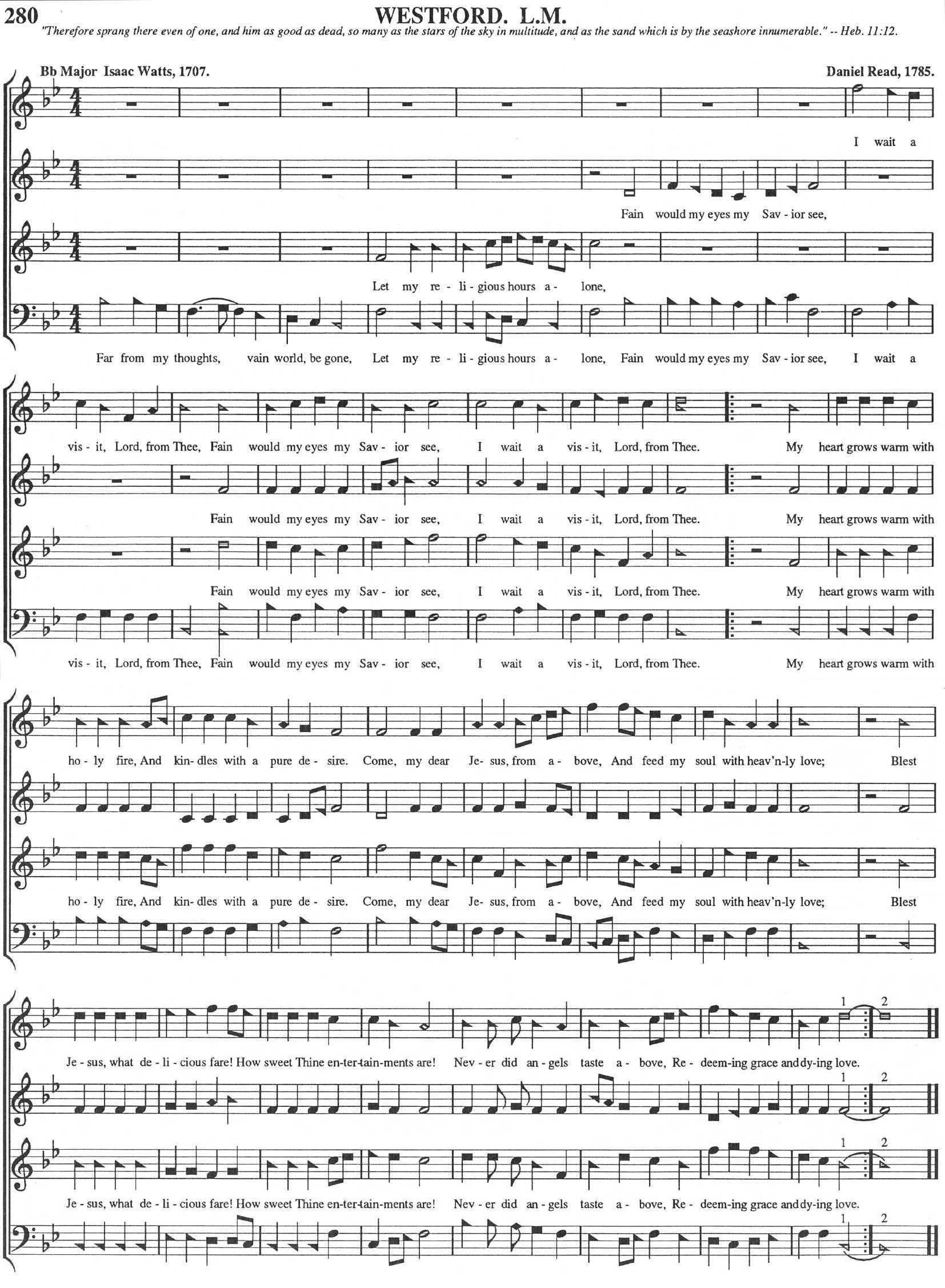
T. – Tripled; indicates a twelve-line stanza instead of four, as in L. M. T. – Long Meter Tripled (8/8/8/8/8/8/8/8/8/8/8/8). See Westford/Vain World Be Gone in The Sacred Harp. (“Tripled” is not very common.)

With Refrain – The hymn meter designation may be followed by the words “with refrain” – indicating a repeating refrain or chorus that does not follow the metrical pattern of the hymn itself. Similar designations are “With allelulias” and “With amens” indicating “allelulias” or “amen(s)” added to the end of the hymn.

Numerical Metrical Designations

7s. 6s. – Sevens and sixes; a quatrain with alternating lines of three and one-half feet and three feet, which rhymes in the second and fourth lines and sometimes in the first and third (7/6/7/6).

8s. 7s. 4s. – Eights, sevens and fours; a six-line stanza with alternating syllables of 8, 7, 8, 7, 4, and 7 (8/7/8/7/4/7). In practice (in singing) the four-syllable line is often repeated to create a line of eight syllables, and also the last two lines repeated. This enables the 8s. 7s. 4s. meter hymn to be sung with a doubled 8s. 7s. meter tune.

8s. 7s. – Eights and sevens; a trochaic quatrain with alternating lines of four feet and three and one-half feet, which rhymes in the second and fourth lines and sometimes in the first and third (8/7/8/7); also called Psalm Meter. Trochaic is one long syllable followed by one short syllable.

8s. – Eights; used to distinguish an eight-syllable quatrain that does not contain the iambic stress pattern characteristic of Long Meter (8/8/8/8). 

11s. – Elevens; used to distinguish an eleven-syllable quatrain (usually anapestic, which may rhyme in either the first and second, third and fourth lines, or first and third, second and fourth (11/11/11/11).

12s. 11s. – Twelves and elevens. A four-line stanza with alternating lines of twelve syllables and eleven syllables (12/11/12/11).

12s. – Twelves; see “M. T.” above.

Summary

The more common designations (C. M., L. M., S. M.) are almost universally standard across hymn books. “Common Meter” is what it appears to be – the most common hymn meter used in English hymnody. In relation: (1) “Long Meter” is longer than “Common Meter” in its second and fourth lines; (2) “Short Meter is shorter than “Common Meter” in its first line. Some designations vary by editors, geography, and time periods. For example, William Gadsby’s A Selection of Hymns, for Public Worship includes the following designations: 104th for the 10.10.11.11 pattern; 112th for L. P. M.; 122nd for S. P. M.; and 148th for H. M. These metrical patterns were related to old psalm tunes. H. M. (6.6.6.6.8.8.) was the meter for the Old Version Psalm 148, and so, often 148th was used to identify this pattern. The same sort of history applies to the designations 104th, 112th, and 122nd. Some hymn-meter variations made by editors may intend to encompass rhyme patterns as well, but rhyme patterns (though often prevalent in a certain way) are not inherent in hymn meter designations.

Most of the numerical meter designations are fairly intuitive (the number equals the number of syllables per line). 10s has ten syllables per line; 9s has nine. Some are not as intuitive, however. For example, many books use the label 8.7.4. The actual pattern of the hymn is 8.7.8.7.4.7. An almost endless combination of numerical designations of meter could be assembled. 

Both syllables and stress must be accounted for; but at the most basic level meter involves counting the number of syllables in a line of poetry. Amazing Grace is Common Meter: “A-ma-zing grace how sweet the sound” is 8 syllables; “That sav’d a wretch like me” is 6 syllables; “I once was lost but now am found” is 8 syllables; and “Was blind but now I see” is 6 syllables. Every Common Meter hymn and tune will follow that same pattern. If C. M. is written as C. M. D., or L. M. as L. M. D., etc., then that means the tune has enough music to sing two stanzas of a hymn instead of just one.

For another example, if you find a hymn labeled “11s”, a tune paired with the words “How firm a foundation, ye saints of the Lord” will likely work for singing that hymn.

Although any hymn of a particular meter can be sung with any tune of that same meter, the music of a particular song does not always seem fitting in mood for every hymn – even though it might work metrically. Also, the same number of syllables with different stress patterns will not fit well with the same tune. For example, compare “When I survey the wondrous cross” (Hamburg) with “How tedious and tasteless the hours” (Greenfields). They have the same number of syllables but different stress patterns.

In metrical hymn singing, there are tunes that have been passed down and have not been written down (or at least not in the forms in which they are sung). Songs from The Sacred Harp are good sources for tunes to set with the metrical hymns. Additionally, many hymnals will have a “Metrical Index” by which tunes may be found according to the meter in which they are written.

May the Lord bless this to be useful to someone.

Compiled by Robert Vaughn, initially in September 2006, with recent revisions and additions. Gathered from many sources over many years, so that little of what you read is original with me.


[i] Dactylic feet/stress is the reverse of Anapestic, having one long accented syllable followed by two short syllables, and might be found in some hymns.
[ii] “Irregular” or “Irr.” seems to now be the more commonly preferred designation rather than “P. M.” for lines and/or meters that are not standard. On occasion “P. M.” seems to be used in place of multiplying the number of designations in a hymn book. For example, I have seen “P. M.” used in place of “H. M.” (6/6/6/6/8/8). The Psalter (Grand Rapids, MI: Wm B. Eerdmans Publishing Co., 1912/1927) includes two alphabetical metrical designations I have not commonly found – Common Hallelujah Meter (C. H. M., 8/6/8/6/8/8) and Long Hallelujah Meter (L. H. M., 8/8/8/6/8/6).

Thursday, November 12, 2020

50th hymn meter

I recently discovered a new hymn meter designation – 50th meter – that I do not recall seeing before (Thanks to Matt Bell.) The 50th meter was a meter for the 50th Psalm. Similarly, William Gadsby uses Psalm Tune names for several of his hymn meters – 104th for the 10.10.11.11 pattern, 112th for L. P. M., 122nd for S. P. M., and 148th for H. M.

According to Richard Crawford in The Core Repertory of Early American Psalmody (Volumes 11-12, pp. xxxix, xl), the “old” 50th meter was 10.10.10.10.11.11. (as in the tune Lyons), and the “new” 50th meter was 6 lines of 10 (as in the tune Wordsworth).

Tuesday, September 10, 2019

Hymn Meter Again

Here are miscellaneous comments on hymn meter that I have written or collected – some of which may need more context for clarification. I have previous posts on hymn meter HERE, HERE, HERE, HERE, and HERE. These may help.

Unless they are irregular[i] or have prose texts, hymns follow a “metrical” pattern – that is, the hymn meter indicates the number of syllables in the lines in each stanza of a hymn. The number corresponds to the number of syllables per line of poetry. It further, in some cases, implies a certain stress pattern, such as iambic, trochaic, dactylic, or anapestic.[ii] This pattern of syllables and stress in the text is different from the meter of the music, which is the arrangement of the rhythm into measures and signified by the time signature (a symbol at the beginning of the musical staff, e.g. 3/4, 4/4, 6/8, etc.). The hymn meter is the pattern of syllables and stresses in the text itself. While there is some relationship between the two, they are not the same thing.

The listing of meter in hymn and tune books is generally based on a four-line stanza. The named meters – e.g., Common, Long, Short – are usually quatrains (four lines).When the letter “D” follows the meter designations, the pattern is repeated (doubled). For example, rather than four lines of stanza there will be eight lines.

Another metrical variation is the hymn with a standard meter and an added chorus or refrain. Most hymnals and songbooks do not count out the number of syllables in refrains.  In this case, if a hymn is listed as “C. M. with Refrain,”[iii] it means the stanzas are Common Meter, and the refrain is in addition to and does not correspond with that. (See At the Cross for an example.)  The only way to know for sure is to count the syllables in the refrain.

Common Meter (C. M.) is often referred to as ballad meter outside of hymnals (though some make a difference in common meter and ballad meter).

M. T.  means Meter Twelves (four lines of 12 syllables per line).

William Gadsby’s A Selection of Hymns, for Public Worship uses 104th for the 10.10.11.11 pattern, 112th for L. P. M., 122nd for S. P. M., and 148th for H. M. These less common meters were related to old psalm tunes. For example, H. M. (6.6.6.6.8.8.) was the meter for the Old Version Psalm 148.

Most of the numerical symbols are reasonably intuitive, but some are not. For example, many books use the label 8.7.4. The actual pattern of the hymn is 8.7.8.7.4.7.

The numerical symbols vary in the ways they are printed in different hymnals. For example, a four-line stanza of eight syllables might be listed in any of the following ways (and probably others).
  • 8s.
  • 88.88
  • 8.8.8.8.
  • 8,8,8,8.
  • 88 88
Hymns written with a particular syllabic pattern may be sung to any tune in that same pattern, as long as the poetic foot/stress conforms. For example, “How tedious and tasteless the hours” (8s.) could only with difficulty be sung with Hamburg (L. M.), though both have eight syllables per line.


[i] Not the same from one stanza to another. Some editors call anything that does not fall into one of the more common metrical categories either “P. M.” or “Irregular.” Others distinguish between these terms, using P. M. for lyrics whose meters are definite, regular, but rare (an unusual meter that is unlikely to be matched by another hymn or tune) – as opposed to using “Irregular” to denotes lyrics whose syllable counts do not bear definition (as above, the syllable counts are not the same from one stanza to another). In this case, P. M. is “Peculiar Meter” or “Particular Meter.” Tunes labeled P. M. is usually not interchangeable with other tunes labeled P. M. However, in some books, P. M. stands for Psalm Meter, which is 8s.7s. or 8.7.8.7.
[ii] Some designations by some editors may intend to encompass rhyme patterns as well.
[iii] Or, “C. M. D. with Chorus.”

Saturday, July 27, 2019

Explanation of Meter, from The Baptist Standard Hymnal

The following explanation of Meter (the author prefers the spelling “Metre” which we do not as commonly use nowadays) is taken from The Baptist Standard Hymnal, with Responsive Reading: a New Book for All Services, edited by Mrs. A. M. (Willa Ann) Townsend and published in 1924 by the Sunday School Board of the National Baptist Convention (page 6). The explanation is presumably written by the editor.

Follow the link above to also see some examples that are on the page. The examples are helpful, but contain some markings I was unable to reproduce.


METRE— EXPLAINED 

The term Metre or Meter, is a Greek word and properly belongs to poetry, from whence it is transferred to music. Metre is the Measure, or the Standard by which the long and short syllables in the verses of a hymn are rhythmically and definitely arranged into groups of syllables called poetic “Feet.” Each “Foot,” having a distinctive name, is to poetry what a measure is, in many respects, to music. Very little is known of the actual way Greek verse was adapted to singing tones, yet it is safe to assume that every long syllable was sung to a longer tone and every short syllable to a shorter tone. Modern verse is set to a larger variety of patterns of long and short tones, provided that the “Accented” Syllables match with “Accented” Tones. The regular recurrence of the “Accent” constitutes and determines the Metre of the line or verse. In a modern Hymnal a very large number of forms may be represented but the form of every hymn-tune depends on the verse-form to which it belongs. Out of four or five types of “Feet,” developed the fundamental rhythm of modern music and its types of Metre. Of the many recognized “Feet,” Iambic with lines sometimes of 10 or more syllables, Dactylic, Amphibrachic, Anapestic and Trochial are the chief types. Trochial, having the greatest extension in the variety. Syllables of two and three “Feet” are called Simple Feet. When there are four, five and six syllables in a word they are reckoned as “Double” or “Compound Feet,” though often they are resolved Into Single Feet. The most frequently used Meters are: Common Metre (C. M.), Common Hallelujah Metre (C. H. M.), Long Metre (L. M.), Long Particular Metre (L. P. M.), Hallelujah Metre (H. M.), (Short Metre (S. M.), Short Particular Metre (S. P. M.) 7s; 8s; 8s 7s; 8s 7s 4s; 10s; 10s 11s; 11s; 12s.


HOW TO KNOW WHAT METRE TO ADAPT 


Common Metre 
Common Metre is known by a stanza of four lines composed of one short unaccented syllable and one long accented syllable in each poetical foot. The syllables being in number and order as follows: 8, 6, 8, 6, that is, there are 8 syllables in first and third lines and 6 syllables in the second and fourth lines.


Iambic Feet — C. H. M. 
Common Hallelujah Metre is a stanza of six lines, each poetical foot consisting of one short unaccented syllable and one long accented syllable. The syllables each being in number and order as follows: 8, 8, 6, 8, 8, 6.


Iambic Feet — L. M.
Long Metre consists of four lines, of which each foot contains one short unaccented and one long accented syllable. Each line contains 8 syllables.


Iambic Feet — L. P. M. 
Long Particular Metre differs from Long Metre only in having six lines Instead of four, each of which contains 8 syllables.


Iambic Feet — H. M. 
Hallelujah Metre is a stanza of 6 lines with one short unaccented syllable, and one long accented syllable in each poetical measure or Musical foot. The syllables of each being in number and order as follows: 6, 6, 6, 6, 8, 8.


Iambic Feet — S. M. 
Short Metre consists of a stanza of four lines whose poetic foot is composed of two syllables — a short or unaccented syllable followed by a long or accented syllable. The syllables in number and order are as follows: 6, 6, 8, 6.


Iambic Feet — S. P. M. 
Short Particular Metre consists of six lines whose poetic foot is made up of two syllables — one short or unaccented followed by a long or accented syllable. The syllables in number and order are 6, 6, 8, 6, 6, 8.

Trochaic Feet — 7s

A stanza of Sevens consists of four lines with a poetic foot containing one long and one short syllable. The accented syllable followed by an unaccented syllable. Each line contains 7 syllables.


Trochaic Feet — 7s 6s 
A stanza with a Metre thus designated consists of eight lines in Trochaic and Iambic feet.


Anapestic Feet — 8s 
A stanza of four lines with a poetical foot containing two short syllables followed by one long syllable, is known as 8s. Each line contains eight syllables and is marked 8s.


Trochaic Feet — 8s 7s 
Eights and Sevens consists of four lines with a poetic foot containing one long and one short syllable; an accented syllable is followed by an unaccented one and designated thus: 8s 7s. The syllables are as follows: 8, 7, 8, 7.


Trochaic Feet — 8s 7s 4s 
A Metre designated 8, 7, 4, differs from the Metre 8s 7s only in that it contains six lines instead of four lines; the syllables being in number and order as follows: 8, 7, 8, 7, 4, 7.


Anapestic Feet — 10s 11s 
10s 11s Metre consists of a stanza of 4 lines with 2 short syllables followed by a long syllable. The syllables in number and order are 10, 10, 11, 11, or six lines with a poetical foot consisting of one short unaccented and one long accented syllable thus: 10, 10, 10, 11, 11.


Anapestic Feet — 11s 
A Metre designated 11s, consists of a stanza of four lines with a poetical foot containing 2 short syllables followed by a long syllable, each line containing eleven syllables.


Anapestic Feet — 12s 
A Metre of twelves consists of a stanza of four lines, each containing twelve syllables with two short syllables followed by a long syllable, composing the poetical foot.


Dactylic Feet 
is just the reverse of the Anapestic, being composed of one long accented syllable followed by two short unaccented syllables.


Amphibrachic Feet 
is represented by three syllables. The first and third syllables are short, the middle syllable is long.

Thursday, September 13, 2018

Hymn meter

Hymns, unless they are irregular or have prose texts, follow a “metrical” pattern – that is, the hymn meter indicates the number of syllables in the lines in each stanza of a hymn.[i] The number corresponds to the number of syllables per line of poetry. It may also imply a certain stress pattern, such as iambic, trochaic, dactylic, or anapestic.[ii] For example, Long Meter and 8s. both have four 8-syllable lines, but have different stress patterns.[iii]

The listing of meter in hymn and tune books is generally based on a four line stanza. Knowledge of hymn and tune meter allows the pairing of hymns and tunes that share the same meter. In theory, any hymn of a certain meter may be sung to any tune of that same meter. However, for the most edifying usage, the mood and motion of the tune should agree to that of the hymn. Below is an explanation of some of the metrical symbols used hymn books, including a few examples of how to read the numerical symbols.

C. M.                Common Meter (8.6.8.6.)
C. M. D.           Common Meter Doubled (8 lines rather than 4)
C. M. E.           Common Meter Extended (8.6.8.8.6.)
C. P. M.            Common Particular Meter (8.8.6.8.8.6)
H. M.                Hallelujah Meter (6.6.6.6.8.8.)
L. M.                Long Meter (8.8.8.8.)
L. M. D.           Long Meter Doubled (8 lines rather than 4)
L. P. M.            Long Particular Meter (8.8.8.8.8.8)
S. M.                Short Meter (6.6.8.6.)
S. M. D.           Short Meter Doubled (8 lines rather than 4)
S. P. M.            Short Particular Meter (6.6.8.6.6.8.)
7s.                    (7.7.7.7.)
7s. D.               (7.7.7.7.7.7.7.7., 8 lines rather than 4)
8s. 7s.               (8.7.8.7.)
10s. 6 lines       (10.10.10.10.10.10.)
12s. 11s.          (12.11.12.11)

The more common symbols (C. M., L. M., S. M.) [iv] are almost universally standard across hymn books. Some vary by editors.[v] “D” means the pattern is repeated or “doubled.” Most of the numerical symbols are fairly intuitive, though some aren’t. For example, many books use the label 8.7.4. The actual pattern of the hymn is 8.7.8.7.4.7. P. M. (usually explained as “peculiar meter” or “particular meter”) is often used as an abbreviation for hymns that have an unusual meter that is unlikely to be matched by another hymn or tune.

To find the meter of hymn, count the syllables in the lines of each stanza. If they fit a common tune – for example, 8.8.8.8. fitting with Hamburg/When I Survey the Cross – then they are that same meter. Nevertheless, the same number of syllables with different stress patterns that don’t fit the tune well exclude them from being strictly the same meter.


[i] Hymn meter – the pattern of syllables and stress in the text – is different from the meter of the music, which is the arrangement of the rhythm into measures and signified by the time signature.
[ii] Anapest: a metrical foot consisting of two unstressed syllables followed by one stressed syllable; Dactyl: a metrical foot consisting of one stressed and two unstressed syllables; Iamb: a metrical foot consisting of one unstressed syllable followed by one stressed syllable; Trochee: a metrical foot consisting of one stressed syllable followed by one unstressed syllable. In a sense anapestic is the opposite of dactylic, and iambic is the opposite of trochaic. C. M., L. M., and S. M. are iambic. 7s. and 8s.7s. are trochaic. (Don’t you wish you had paid attention while in school? I do!)
[iv] Common Meter is often referred to as ballad meter outside of hymnals (though some make a difference in common meter and ballad meter).
[v] William Gadsby’s A Selection of Hymns, for Public Worship  uses 104th for the 10.10.11.11 pattern, 112th for L. P. M., 122nd for S. P. M., and 148th for H. M. These less common meters were related to old psalm tunes. For example, H. M. (6.6.6.6.8.8.) was the meter for the Old Version Psalm 148. Some variations by some editors may intend to encompass rhyme patterns as well. Another metrical variation is the hymn with a standard meter and added chorus or refrain. These may be labeled as “C. M. with chorus” or “C. M. with refrain.” See At the Cross for an example.

Sunday, December 28, 2014

Online metrical indices

Following is a list of some online metrical indices for hymns and tunes. Some are more useful and/or user-friendly than others. Some are more useful for finding texts, while others are more useful for finding tunes. Providing these links as resources does not constitute an endorsement of the sites or their contents.

* A Metrical Index to Gadsby's Hymns
* Chalice Hymnal Metrical Index
* Christian Classics Ethereal Library Hymn Tune metrical index
* Fasola Modality -- (Two sets of indices, including METER, of The 1991 edition Sacred Harp and seven 19th Century Shape-Note Hymnals.)
* Harmonia Sacra Metrical Index
* Hope Publishing Company Index of Hymn Tunes (Metrical Index begins on page 4)
* Hymn Time's Cyber Hymnal Meter Index
* Index of Meters for Spiritual Songs Hymn Book (There is also a metrical index for the Little Flock 1881 hymn book, but it is not easy to navigate -- for example _1metric.htm is 'long meter', _2metric.htm is 'short meter', etc.)
* Metrical Index of the tunes from the UK Methodist hymn book, Hymns and Psalms
* Metric List of Hymn Tunes of the 1982 Episcopal Church Hymnal (listed by meter, but only gives the first line of the hymn)
* OCP Master Index 2015 (The Metrical Index of Hymn Tunes starts on page 27.)
* Open Hymnal Metrical Index of Tunes
* Psalms and Hymns Metrical Index
* Southern Harmony
* The Free Lutheran Chorale Book Metrical Index of Tunes (links will go to a melody and associated hymn text)
* The Mystery Telling Vol 1 Metrical Index (each link takes you to a music score and hymn text)
* The Sacred Harp, 1991 Denson Edition
* The Sacred Harp, 2012 Cooper Edition
* Timeless Truths (From "all titles" choose to sort by meter.)
* Wesley Hymn Collection Metrical Index

Other resources
These are nice online resources with lots of information, but not indexed by hymn meter.

* Hymnary.org (you can enter a meter in their search tool, or you can find a tune or text with the meter you want and click the linked meter from the tune or text's page)
* Oremus Hymnal (you have to look at each individual song to find the meter)
* Psalters (8 different Psalters, but you have to look through the Psalms for the right meter.)
* The Psalms of David in Metre (though these Psalms are in meter, the meter is not listed; they appear to be all, or mostly, in common meter)

Saturday, June 15, 2013

Common Meter Extended hymns

In 1982 I wrote a hymn (A Sinner’s Meditation on Christ’s Death) and tune (Ogilvie), which were published under the title Sweet Thought in the 1992 Sacred Harp, Revised Cooper Edition. The words, slightly revised, were printed in 2009 in A Sheaf of Psalms and Hymns and Spiritual Songs.

1. How sweet to think He died for me,
Upon the cruel tree;
It brings me pain and agony,
And yet it brings me ecstacy--
Just think, He died for me.
2. A wretched sinner, vile am I,
For whom the Lord did die;
He sent His own begotten Son,
Redemption paid and vict'ry won--
Just think, He died for you.

I recently wrote another tune that “takes off” from Ogilvie, has much the same run, but is in minor rather than major. This hymn is in a not so common meter -- 8.6.8.8.6. (Myron Sauder calls it Common Meter Extended or C.M.E. in his Handbook for Spiritual Hymns). I thought I might write a hymn for this new tune, and did write one stanza. But I also decided to look around and see what other hymns might follow this metrical pattern. I found several, the first stanzas of which I list below. Ultimately, I chose William Bingham Tappan's hymn “There is an hour of peaceful rest.”

Below are Tappan's hymn, plus the first stanzas of 8 other hymns that I found written in Common Meter Extended. I do not recommend all of them, but include them as examples of hymns written in 8.6.8.8.6., or Common Meter Extended. Do you readers know of others?

1. There is an hour of peaceful rest
To mourning wand'rers giv'n;
There is a joy for souls distrest,
A balm for ev'ry wounded breast:
'Tis found above--in heav'n.
2. There is a home for weary souls,
By sin and sorrow driv'n
When tossed on life's tempestuous shoals,
When storms arise and ocean rolls,
And all is drear--but heav'n.
3. There faith lifts up the tearless eye,
To brighter prospects giv'n,
And views the tempest passing by,
The evening shadows quickly fly,
And all serene--in heav'n.
4. There fragrant flow'rs immortal bloom,
And joys supreme are giv'n;
There rays divine disperse the gloom;
Beyond the confines of the tomb
Appears the dawn of heav'n. 
Words: William Bingham Tappan, 1818

“Be not afraid, ’tis I, ’tis I,
Though the storm rages wild;
In thy sore need I’m passing by,
Off’ring to help thee, hear thy cry—
Be of good cheer, My child.”
Words: Barney E. Warren, pub. 1911

Dear Lord and Father of mankind,
forgive our foolish ways;
reclothe us in our rightful mind,
in purer lives thy service find,
in deeper reverence, praise.
Words: John Greenleaf Whittier, 1872

Eternal Light! Eternal Light!
How pure the soul must be
When, placed within Thy searching sight,
It shrinks not, but with calm delight
Can live and look on Thee.
Words: Thomas Binney ca. 1826 (This hymn sometimes appears with the first line "O Thou Who art enrobed in Light")

Give to me, Lord, a thankful heart 
And a discerning mind;
Give, as I play the Christian's part, 
The strength to finish what I start
And act on what I find. 
Words: Thomas Caryl Micklem 1973

I cannot breathe enough of Thee,
O gentle breeze of love;
More fragrant than the myrtle tree
The Henna-flower is to me,
The Balm of Heaven above.
Words: W. Spencer Walton, pub. 1923

O God of hope, your prophets spoke 
of days when war would cease: 
when taught to see each person’s worth,
and faithful stewards of the earth, 
we all would live in peace.
Words: Basil Ernest Bridge

The hush of midnight here below,
the shining stars above,
a night of wonder long ago
when in the stable lantern's glow 
is born God's gift of love.
Words: Timothy Dudley-Smith, 2000

The Saviour gently calls you now 
In accents soft and clear; 
His hand outstretched in tender love 
Will guide you to His home above– 
O come while He is near.
Words: Ken Paginton, 1981

Saturday, December 12, 2009

Metrical Index of Tunes

The following from Wordwise Hymns by Robert Cottrill

“Tunes are grouped according to metre. This can be useful information if you wish to sing a particular set of words to a different tune. Perhaps the tune assigned to a hymn by the book is unknown, or more difficult for congregational use. This index will suggest alternatives.

“Each tune has a metre. So many beats per line, and so many lines. For example, the metre for the tune Aurelia above is 7.6.7.6D (“D” meaning doubled.) That tells us that each stanza of poetry has 7 or 6 sounded syllables, alternately, and each stanza has a total of 8 lines. For example:

The chur-ch’s one foun-da-tion (7)
Is Je-sus Christ her Lord; (6)
She is His new cre-a-tion, (7)
By wa-ter and the Word; (6)
From heav’n He came and sought her (7)
To be His ho-ly bride; (6)
With His own blood He bought her, (7)
And for her life He died. (6)

“These words could also be sung to the tune Missionary Hymn or the tune Webb, among others, as they also have the 7.6.7.6D metre.”

The Back of the Hymn Book